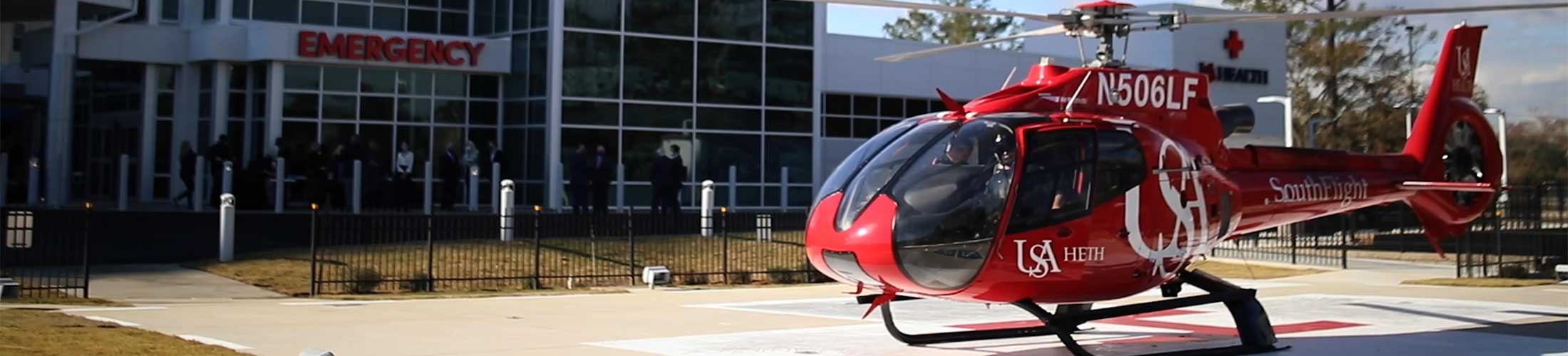
Welcome to the Dept. of Emergency Medical Services
The Department of EMS prepares students for careers in Emergency Medical Services.
To meet the expanding role of prehospital providers, the department offers three certificate
programs, EMT, AEMT and Paramedic, as well as a Minor in Emergency Medical Services,
a Bachelor of Science in Emergency Medical Services, and a Bachelor of Science in
Professional Health Sciences. The Department of EMS strives to prepare competent entry-level
Emergency Medical Technician-Paramedics in the cognitive (knowledge), psychomotor
(skills), and affective (behavior) learning domains, with or without exit points at
the Advanced EMT, and/or Emergency Medical Technician-Basic. Whether you are a student
enrolled at the University of South Alabama, someone who would like more information
about our certificate programs, our minor program or our bachelor’s degree programs,
thank you for visiting. We want you to receive the information that you are seeking.
However, if you have questions that remain unanswered, or would prefer to speak with
a faculty or staff member in person, please feel free to contact us by phone or email.
Programs
The Department of Emergency Medical Services offers the following programs.
The Department's EMT certificate program prepares students for careers in pre-hospital emergency medicine and enables graduates of the program to work as emergency medical technicians (EMT's) in a variety of settings, such as fire departments and public and private ambulance services. The program can be completed in one semester.
About EMS
Our Department is proud of its more than 50-year tradition of educating EMT’s, Advanced
EMT’s and Paramedics. Our students receive didactic, laboratory and clinical education
in every facet of emergency medical care and prehospital medicine. Areas covered in
in our education programs include, but are not limited to, Advanced Cardiac Life Support,
Pediatric Advanced Life Support, Prehospital Trauma Patient Management, Advanced Medical
Patient Management, and Advanced Airway Management. Advanced reasoning and critical
thinking is incorporated into every aspect of our educational programs.
Our Paramedic graduates are highly sought and actively recruited by employers because
they possess in-depth knowledge and fine-tuned clinical skills. Public and private
EMS providers and fire and rescue services from across the country often call to inquire
about our highly-skilled and multi-competent graduates.
Bachelor Degree graduates are well trained in Hospital and Emergency Management skills
and are routinely offered positions in Healthcare Management and Administration. Professional
Health Science students have two exciting tracks that they can choose from; Healthcare
Management and Informatics, which qualifies them to compete for opportunities at every
level within a hospital or medical office setting.
Our faculty members provide a wealth of knowledge and experience to help you achieve
your academic and career goals. They strive to provide a friendly, personal, and encouraging
atmosphere where you can learn how to care for patients in an emergency and out-of-hospital
setting.
Paramedic Certificate Program Accreditation
The University of South Alabama’s Emergency Medical Services Paramedic program is accredited by the Commission of Accreditation of Allied Health Education Programs (www.caahep.org) upon the recommendation of the Committee on Accreditation of Educational Programs for the Emergency Medical Services Professions (CoAEMSP).
Commission on Accreditation of Allied Health Education Programs
727-210-2350
www.caahep.org
To contact CoAEMSP:
214-703-8445
www.coaemsp.org
The Alabama Commission on Higher Education (ACHE) and the Alabama Department of Public Health Office of EMS have recognized and approved the University of South Alabama paramedic program. The Program is in good standing and in full compliance with all accreditation and authorizing agencies. The University of South Alabama is accredited by the Southern Association of Colleges and Schools Commission on Colleges (SACS COC).
The following chart reflects the Department of EMS Education’s three-year student success averages that were reported to our accrediting body, CoAEMSP.
Paramedic Certificate Program
Student Outcomes
| Year | National Registry Written Exam Success Average |
Program Retention |
Graduate Positive Placement |
|---|---|---|---|
| 2024 | 95.2% | 95.5% | 100% |
| 2023 | 100% | 58.8% | 100% |
| 2022 | 92.3% | 81.3% | 92.3% |
| 3 Year Average | 95.8% | 78.5% | 97.4% |
Alabama Licensure and National Certification
Successful completion of the Emergency Medical Technician (EMT), Advanced Emergency Medical Technician (AEMT), and Paramedic programs qualify graduates to take the following exams for Alabama licensure and National Certification:
- National Registry of Emergency medical Technicians (NREMT) EMT Cognitive Exam.
- NREMT Advanced EMT Cognitive Exam.
- NREMT Paramedic Cognitive Exam.
NC-SARA State Professional Licensure Disclosure
The Department of Education requires compliance with state regulations of any state in which the University of South Alabama provides distance education for students. To facilitate this compliance with state regulations, USA has joined the National Council for State Authorization Reciprocity Agreements (NC-SARA). NC-SARA allows USA to offer distance education in 49 states plus the District of Columbia, Puerto Rico, and the U.S. Virgin Islands (California is not a SARA state). The USA Department of Emergency Medical Services EMS certificate program meets all professional licensure or certification requirements in the 49 SARA states except for the state of New York.