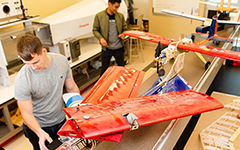

Click here for Larger image of Micro Fuel Cell


Faculty Member: Dr. Srinivas Palanki
Collaborator: Dr. John C. Telotte (Florida State University)

The Air Force has been conducting research to develop micro air vehicle (MAV) platforms but is limited by the restricted time of operation due to power constraints. Current battery technology is unable to provide necessary time of operation for some MAVs and for other military sensor and robotic platforms due to low energy density (gravimetric and volumetric) and tight weight and/or volume system requirements. This has resulted in a need for alternative power sources of higher energy density across all services that will outperform and outlast current batteries.

Fuel cells have been used successfully in the space program, starting from the Gemini missions. While the development of air vehicles that run directly on hydrogen is the true long-term goal, significant difficulties exist associated with storing hydrogen onboard. For this reason, we propose a design that involves a micro fuel processor that generates hydrogen in situ by using methanol and steam reformation. The figure below provides a schematic of this system.

This system consists of four parts: (1) an in situ hydrogen generation subsystem, (2) a power generation subsystem, (3) a thermal management system, and (4) a power management system. We have completed a requirements analysis, a concept design, and an analytical system solution for this system. The system can replace conventional battery powered MAVs, with the added benefit of longer range. The system is also capable of recharging or replenishing fuel.

The novelty of this research lies in the fact that the entire system was considered from a systems engineering viewpoint with realistic constraints. A virtual prototype of an integrated in situ hydrogen production and fuel cell system that is capable of operating a MAV was developed.

We showed that we could build a very compact (35 ml weighing just 54g) MFC “plant” with very high power density (2,507 W/l and 1,333 W/kg) capable of providing 9 – 14 VDC at up to 6A. The 1.14:1 molar water:methanol mix fuel has very high energy density (1,099 Wh/l and 1,220 Wh/kg) which is much higher than current battery technology. We are currently developing adaptive control algorithms for tracking desired power profiles in MAV applications.


© 2012 University of South Alabama Mobile, Alabama 36688-0002 (251) 460-6160
For questions or comments
Contact Us
Date last changed: December 16, 2008 8:54 AM
http://www.southalabama.edu/engineering/chemical/fuelcellcontrol.html
  text only