Meteorology
About Us Location Faculty Program Requirements Contact Us Links Home
Program Requirements
Course Descriptions

MET 140 - Intro to Meteorology
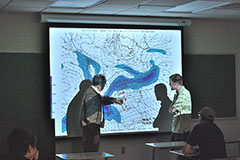
This course focuses on introducing the student to basic concepts involved in the analysis of weather phenomena on a global and local scale. Major topics include heat balance, atmospheric stability, precipitation processes, cyclonic activity, severe weather, weather analysis, and very basic weather forecasting techniques. Particular attention is devoted to the analysis of US Government weather charts and diagrams.

MET 341 - Climatology
Analysis of global climate as aggregate weather. Component elements, factors controlling distribution, resulting area patterns, and climatic classification are studied.

MET 342 - Severe Weather
A study of the causes, structure, and impact of tornadoes, hurricanes, thunderstorms and other severe weather systems.

MET 353 - General Meteorology
An overall view of the field of meteorology for science majors. The course uses a quantitative approach to study the composition of the atmosphere, atmospheric processes, global circulation, and storm development.

MET 354 - Dynamic Meteorology I
A quantitative study of solar and terrestrial radiation and the processes that result from the unequal heating of the earth’s surface and the atmosphere. A special emphasis is placed on adiabatic processes, thermodynamic diagrams, and atmospheric stability.

MET 355 - Dynamic Meteorology II
The circulation of the atmosphere and the structure of storms is quantitatively analyzed using equations of atmospheric flow. The jet stream, atmospheric waves, mid-latitude cyclones, and the concept of vorticity are given considerable attention.

MET 356 - Physical Meteorology
A detailed investigation of atmospheric aerosols, the disposition of radiant energy, the earth’s radiation budget, precipitation processes, atmospheric optics and electricity.

MET 357 - Meteorological Instrumentation
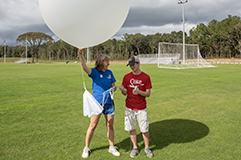
Design, calibration, use, and maintenance of existing and newly developed meteorological instruments and instrumentation systems as well as remote sensing applications.

MET 358 - Radar Meteorology
The course is designed to give the student a three-fold introduction to weather radar and its value in the workplace. Basic radar principles and assumptions applicable to all radars are presented: the Doppler function and limitations are covered in depth with final emphasis on properly utilizing weather radar in an operational setting.

MET 359 - Intro to TV Weather
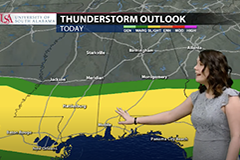
This course gives the students the basic skills necessary for broadcasting weather information on TV. This course will focus on the basic principles and techniques of effective TV weather broadcasting.

MET 420 - Computer Applications in Meteorology
Students will be introduced to computer applications that are commonly used in meteorology. Simple programming skills will be developed using FORTRAN, including UNIX, programming, and data visualization. In addition, students will gain experience with the GrADS meteorological graphics package and the MM5 numerical weather model.

MET 442 - Tropical Meteorology
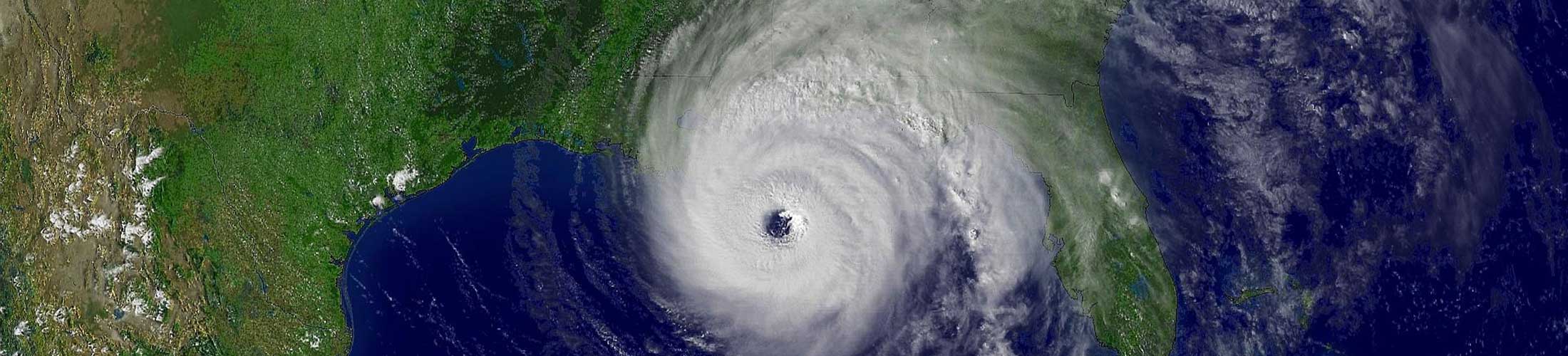
This course will focus on the structure and behavior of tropical cyclones. Students will be introduced to the physics and dynamics of tropical cyclones and the equations that describe them. In addition, students will be exposed to a research environment where they will utilize scientific journals and participate in a simulated scientific conference.

MET 454 - Synoptic Meteorology I
Principles of dynamic meteorology are applied to current surface and upper air analyses of frontal cyclones. An emphasis is placed on forecasting techniques, daily weather discussions, and computer model forecasts.

MET 455 - Synoptic Meteorology II
Through the use of surface and upper air analysis, satellite and radar imagery, and the principles of atmospheric dynamics, convective weather systems are studied and forecasted. Special attention will be placed on predicting and monitoring severe weather events, using computer model forecasts, and daily weather discussions.

MET 456 - Applied Climatology (W)
Training in the application of climatology to solve real world problems. In addition to an examination of present day climate patterns, their causes, and mechanisms, the course focuses on the El Nino, recent and past climates, the natural and human impact on the earth’s energy balance, Greenhouse warming and the chaos theory.

MET 490 - Special Topics
Meteorology topics not covered in current meteorology courses.

MET 492 - Seminar
Departmental seminar investigating a special field of meteorology.

MET 494 - Directed Studies
Independent research in field, laboratory, or library under the direction of a member of the meteorology faculty.

MET 496 - Internship in Meteorology
On-the-job learning through occupational or professional work with an approved firm or agency. Open only to meteorology majors.

MET 497 - Broadcast Practicum I
This course focuses on introducing the student to the ever evolving technology in broadcast meteorology. Emphasis is placed on the application of meteorological data through the use of professional television weather graphics systems in order to develop a "weather story." Particular attention is given to the use of chroma key mechanics/techniques for public viewing .

MET 498 - Broadcast Practicum II
This course focuses on communicating accurate forecasts and other important weather info to the public. Attention is given to fine-tuning the on-air weather presentation style, as well as developing a professional resume tape of weather shows in order to gain employment as a broadcast meteorologist. Special attention is given to severe weather cut-ins and accurately conveying severe weather threats to the public .

GEO 332 - Introduction to Remote Sensing
Introduction to the theory and use of remotely sensed data for analysis of earth surface phenomena.

GEO 461 - Computer Mapping and GIS Technology
Techniques for the preparation of Geoscience maps with the aid of desktop computer workstations with emphasis on GIS analysis.

GY 475 - Hydrology
Principles of sources, occurrences, and movement of ground-water. Surface and subsurface investigations of groundwater and elementary groundwater hydrology and chemistry.

CA 240 - Television Production I
Theory and practice of television production. Concentrates on exploring the uses of television in varied contexts, including corporate, community, and broadcasting applications.

CA 244 - Introduction to Radio Production
Introduction to the theory and techniques of radio production. Emphasis on the effective use of words, music, and sound. Students create and critique radio dramas, public affairs and documentary programming, commercials, promotional and public service announcements, and music programs.

CA 250 - Radio & Television Performance
Course focuses on the unique aspects of radio and television as communicating media. Different styles of delivery for various media projects will be studied-broadcast news, advertising, and entertainment. Course also focuses on restraints and requirements of the individual medium on the practice of broadcast delivery.

MGT 300 - Management Theory and Practice
Theories of organizational structures, practices, and behavior, and the effective leadership and management of organizations. Emphasis on leadership and developing patterns and strategies of organization management in a dynamic environment as affected by the interaction of material and human resources using the technique of applied social and management sciences.

MKT 320 - Principles of Marketing
Description and analysis of the institutions involved in the operations required to create and coordinate the kind, quality, and quantity of market transactions necessary to satisfy the need of households, industry, government and international customers. Topics include marketing planning, market segmentation, societal and ethical obligations, and strategies for products, pricing, promotion, and channel decisions.

MA 125 - Calculus I
Introduction to calculus with emphasis on presenting the key concepts graphically, numerically, and algebraically. Limit of a function; the derivatives of algebraic, trigonometric, exponential, and logarithmic functions; applications of the logarithmic functions; applications of the derivative to curve sketching; optimization problems including examples in the physical/natural sciences and economics; introduction of the definite integral; Fundamental Theorem of Integral Calculus.

MA 126 - Calculus II
A continuation of MA 125. Techniques of symbolic and numerical integration; applications of the definite integral to geometry, physics, economics, and probability; indeterminate forms; improper integrals; introduction to differential equations; sequences and series; Taylor polynomials and Taylor series. Vectors and geometry.

MA 227 - Calculus III
Vectors; functions of several variables; partial derivatives; local linearity; directional derivatives; the gradient; differential of a function; the chain rule; higher order partial derivatives; quadratic approximations; optimization of functions of several variables; multiple integrals and their applications; parametric curves and surfaces; vector fields; line and surface integrals; vector calculus.

MA 238 - Applied Differential Equations I
First order differential equations. Higher order linear differential equations. Systems of first order linear differential equations. Laplace Transforms. Methods for approximating solutions to first order differential equations. Applications.

ST 315 - Applied Probability and Statistics
Concepts of probability theory, discrete and continuous probability distributions including gamma, beta, exponential and Weibull, descriptive statistics, sampling, estimation, confidence intervals, testing of hypothesis, ANOVA and multiple comparisons, linear and multiple regression, correlation, nonparametric analysis, contingency table analysis, computer-assisted data analysis using appropriate statistical software.

PH 201 - Calculus-Based Physics I
First semester of a two-semester introductory course in calculus-based physics with laboratory. This course covers: one and two-dimensional motion, vectors. Newton’s laws of motion and their applications, work and energy, momentum and collisions, circular motion, rotational motion, properties of materials, simple harmonic motion, wave motion and topics in thermodynamics.

PH 202 - Calculus-Based Physics II
Second semester of a two-semester introductory course in calculus-based physics with laboratory. This course covers electrostatic fields and Gauss’ law, electric potential, electric circuits, magnetic fields, Ampere’s law. Faraday’s law, inductance, Maxwell’s equations, electromagnetic waves and optics.

CIS 227 - Numerical Computation I
Floating point numbers, representation, and errors; software tools for scientific computing; elementary problems in scientific computing.
    

About Us | Location | Faculty | Program Requirements | Contact Us | Links | Home


USA Logo University of South Alabama   -  Mobile, AL 36688-0002 / (251) 460-6101
For comments or questions about our Web site, please Contact Us
Last date changed: July 27, 2006 10:49 AM
URL: http://www.southalabama.edu/meteorology/courses.html