University of South Alabama
      Department of Pharmacology ---- Program in Molecular and Cellular Pharmacology


Name
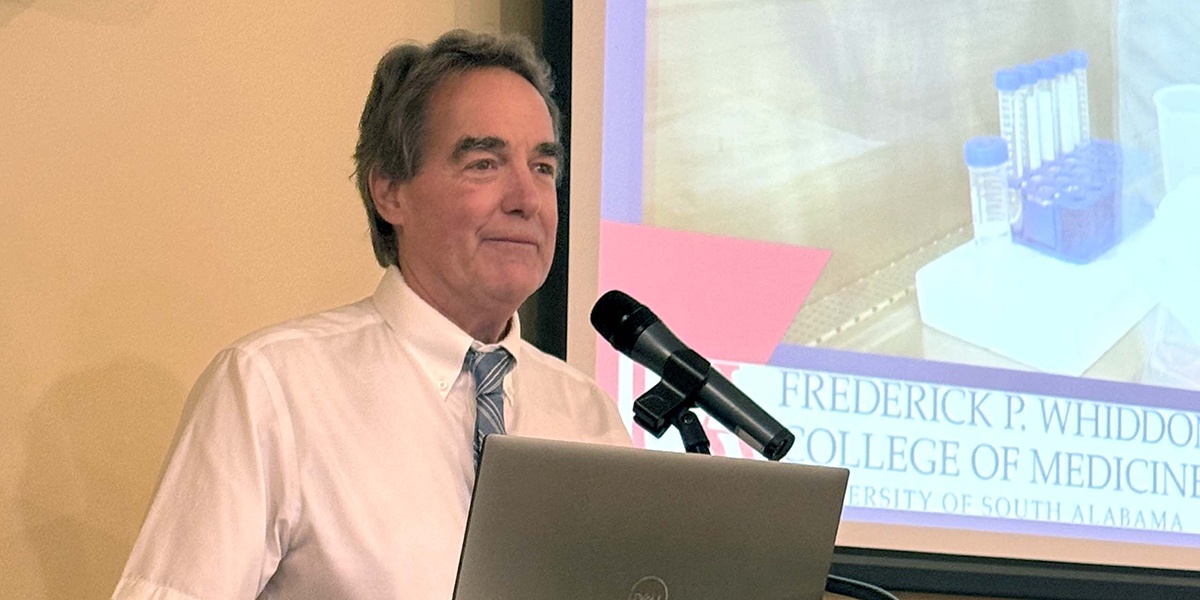
  Mark Gillespie, Ph.D.
Ph.D
  University of Kentucky
Post-doctoral
  University of Colorado
Current Position
  Professor and Chairman of Department of Pharmacology
Phone
  (251) 460-6497
E-mail
  mgillesp@jaguar1.usouthal.edu

   
Research Interests

Research in the Gillespie laboratory focuses on defining novel biological roles of oxidative injury or modification to the two cellular genomes, mitochondrial (mt) and nuclear DNA, in governing the life and death of lung cells.  One series of studies tests the idea that mtDNA functions as a “sentinel” molecule in which excessive damage caused by toxic oxygen radicals serves to activate cell death pathways.  In an extension of this idea, we also are exploring the prospect that mtDNA repair pathways could emerge as isolated targets for pharmacologic intervention in acute lung injury.  In contrast to oxidative damage to mtDNA, which occurs in the setting of toxicity, oxidants generated in the context of normal cell signaling do not alter mitochondrial DNA integrity, but surprisingly cause sequence-specific base modifications in nuclear genes.  Because these oxidative modifications are clustered in promoter regions of inducible genes, our second major project tests the idea that oxidative DNA modifications accompanying physiological signals modify the topography and protein binding of functionally important DNA sequences and thereby influence gene regulation. This general hypothesis is tested experimental systems ranging in complexity from cultured lung cells to human lung tissue specimens from patients with COPD, idiopathic pulmonary hypertension, and other pulmonary disorders. These studies are significant because they have identified a new level of oxidant regulation of cell function at the level of the genome, and perhaps more importantly, because they point to links between normal cell signaling and somatic mutation underlying both malignant and non-malignant lung diseases.
   
Representative publications:
  1. Grishko, V., M. Solomon, J.F. Breit, D.W. Killilea, S. P. LeDoux, G.L. Wilson, and  M.N. Gillespie.   Hypoxia promotes oxidative base modifications in the pulmonary artery endothelial cell VEGF gene.  FASEB J.  15: 1267-1269, 2001.
  2. Grishko V., M. Solomon, G.L. Wilson, S.P. LeDoux, and M.N. Gillespie. Oxygen radical-induced mitochondrial DNA damage and repair in pulmonary vascular endothelial cell phenotypes. Amer. J. Physiol:  Lung Cell Molec. Physiol. 280:  L1300-L1308, 2001.
  3. Dobson, A.W., V. Grishko, S.P. LeDoux, M.R. Kelley, G.L. Wilson, and M.N. Gillespie. Enhanced mitochondrial DNA repair capacity protects pulmonary artery endothelial cells from oxidant-mediated death.  Amer. J. Physiol:  Lung Cell Molec. Physiol. 283: L205-10, 2002.
  4. Grishko, V., V. Pastukh, V. Solodushko, M.N. Gillespie, J. Azuma, and S.S. Schaffer.  Apoptosis cascade initiated by angiotensin II in neonatal cardiomyocytes: role of DNA damage.   Amer. J. Physiol.  Heart Circ Physiol.  285:  H2364-H2372, 2003.
  5. Ziel, K.A., C.C. Campbell, G.L. Wilson, and M.N. Gillespie. Ref-1/Ape is critical for formation of the hypoxia-inducible transcriptional complex on the hypoxic response element of the rat pulmonary artery endothelial cell VEGF gene.  FASEB J. 18: 986-988, 2004
  6. Ruhko, M., O. Gorodyna, S.P. LeDoux, M. Alexeyev, A-B Al-Mehdi, and M.N. Gillespie. Mitochondrial DNA damage triggers mitochondrial dysfunction and apoptosis in lung endothelial cells.  Am. J. Physiol:  Lung Cell, Molec. Physiol.  288:  L530-535, 2005.
  7. Ziel, K.A, V. Grishko, J.F. Breit. C.C. Campbell, G.L. Wilson, and M.N. Gillespie. Oxidants in Signal Transduction: Impact on DNA Integrity and Gene Expression.  FASEB J. 19: 387-394, 2005.
  8. Gillespie, M.N and G.L. Wilson.  Bending and breaking the code:  dynamic changes in promoter integrity may underlie a new mechanism regulating gene expression. Am. J. Physiol:  Lung Cell, Molec. Physiol.,292: L1-L3, 2007.
  9. Stevens, T. and M.N. Gillespie.  The hyperproliferative endothelial cell phenotype in idiopathic pulmonary arterial hypertension. Am. J. Physiol:  Lung Cell, Molec. Physiol., 293:  L546-547, 2007.
  10. Pastukh, V., M. Ruchko, O. Gorodnya, G. L. Wilson, and M. N. Gillespie. Hypoxia causes sequence-specific oxidative base modifications in multiple hypoxia-inducible genes:  Implications for transcriptional regulation.  Free Rad. Biol. Med., 43: 1616-1620, 2007.
  11. Breit, J.F., W-J Dong, H.C. Cheung, K. Ault-Ziel, A-B Al-Mehdi, and M.N. Gillespie.  Nuclear protein-induced bending and flexing of the hypoxic response element of the rat VEGF promoter.  Faseb J. 22: 19-29, 2008.
  12. Ruchko, M., O. Gorodnya, V. Pastukh, N. Middleton, and B.M. Swiger, G.L. Wilson, and M. N. Gillespie.  Hypoxia-induced oxidative base modifications in the VEGF promoter are associated with transcriptionally-active nucleosomes. Free Rad. Biol. Med 46:  352-59, 2008.
 
University of South Alabama - Mobile, Alabama 36688-0002 (251) 460-6101
For questions or comments Contact Us
http://www.southalabama.edu/com/pharmacology
Copyright © 2009 University of South Alabama