

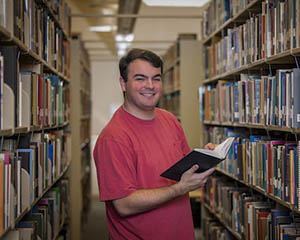
The Bachelor and Master of Arts in English degree programs at the University of South Alabama prepare students for jobs in professional settings including teaching, writing, and business areas. English majors and minors are taught by talented faculty and field experts in creative writing, literature, and professional writing in the College of Arts and Sciences. English undergraduate student Kelsi Fails describes her passion for writing poetry and studying literature at USA.
The English undergraduate program allows students to explore the study of literature and interpretation of novels, stories, poems and essays through critical approaches and writing, build the skills to craft meaningful creative work, and develop skills in professional writing and editing. The English master's program offers students in the creative writing and literature concentrations advanced study and preparation for careers in English as well as further graduate study. Through classes, as well as research opportunities and internships, students build skills in critical reading and writing, research, and instruction that support a range of career fields in business and education.
Upcoming Events
 Spring Series on Nature and Sustainability: David George Haskell - Thursday, April
9, 2026 - 4:00pm
Spring Series on Nature and Sustainability: David George Haskell - Thursday, April
9, 2026 - 4:00pm
David George Haskell is a British and American biologist and writer. He is a two-time Pulitzer Prize finalist in General Nonfiction. In addition to scientific papers, he has written essays, poems, op-ends, and the books The Forest Unseen (Viking Press, Penguin Random House, 2012), The Songs of Trees (Viking Press, Penguin Random House 2017), Thirteen Ways to Smell a Tree (Hachette 2021), and Sounds Wild and Broken (Viking Press, Penguin Random House 2022). In 2026, Viking Press will publish How Flowers Made our World. In 2025, he was appointed Adjunct Professor in the Department of Environmental Sciences at Emory University in Atlanta, Georgia. He was professor at The University of the South from 1995 to 2025, serving as Chair of Biology (2004-2009) and Director of Environmental Arts and Humanities (2024-2025), and was named William R. Kenan, Jr. Professor of Biology and Environmental Studies in 2021. In 2020-2021, he was Professor Adjunct in the Department of Ecology & Evolutionary Biology at The University of Colorado, Boulder.
Please note: this free event will be held in the Student Center Terrace Room.
 Oracle Launch Party - Friday, April 24, 2026 - 5:30pm
Oracle Fine Arts Review, the university’s student-run literary magazine, will be hosting a launch event for its 24th edition on April 24 from 5:30-7:00pm in the Student Center Terrace Room. The event will feature the free distribution of the new issue alongside readings from contributors. The current Editor in Chief, graduate student Hannah Rhodes, will also present the Rebecca Davis-Brown Award for Excellence in Poetry and announce the Editor in Chief for next year’s issue. Join us after the event for a reception with food and drink generously provided by the Stokes Center for Creative Writing.
Please note: this free event will be held in the Student Center Terrace Room.
 IMC Book Fair - Wednesday, August 26, 2026 - 9:00am to 4:00pm
Weather permitting, the Independent Music Collective (IMC) will be holding its first book fair of the semester in the Humanities Courtyard at USA from 9am to 4pm on Wednesday, August 26th. Come browse a wide selection of used books (on all topics), music in a variety of formats, and a bunch of random wall art. Donations support the IMC Concert Series!
Please note: weather permitting, this event will be held in the Humanities Courtyard.
Department of English, Instructor
The University of South Alabama's Department of English invites applications for a full-time (9-month) non-tenure-track instructor position, starting August 15, 2026. The successful applicant will teach primarily freshman composition courses (4/4 teaching load). Departmental, college, university, and/or community service also expected. We seek a candidate who will coordinate the Freshman Composition Program’s integration of Generative AI into the freshman composition courses.
Required: MA in English or related field with a minimum of 18 graduate hours in English and evidence of strong commitment to teaching college freshmen and sophomores. Candidates with research and teaching experience related to the development of programs and course materials that addresses the use of, and changing landscape with, Generative AI in the composition classroom are particularly encouraged to submit an application.
To apply, send by email the following: vita, cover letter, one-page teaching statement, and names of three references to Dr. Patrick Shaw, Search Committee Chair, c/o english@southalabama.edu.
Applicants invited for a campus interview will arrange to have official graduate and undergraduate transcripts sent directly by the Registrars of all colleges and universities from which a degree was received to the Search Committee Chair:
Official electronic transcripts may be emailed to Dr. Patrick Shaw (pjshaw@southalabama.edu).
Review of applications will begin May 11, 2026, and continue until the positions are filled.
The University of South Alabama is an Equal Opportunity employer and does not discriminate on the basis of race, color, national origin, sex (including pregnancy, sexual orientation, gender identity and gender expression), religion, age, genetic information, disability, or protected veteran status or any other applicable legally protected basis.
Part-Time Teaching
The English Department reviews applications on a continuing basis for part-time instructors, mainly to teach composition. Literature surveys and technical writing sections are available occasionally for those who are qualified in those areas.
Minimum Requirement: M.A. in English.
Please send your vita, cover letter, and contact information for three professional references and transcripts via email to Dr. Patrick Shaw.
The University of South Alabama is an Equal Opportunity Employer and does not discriminate on the basis of race, color, national origin, sex, pregnancy, sexual orientation, gender identity, gender expression), religion, age, genetic information, disability, protected veteran status or any other applicable legally protected basis.