


Doctor of Physical Therapy Program - DPT Program
The Department of Physical Therapy offers the Doctor of Physical Therapy program.
The PT dept. has provided quality physical therapy education for over 40 years with
continuous accreditation. A friendly faculty that is clinically and academically strong
teaches the curriculum leading to the Doctor of Physical Therapy DPT degree.
The exciting and challenging Doctor of Physical Therapy program is offered in an 8-semester
(32 continuous months) format, a new class entering each Fall semester. The DPT program
curriculum includes a variety of professional training/educational experiences to
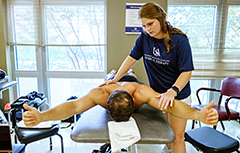
prepare students to enter PT practice. Students benefit from significant hands-on
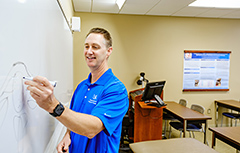
physical therapy clinical practical labs and formal lectures/discussions led by faculty
with experience in each clinical practice area, clinical problem solving activities,
clinical research plus 34 weeks of full-time clinical internship supervised by licensed
physical therapists. The clinical internships are available in over 200 affiliated
general hospitals, rehabilitation centers and various specialty practices representing
a wide variety of educational opportunities for the student. While clinical sites
are spread across the United States, the majority are within the Southeastern region.
The Doctor of Physical Therapy program at the University of South Alabama prepares
graduates for professional practice and is designed as an entry-level, first Physical
Therapy degree. Throughout the DPT program, students develop necessary communication
skills in addition to professional and manual skills and techniques. Strong emphasis
is placed on gaining clinical reasoning/problem solving skills and the ability to
practice as an independent primary care provider in any employment setting. Graduates
of the DPT program will also have the capability of assuming responsibilities in areas
of administration, consultation and research in physical therapy.
Mission Statement
The University of South Alabama Department of Physical Therapy develops compassionate physical therapists, who are movement specialists and primary care leaders in health and wellness, prepared to provide excellent evidence-based care and service while engaging in scientific inquiry to meet the healthcare needs of all communities.
What Is a Physical Therapist?
A Physical Therapist (PT) is a healthcare professional who provides direct patient care to persons who have disorders of movement, mechanical, physiological and developmental impairments and functional limitations, whether caused by injury or disease, to help them achieve maximum physical function and mobility. Physical Therapists have the necessary training to meet the total range of patient care responsibilities involved in preventing disabilities and promoting restoration of function to the physically impaired, including musculoskeletal, neuromuscular, cardiovascular/pulmonary and integumentary disorders that interfere with physical function.
Physical Therapists use their minds and hands to:
- Diagnose and manage movement dysfunction and enhance physical and functional abilities.
- Restore, maintain, and promote optimal physical function and optimal wellness and fitness and optimal quality of life as it relates to movement and health.
- Prevent the onset, symptoms, and progression of impairments, functional limitations, and disabilities that may result from diseases, disorders, or injuries.
Physical Therapists practice in hospitals and medical centers, rehabilitation centers,
private practice clinics, home health settings, sports medicine facilities, colleges,
universities and in various other settings. The broad options in Physical Therapy
allow PTs to develop and pursue a focus of care in any specific population from children
and athletes to senior citizens. Physical Therapists also work as educators, researchers,
consultants and administrators.
Physical Therapy is a sought-after career with virtually unlimited opportunities.
It is a profession that offers a lifetime of satisfaction while directly helping people
move more efficiently and function more effectively.
Accreditation and Licensure
General Disclosure
The Department of Physical Therapy at the University of South Alabama is accredited by the Commission on Accreditation in Physical Therapy Education (CAPTE), 3030 Potomac Ave., Suite 100, Alexandria, Virginia 22305-3085; telephone: 703-706-3245; email: accreditation@apta.org; website: https://www.capteonline.org. If needing to contact the program/institution directly, please call (251) 445-9330 or email ptdept@southalabama.edu.
NC-SARA State Professional Licensure Disclosure
The Department of Education requires compliance with state regulations of any state in which the University of South Alabama provides distance education for students. To facilitate this compliance with state regulations, USA has joined the National Council for State Authorization Reciprocity Agreements (NC-SARA). NC-SARA allows USA to offer distance education in 49 states plus the District of Columbia, Puerto Rico, and the U.S. Virgin Islands (California is not a SARA state). The USA Department of Physical Therapy Doctor of Physical Therapy program meets all professional licensure or certification requirements in the 49 SARA states plus the state of California. It does not meet the requirements in the United States territory, Puerto Rico.
Membership in APTA

The Department of Physical Therapy promotes membership in the APTA, and annually participates in the APTA's Reach100 Challenge, always with 100% faculty membership, and often achieving 100% membership among students.