
Mobile Entry
Posted on June 15, 2026 by Steve Millburg
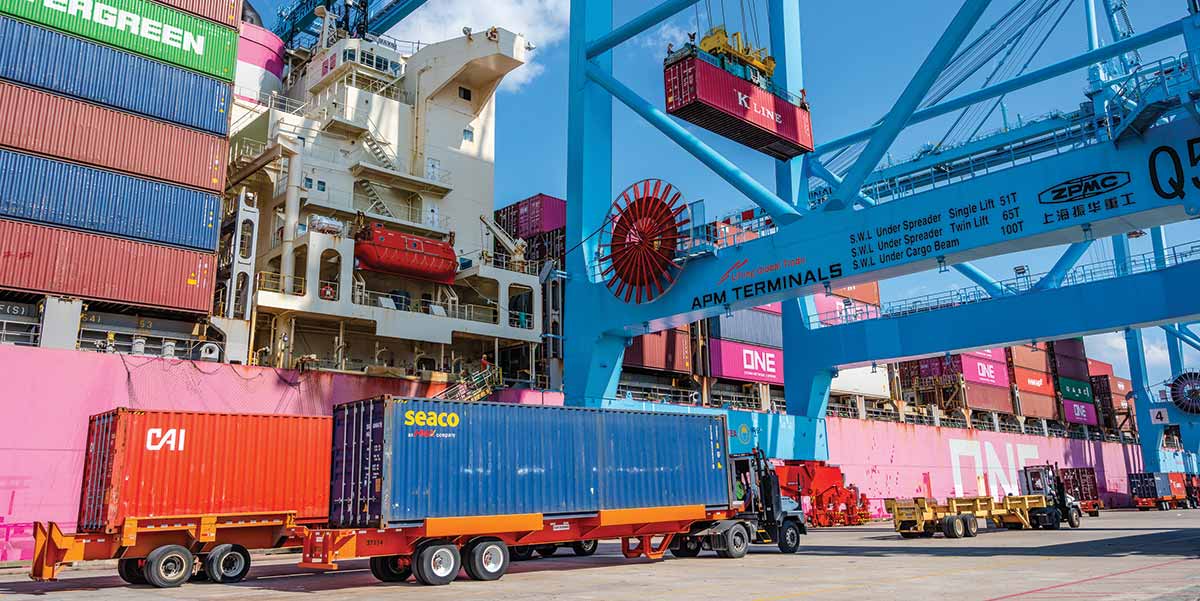
For Everything from dolls and action figures to giant-screen TVs and just about any other consumer goods you can think of, the fastest way from Asia to Chicago can run through Mobile. Specifically, through the Port of Mobile. It ranks 12th among U.S. ports in the amount of stuff that moves through it every year — more than 50 million tons’ worth.
Doug Otto, who became director and CEO of the Alabama Port Authority in November 2025, hopes to make it even busier by boosting Alabama businesses. The idea is to show retailers, wholesalers and manufacturers how the port’s efficient supply chain network could help them prosper. Otto also sees the port as a potential catalyst for growing the state’s industrial base. “If, for example, we can be a differentiator for persuading an automobile manufacturer to come to Alabama, then it helps Alabama, and it helps us.”
Everybody in Mobile knows about “the docks.” Residents have gotten accustomed to giant cranes on the skyline and massive cargo ships along the waterfront. Few realize the port’s true scope. It encompasses some 4,500 acres and dozens of docks, terminals, storage buildings, transfer facilities, and other structures and machines, mostly on both sides of the Mobile River just north and south of downtown Mobile.
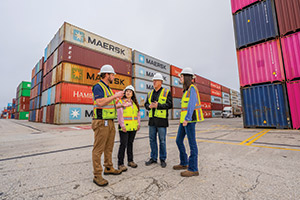 Dr. Peter Simonson, center, assistant professor in the Mitchell College of Business,
collaborates with leadership at the Alabama Port Authority and APM Terminals to make
sure coursework in supply chain logistics aligns with industry needs. He is here with
two APM employees, both USA alumni, and a South Student intern.
Dr. Peter Simonson, center, assistant professor in the Mitchell College of Business,
collaborates with leadership at the Alabama Port Authority and APM Terminals to make
sure coursework in supply chain logistics aligns with industry needs. He is here with
two APM employees, both USA alumni, and a South Student intern.
One terminal, owned by the port and operated by APM Terminals, handles container ships. The largest are built to take advantage of the widened Panama Canal. They are loaded with thousands of 20- or 40-foot-long steel boxes, stacked improbably high on their decks and filled with everything from auto and airplane parts to retail merchandise and fertilizer. USA’s Mitchell College of Business has built a strong relationship with APM Terminals that includes an internship program. Other terminals specialize in steel (the port authority says Mobile is the country’s second-largest steel port, handling $2 billion worth of steel coils in 2025), coal and roll-on/roll-off ships that carry motor vehicles.
The port also handles forest products ($1.7 billion worth in 2025) and “project cargo”: airplane fuselages headed for the Airbus plant, immense wind turbine blades, gigantic machines and structural pieces for new factories, and other supersized freight. As the port authority’s vision statement puts it, the port is remarkably “cargo-diverse.”
“Being so diverse has insulated us from market uncertainties,” says Otto. “We have so many different product lines, so many different terminals. We had a record-breaking year last year. And the year before was a record breaker. And the year before that.” To help him build out the infrastructure for growth, the new CEO recently brought on Jason Krick ’03 as the port’s chief engineering officer; Krick also sits on the Industrial Advisory Board for South’s College of Engineering.
The port owes much of its success to connections: two major interstate highways, five of the nation’s six largest (Class 1) railroads, two airports, and more than 15,000 miles of barge-navigable inland and intracoastal waterways. “A port is a much bigger system than just the waterfront,” says Dr. Peter Simonson, assistant professor of marketing, supply chain management and analytics at the Mitchell College of Business. “It’s the ships that come in. It’s the trucks that handle the material. It’s the rail that moves it out. It’s the highways that can support that transportation. It’s the distribution centers and warehouses. All of that is really part of the port ecosystem.”
The Port of Mobile forms the root of a vast supply network that spreads through the heart of America like a mighty, many-branched oak, reaching north to the Upper Midwest and into Canada. That’s why it can be faster to transport a container of sneakers from Asia to Chicago and other cities farther north via Mobile than through a West Coast port. A ship from China does take a week or two longer to reach Alabama (via the Panama Canal) than California. After that, the advantages shift to Mobile.
West Coast ports can get notoriously congested. Days can stretch into weeks as a ship waits to dock. After unloading, a container may sit a few more days in a warehouse until a railcar is available. On the long journey east, trains work their way through urban sprawl and summit the Rocky Mountains.
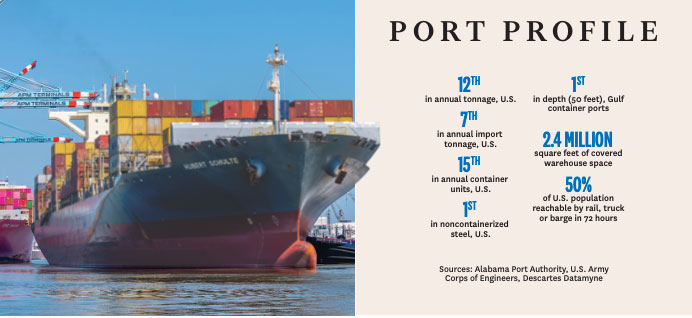
By contrast, the 130 or so large vessels that call at Mobile every month normally berth immediately with no waiting. Most container ships are unloaded, reloaded and sent back to sea within 24 hours. Crewmembers complain that the port’s efficiency gives them too little time ashore. And freight trains shooting north through the heartland face few natural or manmade impediments. “A container can move from off the ship to Chicago in three days coming from Mobile,” says Maggie Oliver, the port authority’s chief development officer. “It takes 10 to 15 days coming from the West Coast.” That container can travel to Toronto in another couple of days, and on to points north.
Dredging the ship channel to 50 feet, completed last fall, moved Mobile to the head of the line for ships coming through the Panama Canal. It gave Alabama’s port the deepest channel in the Gulf except for the 54-foot channel at Corpus Christi, Texas, where the port deals chiefly in petroleum and liquefied natural gas exports.
Heavily laden container ships can now unload first in Mobile so they ride high enough in the water for shallower ports. In addition to its Mobile base of operations, the port operates eight inland river ports, is building a $100 million train-to-truck container transfer facility in Montgomery (expected to open next year) and is contemplating a similar project in the fast-growing Huntsville area.
The Alabama Port Authority estimates that in 2024, the most recent year for which statistics are available, the Port of Mobile contributed $89.1 billion in economic value to Alabama and is directly or indirectly responsible for one in seven of the state’s jobs.
South graduates fill some of those jobs, and the relatively new Mitchell College supply chain and logistics major, launched in fall 2021, will add to those ranks. The program has grown quickly since its inception, and it has evolved — the University recently became the first in the country to offer a marine terminal operator certificate to undergraduate students through a collaboration with the International Association of Maritime and Port Executives.
Mitchell College students have transitioned seamlessly to APM Terminals internships because their coursework accurately reflects real life experience at the docks. South graduates also stay in the Mobile area for employment at higher rates than those of other universities, so the company benefits from its investment in their training. Consumer goods and jobs spread north across Alabama and beyond, thanks to the powerful economic engine that hums along the Mobile waterfront.
-
The Art of Medicine
Dr. Jeffery S. La Rochelle, the new dean of the Frederick P. Whiddon C...
June 17, 2026 -
Base Camp
South to scale up support with new military services home....
June 17, 2026 -
Flagship Futures
One of the newest scholarship programs at the University of South Alab...
June 17, 2026 -

Estuary of Innovation
The Frederick P. Whiddon College of Medicine building, opening in spri...
June 17, 2026