
The Wichita Blueprint: from Fairways to Flight Paths
Posted on June 15, 2026 by Teri Greene
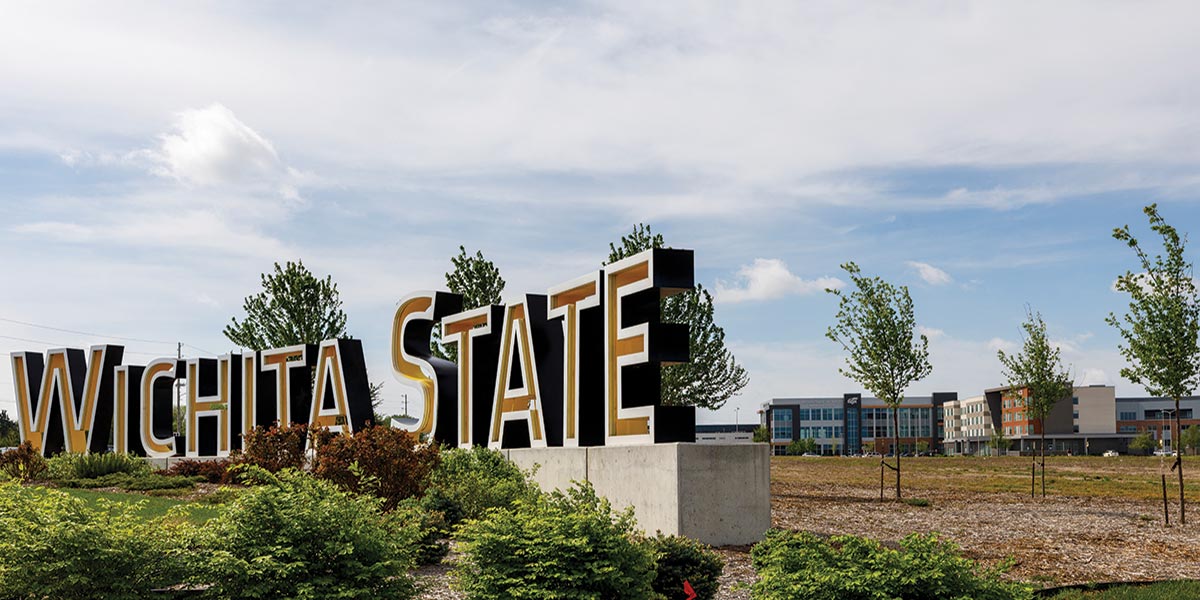
Wichita, Kansas — On a sunny, clear afternoon on Wichita State University’s Innovation Campus, locals trudge through a constant circular wind with the same nonchalance that Alabamians show in dealing with oppressive humidity.
In this wide-open landscape, there is little to buffer the breeze. That stately, settled vibe of a traditional university just isn’t here. But it doesn’t feel like the concrete canyons of a big city, either.
Instead, it’s a vast plain dotted with glassy horizontal monoliths bearing the names of multinational leaders in aerospace, defense and advanced intelligence — among them Airbus. This is a 120-acre industrial ecosystem of regional headquarters spaced out with room to breathe, connected by miles of wide, white sidewalks.
Starting in the 1920s, this property was a Wichita landmark: the picturesque, tree-lined Braeburn Golf Course. After Wichita State purchased the course in 1967, it became the home turf of Wichita State’s golf teams and a favorite recreational spot for alumni and staff. But by 2014, the greens were gone. Everyone knew what was coming; the change fulfilled a vision nearly 50 years in the planning.
The fairways of Braeburn made way for a prototype hub of academic and industrial growth built to move at the same speed as the companies it was designed to house.
The Wichita State story can serve as a road map for the University of South Alabama. As the global aerospace giant Airbus prepares to relocate its Mobile-based engineering team to South’s Technology and Research Park, the city and the University are facing their own seismic shifts in how higher education and heavy industry coexist.
The partnership’s announcement at the MacQueen Alumni Center in fall 2025 brought plenty of fanfare, but it also left a lingering question back home: How, exactly, does this work?
To find the answer, it helps to look 720 miles northwest to the “Air Capital of the World,” where a prototype for this connection has been running at full throttle for a decade.
The Start
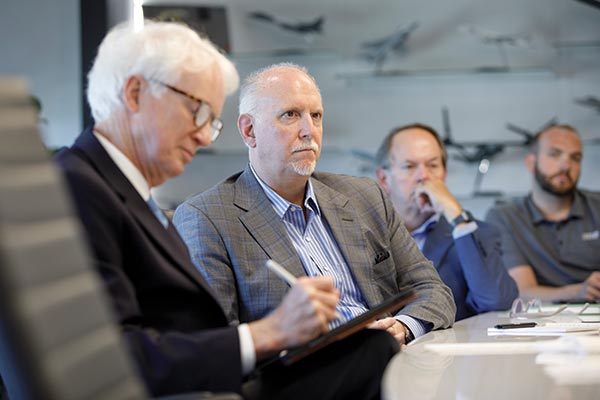 Dr. Michael Chambers (writing), chief economic development officer, and Dr. Michael
Capella (next to Chambers), dean of the Mitchell College of Business, visited Wichita
State University’s Innovation Campus in April.
Dr. Michael Chambers (writing), chief economic development officer, and Dr. Michael
Capella (next to Chambers), dean of the Mitchell College of Business, visited Wichita
State University’s Innovation Campus in April.
In Wichita, a year after the fairways closed, the Innovation Campus was announced, and work started. The progress between 2016 and 2020 alone was staggering.
A foundational partner was The National Institute for Aviation Research — here, they just call it NIAR — a nonprofit aerospace research and testing center established in 1985 to support the aviation industry.
Dr. John Tomblin, the executive director of NIAR and the architect of the Wichita State model alongside the late Wichita State President Dr. John Bardo, envisioned a place where boundaries were erased between school, work and life.
Pierre Harter, Wichita State’s associate vice president for research and industry engagement and a former student of Tomblin’s, represents the living history of that vision. After 20 years in the private sector, Harter returned to Wichita State and served on the Board of Trustees. His very first vote was for the official authorization to tear up the abandoned fairways to build this innovation hub.
“Most universities do basic or fundamental research — theoretical science that doesn’t necessarily solve a problem today,” Harter says. “The niche Wichita State found is applied research. We ask the companies, ‘What’s your problem?’ and then we figure out how to solve it right now.”
Airbus was the first company to relocate its engineering center to Wichita State, in 2016. In the early 2000s, Airbus was seeking a meaningful expansion, looking not only for another building but also for access to the crash test labs, wind tunnels and material research that NIAR possesses. Now, hundreds of its engineers and student employees work on the future of commercial flight.
Value Proposition
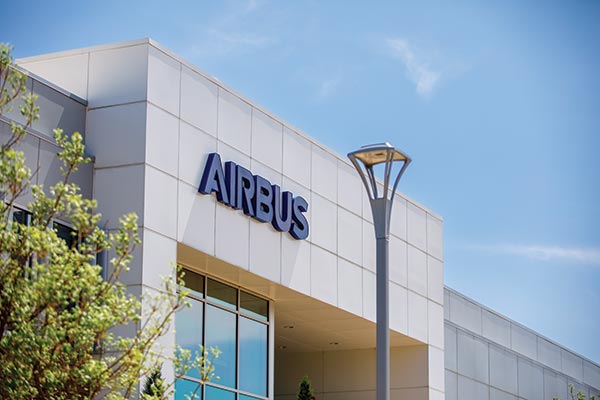 The Airbus Engineering Center in Mobile, AL designs the interior parts of the plane,
while engineers at the Wichita facility design the bones of the aircraft.
The Airbus Engineering Center in Mobile, AL designs the interior parts of the plane,
while engineers at the Wichita facility design the bones of the aircraft.
While engineers at the Wichita facility design and test the skeletons of aircraft, specializing in the heavy physics of stress, loads and structural integrity, the Airbus Engineering Center in Mobile designs the “living” parts of the plane. That includes cabin interiors, seating and electrical systems.
The center opened in 2007 following a commitment from the European aerospace company to expand its U.S. footprint. Less than a decade later, Airbus opened its first U.S. production site with construction of the A320 family final assembly line.
In April, a group of University of South Alabama administrators and deans visited Kansas to witness the Wichita blueprint in action, spending hours on-site and in strategic sessions with the Wichita State Innovation Campus leaders to study the operating system behind this success.
The value proposition for Mobile is measured in a single metric: time.
According to Harter, traditional straight-A students with no internship experience typically require two years of professional training before they’re fully productive at a company like Airbus. An internship may shrink that time to 18 months. But a student immersed in the applied learning model at Wichita State is ready to “take the training wheels off” in just three to six months.
“They get a meaningful resume with years of experience on it while they’re still in college,” Harter says. For Airbus and other companies on the campus, he says, this isn’t just a real estate deal. It’s a four-year working interview that creates a “sticky” workforce, with graduates who are already coded into the company culture before they ever receive a diploma.
Rapid Prototypes, Real-World Scale
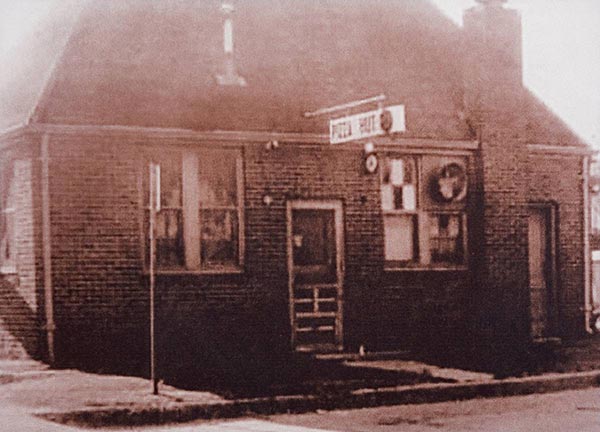 A small standout on the Innovation Campus is the original brick Pizza Hut restaurant,
relocated as a museum to represent entrepreneurial history at Wichita State. Two students
started the now-global company in 1958 from this building. The Innovation Campus also
offers working eateries and hangouts for students, engineers and other Wich-ita residents
to come together for fun and socialization.
A small standout on the Innovation Campus is the original brick Pizza Hut restaurant,
relocated as a museum to represent entrepreneurial history at Wichita State. Two students
started the now-global company in 1958 from this building. The Innovation Campus also
offers working eateries and hangouts for students, engineers and other Wich-ita residents
to come together for fun and socialization.
The heart of Wichita State’s applied research model is visible at NIAR’s Hub for Advanced Manufacturing and Research. The 170,000-square-foot facility is a research, development and training space powering innovation in emerging technology, advanced materials, digital twin modeling, advanced machining, additive manufacturing, automated fiber placement and factory automation. The atmosphere is one of clinical precision.
While it occupies the footprint of a hangar, the facility is a sophisticated hive of interlocking zones. One corner houses robotics, where autonomous arms pivot with to-the-millimeter precision and beyond-human speed. Another is a digital forge for additive manufacturing, where 3D printers hum as they “grow” complex aerospace prototype parts from high-strength polymers and continuous carbon fibers that, in their raw state, look like simple spools of twine.
But the true engine of the facility is upstairs in the engineering bays, where rows of students sit at monitors building the digital twins of the aircraft being modified nearby.
At one workstation, a student is working on a digital model using a 3D mouse, a specialized controller with a glowing blue ring that looks more like something from a flight deck than an office desk. By twisting the center knob, he “flies” through an aircraft’s internal skeleton, rotating a tiny component to see it from every angle. He’s created a digital twin of a metal part that will be printed on the floor and installed on a modification project by the end of the week.
“It’s about seeing the end result before you even start,” he says, gesturing to the component’s image on one of his monitors. No, this exercise won’t result in a grade, but it’s actual intellectual labor that he and his fellow employees know will result in actual aeronautical advancement.
The immersion is total. At another kind of campus, the students might be called interns. Here, they are professional associates earning $12 to $18 an hour while they learn. For many, the lines between class time and work time have vanished. They spend a massive portion of their week here, clocking in as employees before they ever graduate as engineers.
Innovation in the Air
In addition to NIAR, the campus is a sleek glass-and-steel directory of global supply chain leaders. There’s the 90,000-square-foot outpost of Airbus. Across the way are satellite labs for Textron Aviation, the parent company of the city’s heritage aircraft brands, Cessna and Beechcraft, and Spirit AeroSystems, recently acquired by Boeing, one of the world’s largest fuselage manufacturers.
Nearby is the NetApp building, which houses a global cloud data giant. Deloitte’s Smart Factory is a 60,000-square-foot laboratory where AI-driven robots manage production lines in real time and optimize supply chain management for global business.
This trail of industrial leaders attracts visitors year-round, and they can stay right on campus. Hyatt Place at Wichita State University opened in 2020. All these structures represent partnerships — they’re co-owned by the companies and the university.
At any given hour, a student might finish a calculus lecture and walk 200 yards to a paid shift with a global corporation, trading their backpack for a security badge.
The path from the engineering hub to the campus’s social center is marked by a curious outlier. Tucked among the industrial buildings is the original, humble brick Pizza Hut, relocated from across town and reopened as a museum in 2018. It shows that the Wichita spirit of student-led industry isn’t a recent invention; the global franchiser was founded in 1958 by two Wichita State students with a $600 loan. The name was chosen because the sign could accommodate only eight letters.
The Social Experiment
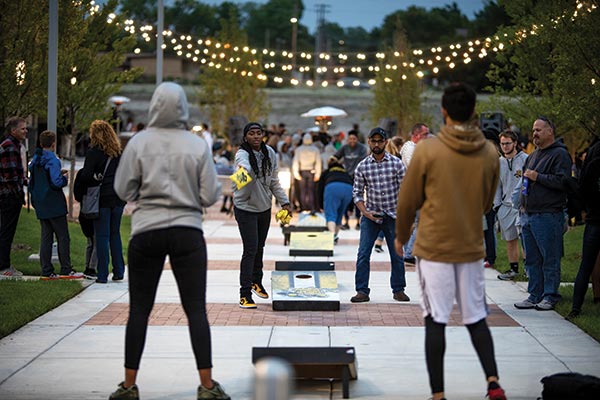 Wichita residents enjoy their evening at Social Tap, the centerpiece of Braeburn
Square at the Wichita State University campus.
Wichita residents enjoy their evening at Social Tap, the centerpiece of Braeburn
Square at the Wichita State University campus.
If the labs represent the brain of the Innovation Campus, Braeburn Square is intended to be its heart. Named for the golf course that once stood here, it’s an upscale, modern hangout with a Starbucks, pizzerias, sandwich shops, Indian fare, and corn dog and taco joints, considered as the campus living room.
On a Tuesday night, Social Tap, the centerpiece of the square, is buzzing. The bar/restaurant is a microcosm of the campus experience. Patrons order burgers and craft beers via QR codes. A patio extends out to one of the campus’s lakes, which are prime dog-walking sites.
The crowd is diverse: students with laptops open next to their meals, pairs of young engineers shooting the breeze over beers and older Wichita residents who’ve driven onto campus just because it’s a great place to spend an evening out. A server mentions that weeknights draw a steady crowd; sometimes, it’s packed.
The university installed firepits with the hope of creating a kind of neighborhood, serving both engineers and students after hours. The infrastructure is in place, but that social collision is still a work in progress.
Glow in the Glass
At night, the campus takes on a different character. Behind the low-emissivity windows, many of the lights glow for employees and students at the always-on aerospace engine — the ones who are still refining digital twins, monitoring 3D printers and solving the problems of a global industry.
This is the vision that USA leaders are bringing to Mobile: a talent pool of students fast-tracking their careers under the wing of industry experts. The infrastructure, South’s Technology and Research Park, is already in place on the north side of campus. The presence of Airbus could not only boost the park’s power as an advanced learning and engineering hub, but perhaps serve as a magnet to draw other national aerospace and tech companies to break ground here.
Twelve years ago, Wichita had a golf course. Today, it has a flight path. As South prepares to open its doors to Airbus, the lesson is clear: The future belongs to those ready to build it in real time.
-
The Art of Medicine
Dr. Jeffery S. La Rochelle, the new dean of the Frederick P. Whiddon C...
June 17, 2026 -
Base Camp
South to scale up support with new military services home....
June 17, 2026 -
Flagship Futures
One of the newest scholarship programs at the University of South Alab...
June 17, 2026 -
Estuary of Innovation
The Frederick P. Whiddon College of Medicine building, opening in spri...
June 17, 2026