Whiddon College of Medicine Announces 2026 Dean’s Predoctoral Fellowship Awardees
Posted on August 14, 2026
The University of South Alabama Frederick P. Whiddon College of Medicine has named three students in the Basic Medical Sciences Graduate Program as recipients of the 2026 Dean’s Predoctoral Fellowship Award, recognizing their academic achievement and promising biomedical research.
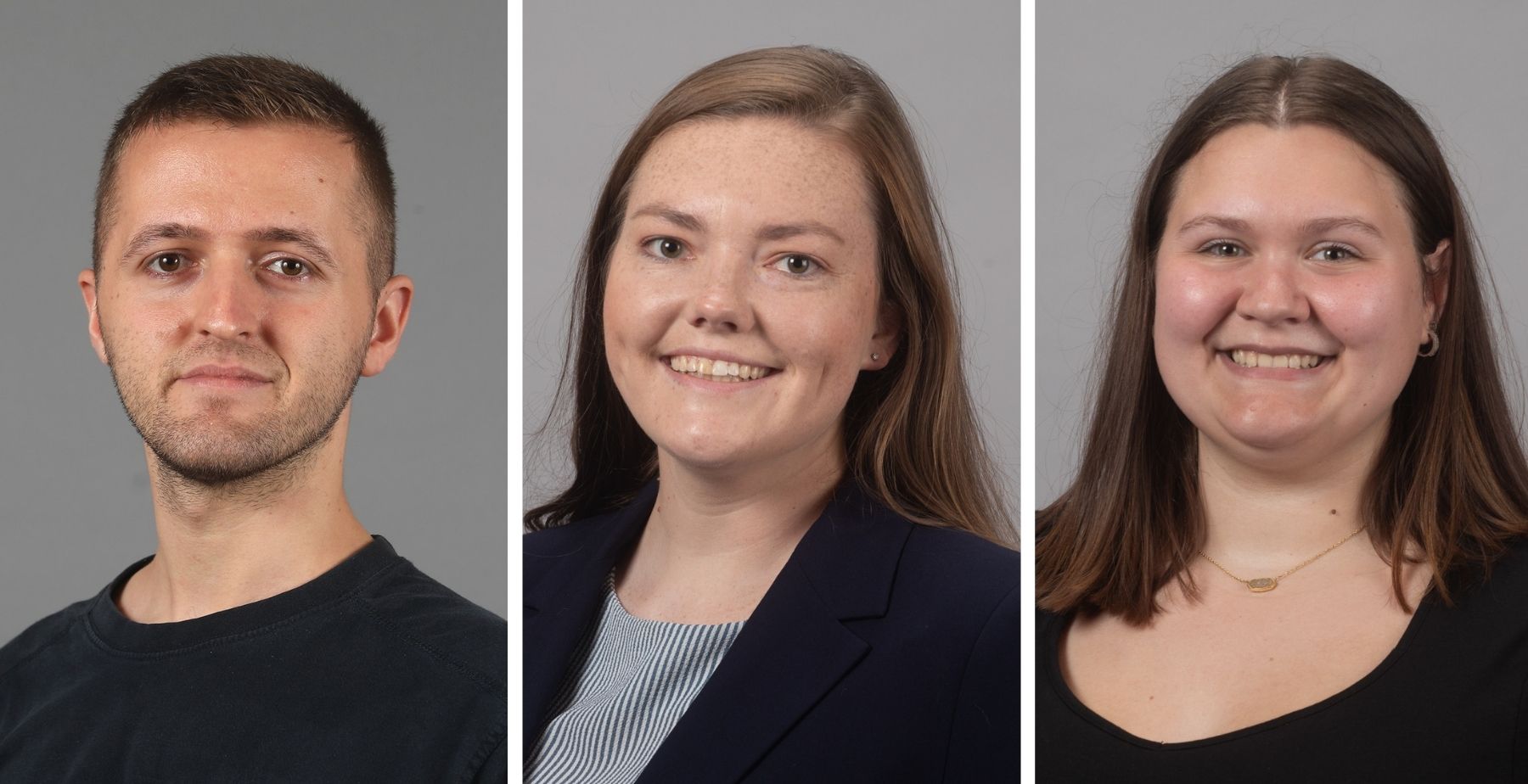
This year’s awardees are Brusi Kola, Sarah Macon-Foley and Brianna Mitchell. Through their research, the students are investigating how cells within the breast cancer environment may contribute to tumor spread, how tick-borne viruses are transmitted, and how cancer therapies trigger inflammation.
The competitive, one-year fellowship provides each recipient with a stipend, individual health insurance and $5,000 to support travel and related expenses for presenting research at national or international scientific conferences or attending extramural courses and workshops.
Brusi Kola
Kola, who is mentored by Chandrani Sarkar, Ph.D., and Debanjan Chakroborty, Ph.D., in the Department of Pathology, is studying how different types of cells communicate within the environment surrounding breast cancer tumors.
His project, “Dissecting adipocyte-lymphatic endothelial cell crosstalk in breast cancer metastasis via neurotensin signaling,” examines the role of neurotensin, a short peptide, in communication between fat cells and lymphatic endothelial cells. Kola is investigating whether this communication contributes to breast cancer progression and the spread of cancer through the lymphatic system.
Because breast cancer frequently spreads through the lymphatic system and metastasis accounts for the majority of breast cancer-related deaths, understanding these cellular interactions could provide insight into the mechanisms behind cancer spread and potentially identify new targets for treatment.
“I feel deeply honored to receive this award,” Kola said. “This recognition means a great deal to me because it not only acknowledges the importance of my research, but also encourages me to continue pursuing questions that could ultimately contribute to a better understanding of breast cancer metastasis.”
Kola said the fellowship will provide valuable support as he advances his research and continues to develop as a scientist.
Sarah Macon-Foley
Macon-Foley, who is mentored by Meghan Hermance, Ph.D., in the Department of Microbiology and Immunology, is investigating how tick-borne viruses spread between ticks feeding on the same animal host.
Her project, “Defining Cutaneous Immune Responses to Tick Co-feeding Transmission in the Context of Pre-existing Immunity,” examines a form of virus transmission that can occur when an infected and uninfected tick feed close together. In this process, the virus can pass from one tick to another without first entering the host’s bloodstream.
Macon-Foley is particularly interested in how a host’s immune response may affect this type of transmission and whether previous exposure to a virus changes the way transmission occurs. Her work could help researchers better understand how tick-borne viruses are maintained and spread among ticks and animal populations before they reach humans.
“As someone with a background in genetics who now studies microbiology and immunology, receiving this fellowship is an incredible honor,” Macon-Foley said. “I am very grateful for this opportunity and look forward to what is to come.”
Brianna Mitchell
Mitchell, who is mentored by Michael Elliott, Ph.D., in the Department of Microbiology and Immunology, is investigating why some patients experience a potentially serious inflammatory reaction when they first receive certain cancer treatments.
Her project, “Characterizing cellular drivers of cytokine release during initial anti-CD20 therapy,” focuses on a type of immune cell called a macrophage. Mitchell is studying whether these cells contribute to cytokine release syndrome, a rapid increase in inflammatory factors that can occur after the initial administration of monoclonal antibody therapies.
Understanding how macrophages contribute to this response could help researchers develop ways to make these cancer treatments safer while maintaining their effectiveness.
“Receiving the Dean’s Predoctoral Fellowship feels like a marker of how far this project, and I, have come since I started my Ph.D.,” Mitchell said. “It is rewarding to see something I have spent a lot of time working on have this kind of support.”
The Dean’s Predoctoral Fellowship Award is designed to support students as they advance their graduate research and prepare for careers in biomedical science. Eligible applicants must be in good academic standing and have completed the Basic Medical Sciences Graduate Program core curriculum. Current awardees may apply for a second year of funding, with preference typically given to students in the middle stages of their graduate training.