Medical students recognized for summer research
Posted on August 20, 2026
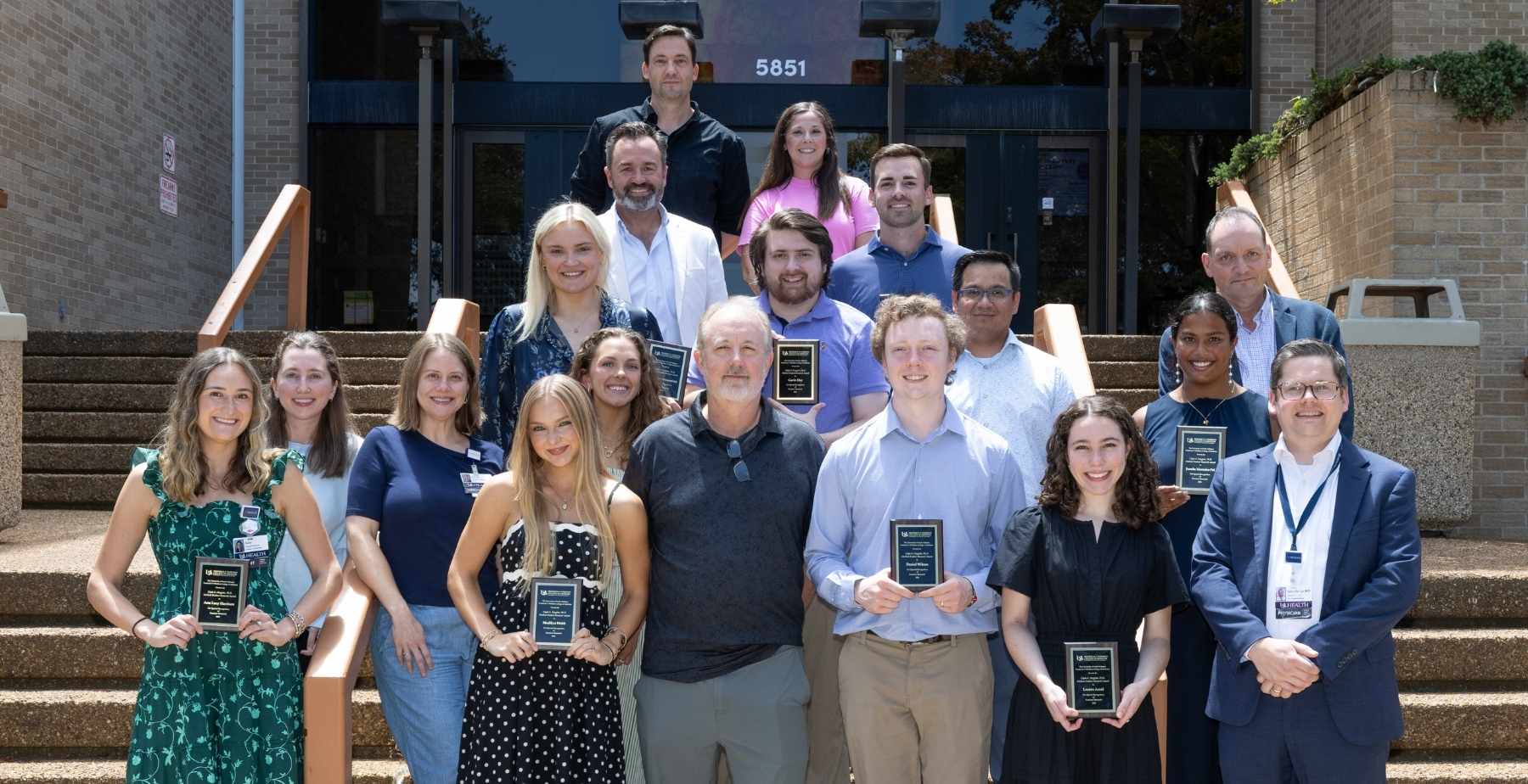
The Whiddon College of Medicine has announced the top oral and poster presentations from the 53rd Annual Medical Student Summer Research Day. These exceptional students have demonstrated outstanding dedication, creativity and excellence in the research projects they worked on as part of the Medical Student Summer Research Program.
Winners of the 2026 Clyde G. Huggins Award for Summer Research each received a plaque and a $100 prize. The award honors the memory of Clyde G. “Sid” Huggins, who served as the first dean of students at the Whiddon College of Medicine.
Oral Presentation Award
Juanita Monteiro-Pai
Mentor: Christopher Davies, Ph.D., Biochemistry and Molecular Biology
Monteiro-Pai investigated the importance of THR498 of PBP2 in Neisseria gonorrhoeae cephalosporin-resistant strain H041 using X-ray crystallography and biochemical techniques.
“The summer research program has allowed me to grow as a researcher and a presenter, and the support I have received from my mentor and the program has been amazing,” she said.
Poster Presentation Awards
Lauren Assaf
Mentor: John Soltys, M.D., Ph.D., Neurology
Assaf evaluated free software tools for quantifying MRI features in multiple sclerosis and examined how those features relate to clinical trajectory.
“Through the summer research program, I connected with a research mentor and identified a topic I hope to develop into a long-term project,” she said. “The experience also gave me a deeper appreciation for the role of the physician-scientist in translating research questions into meaningful improvements in patient care.”
Gavin Day
Mentor: Jose Sanchez, M.D., Neurology
Day analyzed prednisone use and associated side effects in patients with ocular and
generalized myasthenia gravis, a rare autoimmune disorder that causes weakness in
the voluntary muscles. He found that patients with the less severe ocular form were
taking similar amounts of steroids and experiencing similar side effects as patients
with the generalized form. He also categorized side effects, finding that one in four patients who took prednisone
experienced weight gain and 8% experienced anxiety.
“Despite all my past experience of research, I had not done research that I genuinely felt like it could impact someone's life in my lifetime,” he said. “I feel with this that if I keep pushing the project to the best of my ability, it will improve people's lives.”
Jayne Freeman
Mentor: Jennifer Young Pierce, M.D., Gynecologic Oncology
Freeman evaluated the impact of a culinary medicine program on the knowledge, attitides and biometric outcomes among cancer survivors and caregivers.
“This was one of my most rewarding experiences so far in medical school, to be able to work to answer our question while also seeing our participants benefit in real time from the course,” she said. “I am grateful for the relationships I made this summer with the participants as well as those on my team at Mitchell Cancer Institute.”
Lucy Harrison
Mentor: Wito Richter, Ph.D., Biochemistry and Molecular Biology
Harrison investigated whether targeting Type 4 cAMP-phosphodiesterase (PDE4) enzymes could offer a novel therapeutic approach for obesity and metabolic syndromes. Using models genetically deficient in individual PDE4 subtypes, the research team found that targeting PDE4D produced metabolic benefits, including reduced body weight and adiposity and improved glucose and lipid levels. Simultaneous deletion of PDE4B further enhanced these effects.
“Beyond my specific project, I learned how to critically evaluate research studies, gained experience with a variety of laboratory techniques, and strengthened my scientific presentation skills,” she said. “This experience expanded my perspective on research and gave me skills that I can carry forward in my future career.”
Matthew Streitman
Mentor: Ronald Brooks, M.D., Plastic and Reconstructive Surgery
Streitman evaluated postoperative outcomes in patients who underwent breast reduction surgery with and without drain placement.
“Through this project, I gained valuable experience in medical chart review, data collection and analysis, and interpreting clinical outcomes in the context of existing literature. More importantly, the findings from this study may help inform clinical decision-making regarding drain use across a variety of patient populations,” he said. “I look forward to continuing this project toward publication and am incredibly thankful for Dr. Brooks’ mentorship and the Whiddon College of Medicine for providing me with this incredible research opportunity.”
Madilyn Webb
Mentor: Robert Barrington, Ph.D., Microbiology and Immunology
Webb investigated whether FPRLx could help regulate the excessive neutrophil activity associated with autosomal dominant hyper-IgE syndrome, a rare immune disorder that causes recurrent infections.
"Working on this project over the summer was an incredibly rewarding experience,” she said. “I learned so many new skills and gained a much greater appreciation for the research process and the excitement that comes with asking questions and making new discoveries. I am extremely grateful for the opportunity, the mentorship I received, and everything I learned along the way. This experience has strengthened my interest in research, and I look forward to continuing this project and seeing where our future discoveries take us."
Caroline Weisenfeld
Mentor: Harrison Howard, M.D., Surgical Oncology
Weisenfeld evaluated patients with high-risk Stage IIB and IIC melanoma and explored the risks and benefits of adjuvant immunotherapy.
“Through hands-on experience in the OR, I was able to see the surgical management of the patient population I was studying and develop a deeper understanding of how clinical decision-making is shaped by both research and direct patient experience,” she said. “Along with building lasting relationships, I gained a greater appreciation for how clinical research can directly impact our local patient population and help physicians and patients have more informed, individualized conversations about treatment.”
Daniel Wilson
Mentor: Robert Barrington, Ph.D., Microbiology and Immunology
Wilson studied host responses in the cornea to different strains of Herpes Simplex Virus Type 1 that varied in their virulence.
“I appreciated the experience of translating curiosity into discovery as we explored multiple hypotheses in silico,” he said. “This summer's research experience provided me with a valuable perspective on how basic research facilitates a deeper understanding of the complexities in ocular pathology. It really helped shape how I'm considering my future career decisions.”