Borchert Lab gives high school students hands-on research experience
Posted on September 3, 2026
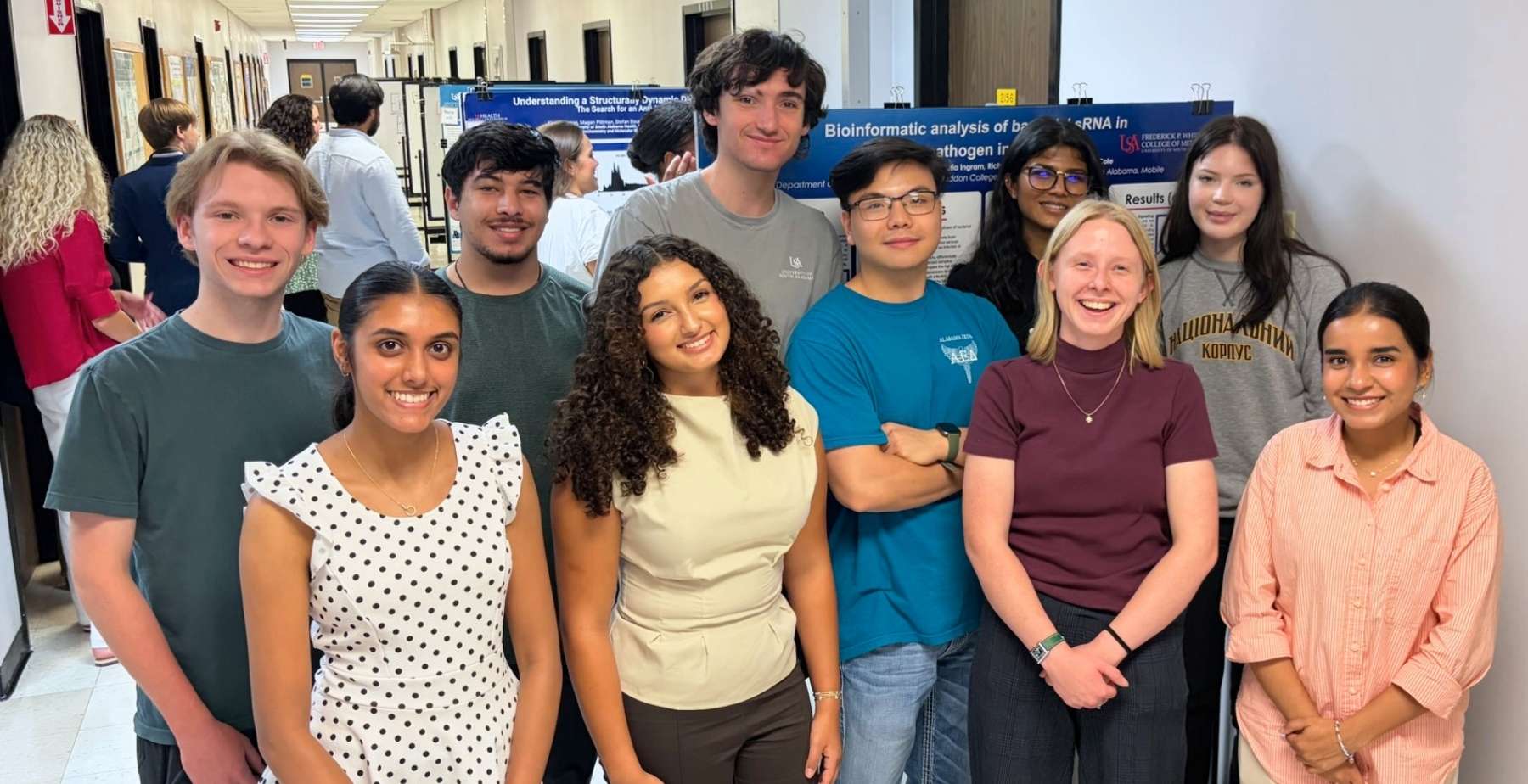
Six high school students spent part of their summer immersed in biomedical research at the University of South Alabama’s Whiddon College of Medicine, gaining firsthand experience in the laboratory and exploring what a career in science might look like.
The students, from the Alabama School of Mathematics and Science (ASMS), UMS-Wright Preparatory School and Davidson High School, participated in the Borchert Lab’s summer research program. Each student was paired with a graduate student mentor and worked on side projects throughout the summer, learning both wet-lab and computational research techniques.
The program is a collaborative summer internship initiative that gives advanced high school students the opportunity to participate in genomic and oncology research. Under the direction of Glen Borchert, Ph.D., a professor of pharmacology in the Whiddon College of Medicine and a professor of biology in University of South Alabama’s College of Arts and Sciences, students are exposed to research involving small RNA production and genetic regulation in colon cancer.
For Joshua Cole, a rising senior at UMS-Wright, the experience provided an opportunity to apply skills from the classroom to actual research questions.
Cole worked on bioinformatics projects examining small RNA upregulation in human samples. He learned to use the BLAST gene alignment tool, write Python code using Windows Subsystem for Linux and compare human AGO ChIP SRA data with bacterial small RNAs.
“Over the summer, I enjoyed learning about wet-lab and dry-lab techniques, including PCR, gel electrophoresis, flow cytometry, and bioinformatics,” Cole said. “These helped me apply classroom knowledge to real-world settings.”
The students' projects varied, allowing them to explore different areas of molecular biology and genetics.
Landon Miller, a rising junior at ASMS, investigated the relationship between LG4s and telomeres, giving him an opportunity to learn more about telomere biology and develop new laboratory skills.
“This summer, I gained hands-on experience in the Borchert Lab and learned a lot about the research process,” Miller said. “I gained new laboratory skills and a better understanding of how scientific research is conducted.”
Miller also said he enjoyed contributing to research and working alongside the members of the lab.
For Kayla Ho, a rising senior at ASMS who returned to the Borchert Lab for a second summer, the program provided an opportunity to build on skills she had developed previously.
“As my second year in the Borchert Lab, this has definitely been my favorite year so far,” Ho said. “I loved learning new wet lab techniques and working with bioinformatics. I can confidently say I am a pro at BLAST (Basic Local Alignment Search Tool, which is a computer algorithm and software program) now!”
Ho said the relationships she developed with the other students and researchers were another highlight of the summer.
“Everyone was amazing to work with this summer, and I will especially miss our after-lab meeting lunches with the high schoolers and undergrads,” she said. “Those were the best!”
Beyond learning individual laboratory techniques, the program gives students an opportunity to experience the collaborative nature of biomedical research. Working alongside graduate students and researchers, participants gain exposure to the process of developing questions, conducting experiments, analyzing data and communicating scientific findings.
The experience also introduces students to research that can have implications for understanding cancer and genetic regulation. Previous work involving students in the program has contributed to research examining the production and regulation of small RNAs, including tRNA, yRNA and rRNA fragments.
For the students who participated this summer, the experience offered an early look at the possibilities available in biomedical science while allowing them to contribute to ongoing research.