USA researchers take a collaborative approach to fighting sepsis
Posted on September 24, 2026
Sepsis can move quickly. What begins as the body’s attempt to fight an infection can escalate into a life-threatening response that damages vital organs, causes lasting health problems and, in severe cases, leads to death.
For researchers at the University of South Alabama’s Frederick P. Whiddon College of Medicine and clinicians at USA Health, understanding why that happens — and finding better ways to detect, treat and ultimately prevent its consequences — has been a longstanding collaborative effort.
September is Sepsis Awareness Month, bringing attention to a condition that remains one of the most serious challenges in critical care. Sepsis occurs when the body’s response to an infection becomes harmful, triggering widespread inflammation and other biological changes that can lead to organ dysfunction and, in its most severe form, septic shock.
“Sepsis remains a major clinical challenge causing high morbidity and mortality,” said Ji Young Lee, M.D., Ph.D., a pulmonary and critical care physician at USA Health and an associate professor of physiology and cell biology and internal medicine. “Despite more than three decades of intensive research, no specific drug has consistently improved survival, underscoring the need for new approaches to treat sepsis.”
At the Whiddon College of Medicine, those approaches span multiple areas of research, largely supported by funding from the National Institutes of Health. Faculty members are studying how sepsis affects the body, including damage to the lungs, blood vessels and mitochondria. They’re also exploring ways to identify patients at greatest risk and understand the long-term effects of the disease.
Together, the research represents a multifaceted effort to address a complex disease.
Understanding the damage
The USA Center for Lung Biology brings together more than 40 faculty members and 25 postdoctoral fellows, clinical fellows and graduate students from basic and clinical science departments, with a shared interest in lung biology. Directed by Troy Stevens, Ph.D., professor and chair of physiology and cell biology, the center has made significant contributions to understanding the mechanisms involved in sepsis and lung injury.
“Faculty, students and staff in the Center for Lung Biology have a longstanding interest in better understanding the molecular basis of sepsis, in an effort to develop novel medical therapies that may mitigate the debilitating consequences of this critical illness,” Stevens said.
One example of this work comes from collaboration among Ronald Balczon, Ph.D., professor and interim chair of biochemistry and molecular biology; Mike Lin, Ph.D., professor of physiology and cell biology; and Stevens, who have shown that infection leads to generation of cytotoxic variants of tau protein within the lung. Cytotoxic tau can be released from the lung and disseminate through the circulation to other organs, like the brain, and contribute to chronic, debilitating long-term effects.
“Work from our investigative team suggests that cytopathic tau represents a new tractable drug target in sepsis,” Stevens said.
Jonathon Audia, Ph.D., professor of microbiology and immunology, is investigating another part of the body's response to severe bacterial infection: how proteins involved in the immune response may contribute to inflammation and tissue injury.
The Audia laboratory found that amyloid-beta (Aβ), a protein best known for its association with Alzheimer’s disease, increases in the circulation of patients with sepsis, remains elevated during critical illness, and correlates with the severity of organ dysfunction. Their experimental studies suggest that Aβ and its precursor, amyloid precursor protein (APP), play a direct role in the body’s response to bacterial infection.
“We are now working to understand how APP processing and Aβ production influence antimicrobial defense, inflammation, and tissue injury during pneumonia and sepsis,” Audia said. “These studies may reveal new mechanisms that help explain why some patients recover from severe infection while others develop persistent organ dysfunction.”
Another long-running research program has focused on the role of mitochondria — the structures within cells responsible for producing energy — in the body's response to severe illness.
Beginning in the mid-1990s, Mark Gillespie, Ph.D., professor of pharmacology, and his laboratory demonstrated that oxidative damage to mitochondrial DNA does more than cause mutations. Damage to the mitochondrial genome can contribute to and worsen acute lung injury associated with sepsis. That insight led to patented therapies designed to repair mitochondrial DNA that are currently under development.
The Gillespie lab later found that small fragments of damaged mitochondrial DNA can accumulate in the bloodstream during sepsis and other inflammatory disorders. These fragments can serve as biomarkers of disease severity in patients, offering another potential avenue for understanding how severely a patient is affected.
Their most recent work revealed another piece of the puzzle: faulty mitochondrial DNA repair following inflammation can result in somatic mutations. The findings have implications for understanding longer-term complications following acute illness and injury, including sepsis, long COVID, and related syndromes.
“Collectively,” Gillespie said, “this work established the mitochondrial genome as an important and drug-targetable controller of both acute and post-acute inflammatory lung disease.”
Protecting the lungs
For Lee, a physician-scientist, and Jamie Meegan, Ph.D., assistant professor of physiology and cell biology, the focus is on the lungs and the cardiovascular and pulmonary consequences of sepsis.
Lee's laboratory is examining how the cells lining the tiny blood vessels in the lungs respond to sepsis. “My laboratory studies how pulmonary microvascular endothelial pH regulation, metabolism, and red blood cell-endothelium interactions regulate lung injury and repair during sepsis,” she said.
The pulmonary microvascular endothelium plays a critical role in maintaining the barrier between the bloodstream and surrounding tissues. When that barrier is disrupted during sepsis, fluid can leak into the lungs and contribute to impaired breathing and other complications.
Meegan's laboratory is investigating one mechanism that may contribute to that damage: the breakdown of red blood cells.
“My laboratory studies why the blood vessels in the lungs become damaged during sepsis,” Meegan said. “We are particularly interested in what happens when red blood cells break down and release hemoglobin and heme into the circulation.”
Hemoglobin and heme normally remain contained within red blood cells. When released into the circulation, however, they can damage the endothelial cells lining blood vessels. That damage can make the normally tight vascular barrier more permeable, contributing to lung injury.
Meegan’s research looks at the cellular mechanisms behind this process, including how endothelial cells handle iron. The ultimate goal, she said, is to identify new ways to protect the lungs and other organs during sepsis.
Identifying patients at greatest risk
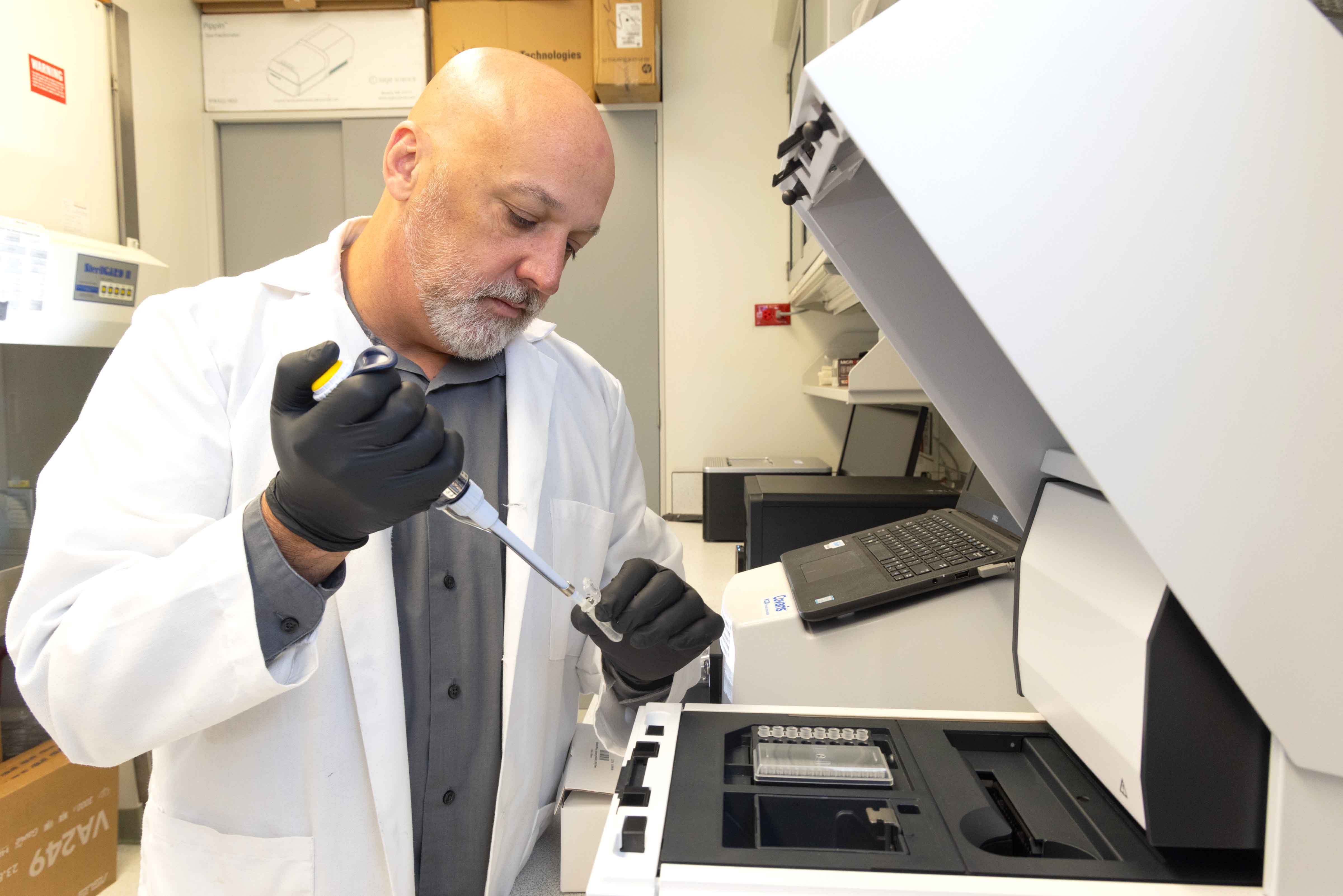 Raymond Langley, Ph.D., associate professor of pharmacology, is studying the biological
changes that accompany severe infection, with particular attention to metabolism and
mitochondrial function.
Raymond Langley, Ph.D., associate professor of pharmacology, is studying the biological
changes that accompany severe infection, with particular attention to metabolism and
mitochondrial function.
While some patients with sepsis recover, others deteriorate rapidly. One challenge for clinicians is determining early in a patient's illness who is most likely to experience severe complications.
That is the focus of research by Raymond Langley, Ph.D., associate professor of pharmacology, and graduate student Adeyeye Haastrup.
“Patients can arrive at the hospital with similar symptoms yet follow dramatically different clinical courses, making it difficult to identify early who is most likely to deteriorate,” Langley said.
Langley’s laboratory is studying the biological changes that accompany severe infection, with particular attention to metabolism and mitochondrial function. Working with Haastrup and clinical and scientific collaborators, the team has identified changes in circulating metabolites associated with poor outcomes in critically ill patients.
“We are now investigating whether these metabolic signatures can be translated into rapid diagnostic tools that could help clinicians recognize high-risk patients earlier, potentially before traditional clinical indicators reveal the severity of their illness,” Langley said.
Langley's research extends beyond the acute phase of sepsis. “As advances in critical care allow more patients to survive sepsis and other severe illnesses, it has become clear that survival does not always mean a return to normal,” he said.
Some survivors experience persistent weakness, fatigue, cognitive difficulties and reduced quality of life, symptoms associated with post-intensive care syndrome, or PICS. PICS is becoming an important clinical concern as a growing population of survivors continues to experience health problems months or even years after leaving the ICU.
Langley's team is beginning to investigate whether the same metabolic and bioenergetic disturbances that identify patients at risk during acute illness might also help explain or predict how they recover.
“The long-term goal is to move beyond simply surviving sepsis toward identifying patients who may need additional support to achieve a meaningful recovery,” he said.