Medical students present clinical research at state pediatrics meeting
Posted on October 14, 2026
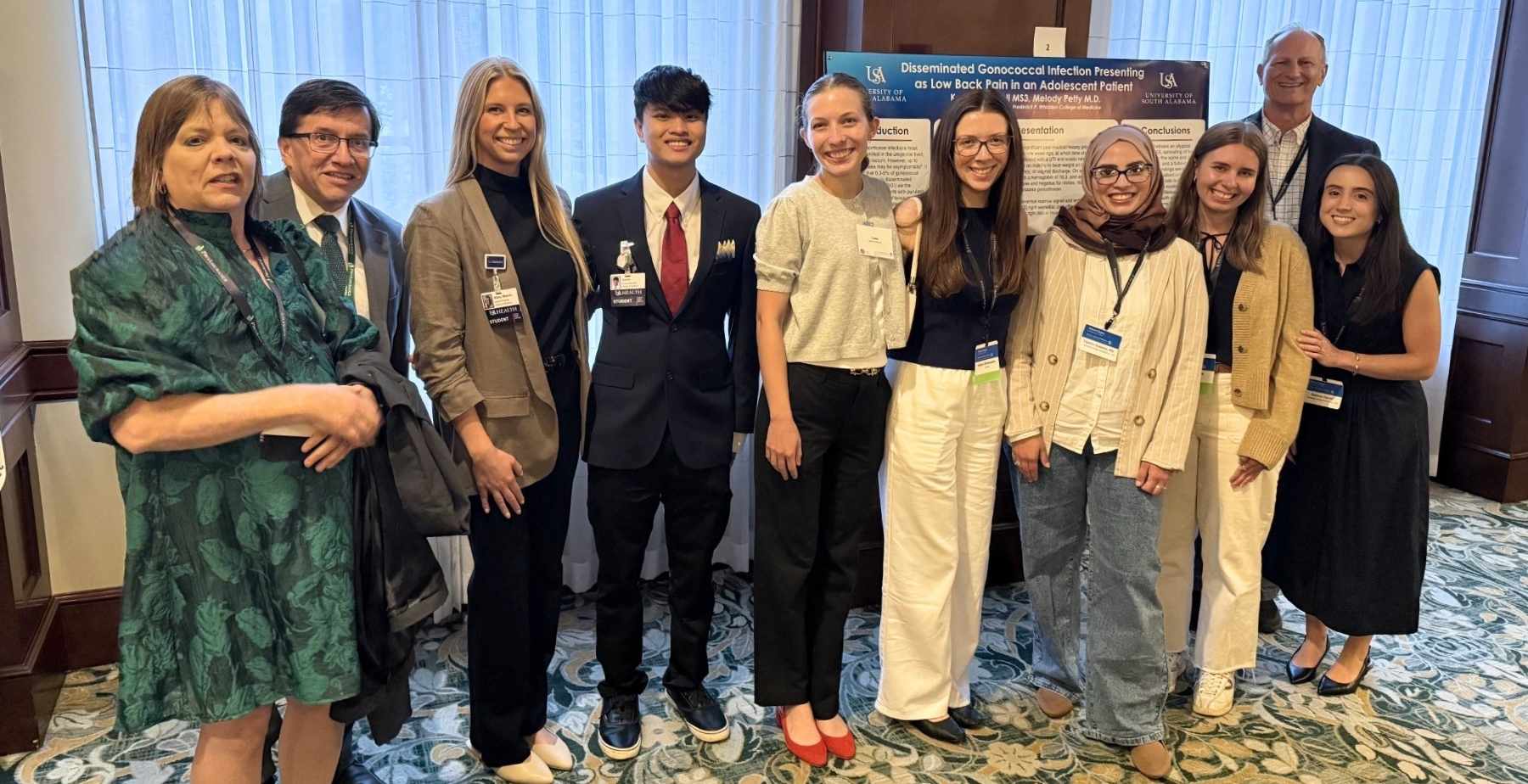
Medical students and pediatrics residents from the Frederick P. Whiddon College of Medicine were selected to present clinical case reports and research projects during the annual meeting of the Alabama Chapter of the American Academy of Pediatrics (AAP) held in Birmingham on Sept. 12.
The presentations highlighted the breadth of scholarly activity within the Department of Pediatrics and reflected the strong mentorship provided by pediatric faculty across multiple divisions and subspecialties, said Benjamin Estrada, M.D., professor and chair of pediatrics.
Representing the Whiddon College of Medicine were second- and fourth-year medical students, along with pediatrics residents with USA Health, who shared a diverse portfolio of educational case reports and clinical research projects addressing infectious diseases, neonatology, endocrinology, cardiology, and critical care.
Among the clinical case presentations was “Disseminated Gonococcal Infection Presenting as Low Back Pain in an Adolescent Patient,” presented by Kamryn Carroll, a fourth-year student under the mentorship of Melody Petty, M.D. The case emphasized an unusual manifestation of disseminated gonococcal infection and the importance of maintaining a broad differential diagnosis in adolescents presenting with musculoskeletal complaints.
Additional infectious disease case reports included “Reactive Infectious Mucocutaneous Eruption (RIME) Secondary to Parainfluenza Virus Type 2,” presented by Rachel Lusk, a fourth-year student whose mentors are Estrada and Maria Roca Garcia, M.D., and “Recurrent Group B Streptococcal Septic Shock in a Premature Infant,” presented by Katherine Sims, a fourth-year medical student, whose mentor is Linda Hasoneh, M.D. These posters highlighted rare pediatric infectious disease presentations and complex clinical management challenges.
Another unique case presentation was “Austrian Syndrome with Embolic Strokes in a Child with Trisomy 21 and COVID-19 Co-infection: A Case Report of an Exceptionally Rare Pediatric Presentation,” presented by Yasmin Sowwan, M.D., and Cristina Gavrilita, M.D. The report described an uncommon and severe complication involving invasive pneumococcal disease in a child with trisomy 21 and concurrent COVID-19 infection.
Neonatal medicine was strongly represented through several scholarly projects. Shristi Sharma, M.D., and colleagues presented “Hypocalcemic Seizures Secondary to Maternal Vitamin D Deficiency Mimicking Withdrawal in a Methadone Exposed Neonate: A Case Report,” describing an important diagnostic consideration in newborns presenting with seizure activity. In addition, Mary Martin Yance, a second-year medical student, along with Michael Zayek, M.D., and Gangajal Kasniya, M.D., presented “Timing of Continuous Glucagon Infusion and Central Line Utilization in Neonates ≥35 Weeks’ Gestation with Persistent Hypoglycemia,” examining treatment strategies and procedural considerations for infants with prolonged hypoglycemia.
Research in neonatal cardiovascular physiology was showcased by Kevin Nguyen, a second-year medical student. Additionally, physicians Juan C. Hernandez, M.D., Induja Gajendran, M.D., Diksha Shrestha, M.D., Kasniya, Fabien Eyal, M.D., and Saminathan Anbalagan, M.D., presented “Does Serum BNP Level Correlate with PDA Score in Extremely Preterm Neonates.” The project explored the relationship between biochemical markers and clinical assessment tools used in the management of patent ductus arteriosus in premature infants.
Beyond presenting their scholarly work, students and residents also took part in the conference’s educational sessions, gaining exposure to current pediatric topics and advances in child health. The meeting provided valuable opportunities to network with pediatricians, pediatric subspecialists, and trainees from across Alabama, fostering professional development and collaboration.
The strong showing by University of South Alabama trainees reflects the Department of Pediatrics’ commitment to scholarly activity, mentorship, and academic excellence. Through close collaboration with dedicated faculty mentors, these students and residents continue to contribute meaningful clinical observations and research that advance pediatric knowledge and improve the care of children throughout Alabama and the Gulf Coast region.