Undergraduate Researchers Present Findings at Annual Symposium
Posted on October 29, 2026
Three undergraduate researchers in the Whiddon College of Medicine’s Department of Pharmacology presented their work at the University of South Alabama’s 28th annual Undergraduate Research Symposium, held Oct. 22 in the Student Center Ballroom. Hosted by the Office of Undergraduate Research, the event celebrated the scholarly achievements of more than 90 undergraduate students.
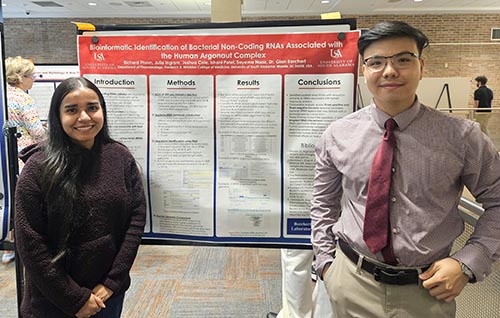 Sayema Naaz, Ph.D. candidate, and Richard Pham, undergraduate researcher
Richard Pham, Rhea Arya and Krista Pledger are members of the laboratory of Glen Borchert, Ph.D., where they investigate how small RNA molecules may influence interactions between bacteria and human cells and how these findings could inform new approaches to treating bacterial infections.
Pham, Borchert Lab manager, used bioinformatics to identify bacterial noncoding RNAs with sequence similarities to RNA molecules associated with human Argonaute proteins. These proteins play a key role in regulating gene expression. His analysis identified candidate bacterial RNAs for further study to determine whether they can interact with human cellular machinery.
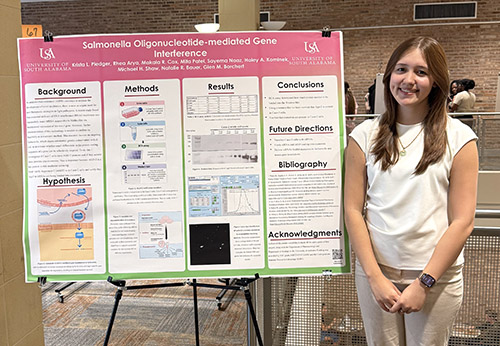 Krista Pledger, undergraduate researcher
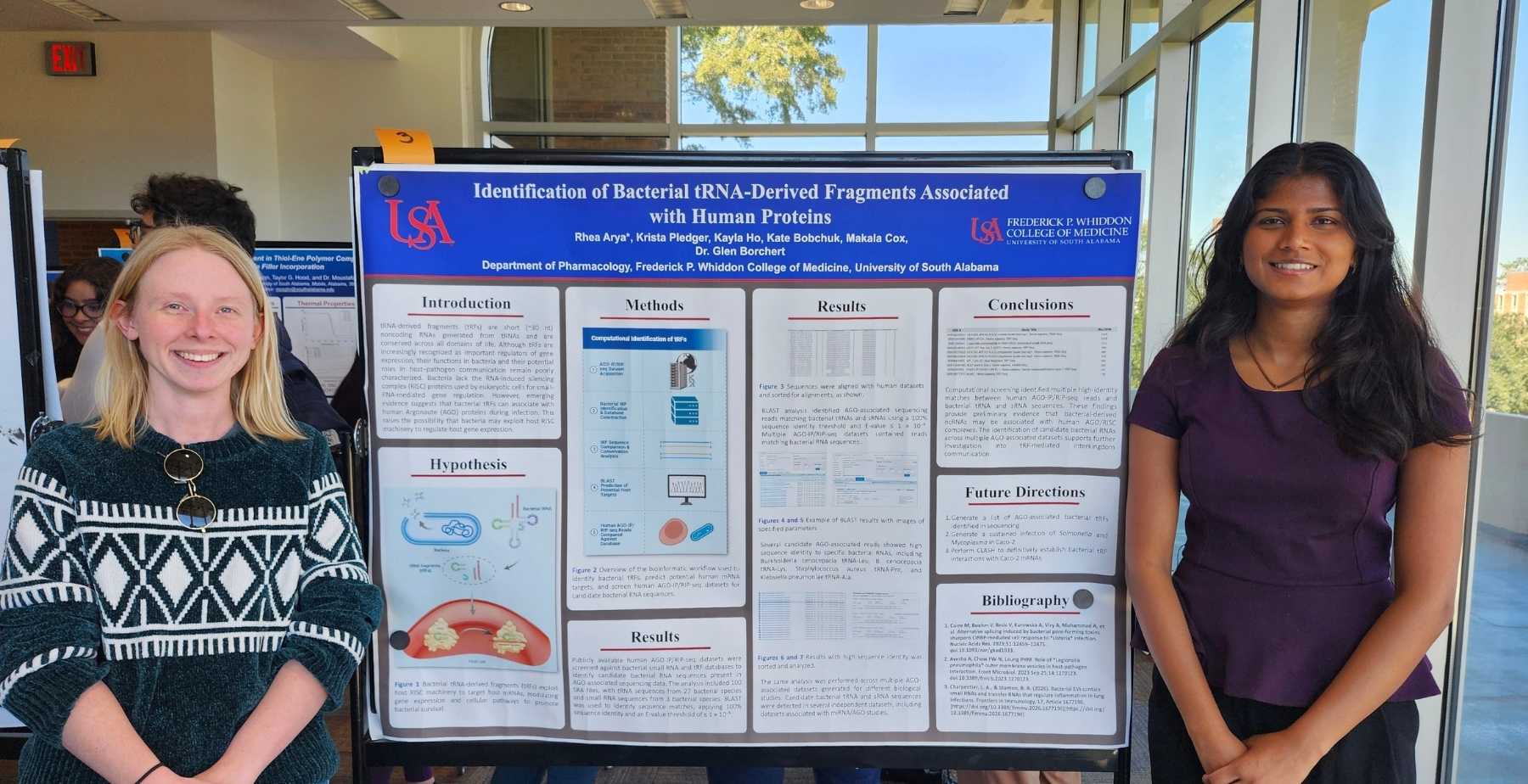
Arya investigated bacterial transfer RNA-derived fragments, or tRFs, and their potential association with human Argonaute proteins. By analyzing publicly available sequencing data, she identified bacterial RNA sequences with strong similarities to sequences found in human Argonaute-associated datasets. Her findings provide preliminary evidence for possible interactions between bacterial RNAs and human gene-regulation pathways.
Pledger’s research focuses on developing potential strategies to address antimicrobial resistance. Building on research exploring the use of RNA-based approaches to restore antibiotic susceptibility in resistant bacteria, she investigated whether human intestinal cells called Caco-2 cells contain Argonaute-2 (AGO-2) proteins and release them in extracellular vesicles known as exosomes. Understanding how these proteins are produced and transported could help inform future efforts to use RNA-based technologies to target bacterial genes.