Trainees Present Research at Regional Microbiology Meeting
Posted on November 4, 2026
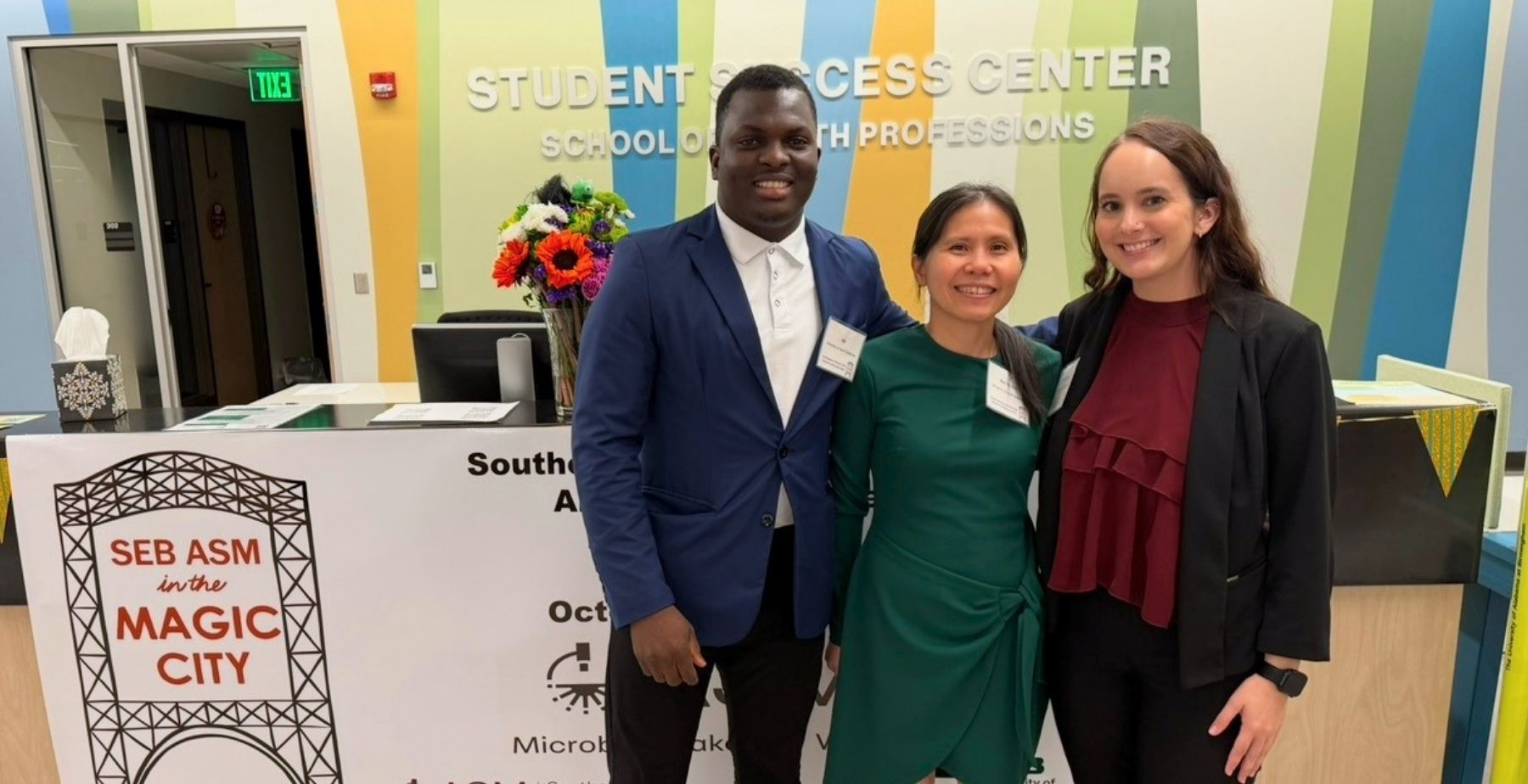
Faculty and graduate students from the Frederick P. Whiddon College of Medicine participated in the Southeastern Branch of the American Society for Microbiology annual meeting, held Oct. 23-25 at the University of Alabama at Birmingham.
Allyson Shea, Ph.D., assistant professor of microbiology and immunology, attended the meeting with three trainees, who presented research and connected with scientists from across the Southeast. The students received travel awards to attend the conference.
Oluwagbenro Adesunloro, a Ph.D. candidate in the Shea laboratory, delivered an oral presentation titled “Amyloid-β Beyond the Brain: Evidence for Local and Systemic Induction During Urinary Tract Infections.”
Adesunloro said the meeting provided an opportunity to reconnect with existing collaborators, establish new professional relationships and learn about research taking place at other institutions.
Sicily Hardy, also a member of the Shea laboratory, presented a poster titled “Urinary Pyridone Ribosides Impact UPEC Growth and Uroepithelial Metabolism.”
Hardy noted that exploring microbiology research across the region offered new ideas and potential applications for her own work.
Hoa Tran, a trainee in the laboratory of Jonathon Audia, Ph.D., delivered an oral presentation titled “Pseudomonas aeruginosa Effector Exoenzyme U Mediates Rapid Cell Death Through Caspase-1 and Lipid Peroxidation in Pulmonary Microvascular Endothelial Cells.”
Tran said the meeting provided valuable opportunities to exchange ideas with fellow researchers, expand her professional network and explore potential interdisciplinary collaborations.
Participation in regional and national scientific meetings allows students and trainees to share their findings, receive feedback from fellow researchers and build connections that can support their continued development as scientists.