Beyond the Curtain
Posted on November 11, 2026
The curtains open, the stage lights come on, and everyone is settled into their seats. To the audience, the production may look effortless, but behind the curtains is a creative team of students and faculty, working to bring the production to life.
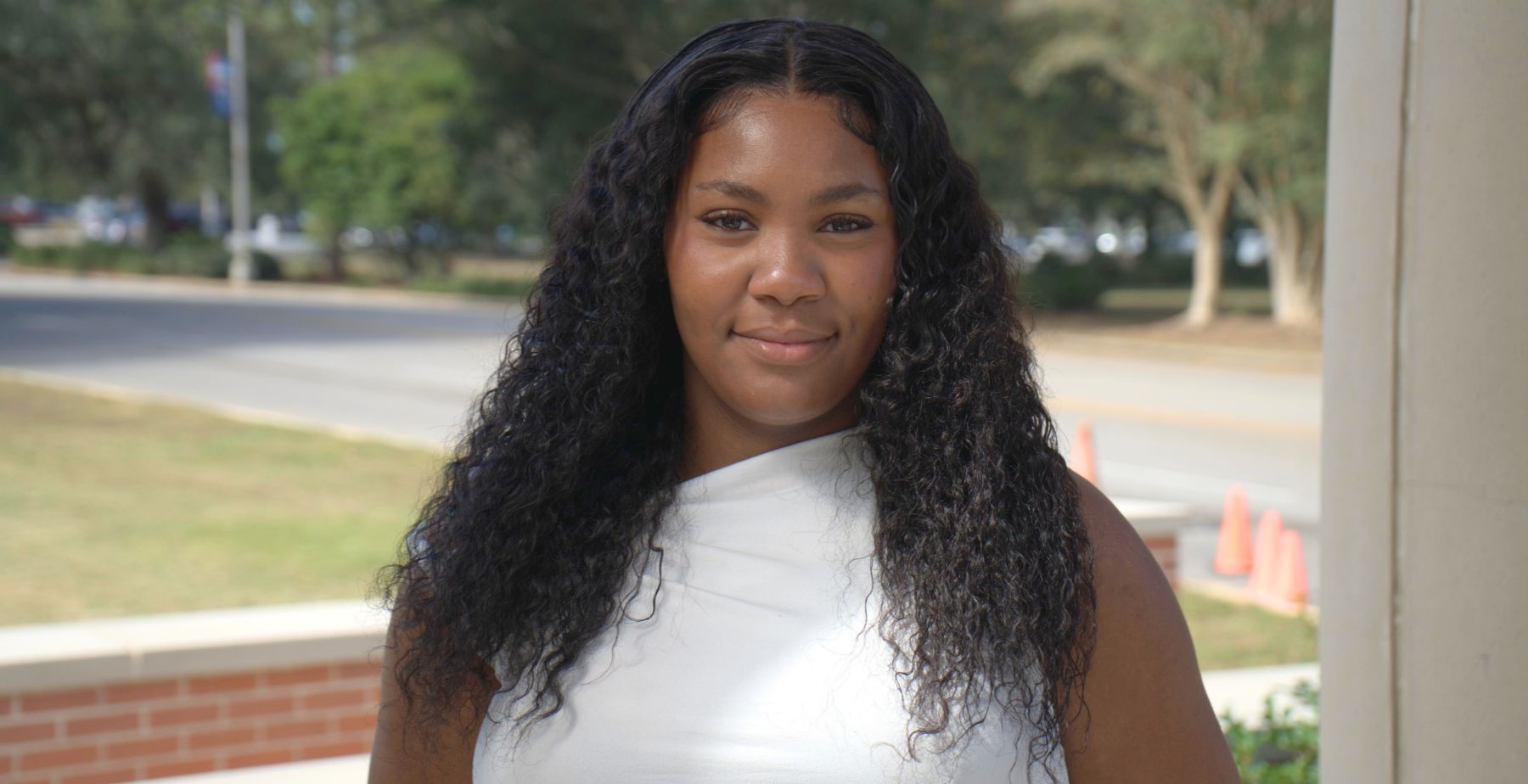
Mobile native Rae Phillips, a senior in the University of South Alabama's Department of Drama and Theatre Arts, minoring in psychology, has been passionate about performing since she was very young. Phillips grew up participating in church productions and began singing at age two. Performing wasn't just a hobby for Phillips, but a way to express herself creatively.
“I got into it really heavily in middle school, and I realized that was one of the many ways I could express myself,” Phillips said. “I love performing for people.”
Phillips came to South as a transfer student. She was originally a psychology major, but she felt like something was missing – and that something was performing. Since switching her major, Phillips has participated in six campus productions with Theatre USA, and is working on her seventh.
Where the audience sees a finished production, they likely have little knowledge about what goes on behind the scenes long before opening night. Academic theatre programs have tighter schedules, while professional theatres have months or years of preparation. “Since we are an educational and academic program, the [production] time we have in a semester is usually, maybe at max, five weeks,” Phillips explains.
Within this time frame, students and faculty work together to complete set design, lighting, props, costumes, makeup and rehearsal.
“We're here, like, twenty-four/seven. Putting on all of these things, which is fine because we all love it, and we all have a passion for it,” Phillips shares. “It's just like hanging out with your friends for an extended amount of time.”
Despite the hard work, Phillips describes the backstage atmosphere as something special.
“It is so unique, I feel, because there is much happening all at once, but at the same time everyone is always on one accord with what needs to be done,” she explains. “It can be chaotic at times, but you know that everyone's working towards the same goal. It's really cool.”
The teamwork carries into rehearsal, which typically starts at 6:30 p.m., when a student leads the cast with vocal warm-ups and stretches. Before the director arrives, the cast members review their blocking, run through dialogue and practice their scenes together.
Rehearsals start to look different as opening night approaches, involving run-throughs without scripts, followed by notes from the director and more practice runs.
Balancing rehearsals with classes and other responsibilities can feel challenging, but, for Phillips, the key is repetition. She keeps her script with her and reviews her lines throughout the day, whenever she has a spare few minutes.
“People ask me all the time, 'How do you remember all of that stuff?’ and I say, ‘I don't know; it's just in my head.’ It also comes naturally because, here, we're taught to be in character all the time. When you make a mistake onstage, you make that mistake while in character, and so you're not just freaking out on stage thinking, 'Oh, what do I do?’ You fix it in a way that the audience will never know because you're so deep into your character.”
Her preparation also helps with performance nerves.
“For me, I'm a perfectionist, and we've rehearsed like 200 times, so by the time show day comes, I'm so comfortable,” Phillips said. “I don't get that nervousness anymore. I tell myself, just go up there and do what you've been doing this entire time, and give 110 percent.”
Phillips is always challenged as an actress by the roles she’s taken. Her first production at South was The Giver, and although she was nervous and didn't know anyone in the department, being cast in the production helped her develop lasting friendships and find her place. Phillips has also appeared in A Comedy of Errors as Adriana, The Importance of Being Ernest as Gwendolen Fairfax and Skeleton Crew as Shanita.
Phillips said that Skeleton Crew, which featured an all-Black cast, was well received. She shared how meaningful the production was because it allowed Black students like herself to see themselves and their stories represented on stage.
In the current production of The Government Inspector, Phillips is playing Anna, stepping out of her comfort zone and the age range of her previous characters. Phillips describes the character as “an older woman who still sees herself as young and beautiful and wants the attention of every man she encounters.” “It’s really funny,” she explains, revealing she drew inspiration from her own mother to help develop the character.
Phillips credits the department’s faculty, John Nara and Interim Chair Christina Johnson, for playing significant roles in her growth as a performer. Because the program is small, students benefit from a more personal learning experience. They also build meaningful relationships with their instructors, which offers a well-rounded experience for their professional future.
“With Christina, we get the backstage tech side, the costumes, the hair and makeup, the lighting design, and from John [the director] we get the acting, and learning how to move in a scene – and learning even how to direct,” Phillips said. “As program graduates, we have more to offer than just tech or just acting. We can be placed in any role and know what to do.”
Unlike other courses, students in the drama and theatre arts department experience hands-on learning through a group setting instead of through lectures in a classroom. Students actively work in theatre, learning from one another. Phillips describes the learning experience as a “chain of knowledge” where students learn from those with more experience and then pass along that knowledge to others.
After graduation, Phillips hopes to pursue an opportunity with the SouthEast Alabama Community Theatre. She’s also a certified daycare teacher, which would allow her to easily attend auditions while taking acting classes. Her long-term goal is to move to New York City within the next five years.
When asked what the best piece of advice received from faculty, Phillips shared an important lesson of not allowing rejection to determine your future.
“Don’t let your no’s affect your yeses,” says Phillips. She explained that rejection is normal in the performing arts industry. Not getting a role doesn’t mean you’re going unnoticed or that you lack talent, and you shouldn't take everything personally because it is not personal. Instead, Phillips encourages students to ask questions, seek feedback and continue auditioning. “Your rejection doesn't mean that you're always going to be a no,” said Phillips.