
The Detective Work of Writing
Posted on January 8, 2026 by Teri Greene
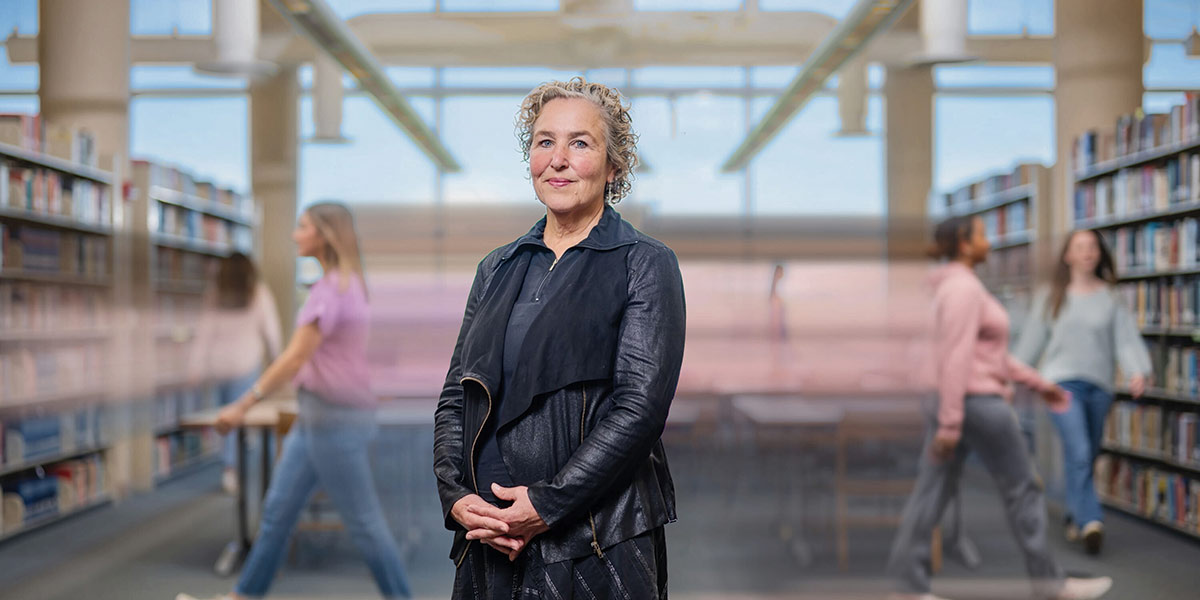
When Dr. Jocelyn Cullity talks about writing a novel, she doesn’t mention inspiration that strikes out of nowhere. She talks about work, the kind that takes years and demands checking every detail, like a film’s release date, the pattern of a bird’s feathers or the way a street sounded in 1857.
“Writing historical fiction is detective work,” says Cullity, who became the director of the Stokes Center for Creative Writing in August. “You follow one clue to the next.”
That mindset — patient, persistent and unafraid of difficulty — is the foundation she’s laying for her students.
Ordinary Women Carrying Extraordinary Burdens
Cullity, whose English family lived in India for five generations, was drawn to that country’s past through her great-great-great-aunt’s diary from the Siege of Lucknow in 1857.
The uprising and the British civilians caught up in it were well-documented in British records. The story of the African Indian women who fought to defend their home was not.
"Once I understood who those women were, there was no turning back."
Her award-winning novels, “Amah and the Silk-Winged Pigeons” and its sequel, “The Envy of Paradise,” center those women as warriors and leaders. In the official historical record, their voices were silent. Cullity resurrected them from fragments with help from historian Rosie Llewellyn-Jones, who has translated hundreds of surviving diaries and memoirs from Lucknow.
Born in Australia and raised in Toronto, Cullity came to the United States for graduate school, earning a master’s degree from the University of Iowa and a Ph.D. from Florida State University, before teaching at several colleges, including a decade in the BFA in creative writing program at Truman State University in Missouri.
She also worked in documentary film, and evidence of that back-ground is easy to see: The walls of her office are mapped with penciled notes and taped-up index cards that chart characters, scenes and notes from history.
Writing historical fiction requires diligent fact-checking. If she writes of characters listening to a Billie Holiday song only to learn that the song had not been released yet at the time of that scene, she rewrites. News events, models of cars and other historical details undergo similar scrutiny.
“You want to get it right,” she says. “You do everything you can to honor the people who lived in that moment.”
Her latest novel, now in the editing stage, moves closer to home: Depression-era Arkansas. “The Nurse at Baker Hospital” follows a young nurse searching for stability in a hospital run by a charismatic showman who sells false cures. Cullity began writing it during the pandemic, reflecting on the resilience of nurses who bear so much during the hardest moments.
It’s a different setting and a different century, but it has the same heartbeat: ordinary women carrying extraordinary burdens.
Passing the Torch to South Writers
Cullity believes South students have their own kind of resilience. Members of Generation Z, she says, are deeply connected to the world and their own communities. Her role is to gently, firmly guide them toward the professional lives they want.
She also wants them to recognize the opportunity in front of them. The United States treats creative writing as a serious pursuit, she says, enabling talented writers to learn directly from working artists. In some other Western countries, writing is seen as an elite, inaccessible profession.
“You only understand how special that is if you’ve lived somewhere else,” Cullity says.
South pays for students to join the Association of Writers & Writing Programs, connecting them to national seminars about the craft, publishing advice and a wider literary community.
Cullity’s mission is to help emerging writers find their voices, build their confidence and connect to Mobile’s creative community, the national literary landscape and the long line of storytellers who came before them.
South Stacks
- A Quick Guide to a Selection of Books Written by Members of the South Community
- Literary Case Studies in Cowardice: Parolles, Waller and Hirsch by Richard Hillyer, professor, English; Springer Nature, 2025
- Pitfalls of Prestige: Black Women and Literary Recognition by Laura Elizabeth Vrana, associate professor, English; The Ohio State University Press, 2024
- Thie Consequences of Confederate Citizenship: The Civil War Correspondence of Alabama’s Pickens Family edited, with commentary and notes, by Henry M. McKiven, professor, history; LSU Press, 2025
- Commemorative Acts: French Theatre and the Memory of the Great War by Susan McCready, professor, modern and classical languages and literature; University of Toronto Press, 2025
- Digging All Night and Fighting All Day: The Civil War Siege of Spanish Fort and the Mobile Campaign, 1865 by Paul Brueske, USA track and field coach, graduate student of history; Savas Beatie, 2024
Click here to view the current issue of South Magazine
-
The Art of Medicine
Dr. Jeffery S. La Rochelle, the new dean of the Frederick P. Whiddon C...
June 17, 2026 -

Base Camp
South to scale up support with new military services home....
June 17, 2026 -
Flagship Futures
One of the newest scholarship programs at the University of South Alab...
June 17, 2026 -

Estuary of Innovation
The Frederick P. Whiddon College of Medicine building, opening in spri...
June 17, 2026