Fiscal Fitness
Posted on January 8, 2026 by Steve Millburg
2015
YEAR FOUNDED
$250,000
ORIGINAL INVESTMENT
13.71%
ANNUALIZED RETURN SINCE INCEPTION
NVDA
(NVIDIA CORP.)
TOP-PERFORMING STOCK EVER UP 3,000% SINCE 2017
3 STOCKS
STILL IN PORTFOLIO FROM 2015:
• THE WALT DISNEY CO. (DIS)
• LOCKHEED MARTIN CORP. (LMT)
• AMERICAN TOWER CORP. (AMT)
GLW
(CORNING INC.)
TOP-PERFORMING STOCK FY 2025
 81.68%
LYB
(LYONDELLBASELL IND.)
WORST-PERFORMING STOCK FY 2025
 48.86%
A student-run investment fund celebrates 10 years of smart choices and lessons learned.
In November 2017 an investment fund purchased stock in a tech company known for graphics processing units used in video games. The fund managers liked the company’s plans to expand into a promising field: artificial intelligence.
Smart move. The company was Nvidia Corp. (ticker symbol NVDA), now the world’s largest corporation, with a staggering market valuation of $5 trillion. The 2017 per-share price, adjusted for subsequent stock splits, was $5.23. The closing price at the end of fiscal year 2025 (Sept. 30) was $186.58.
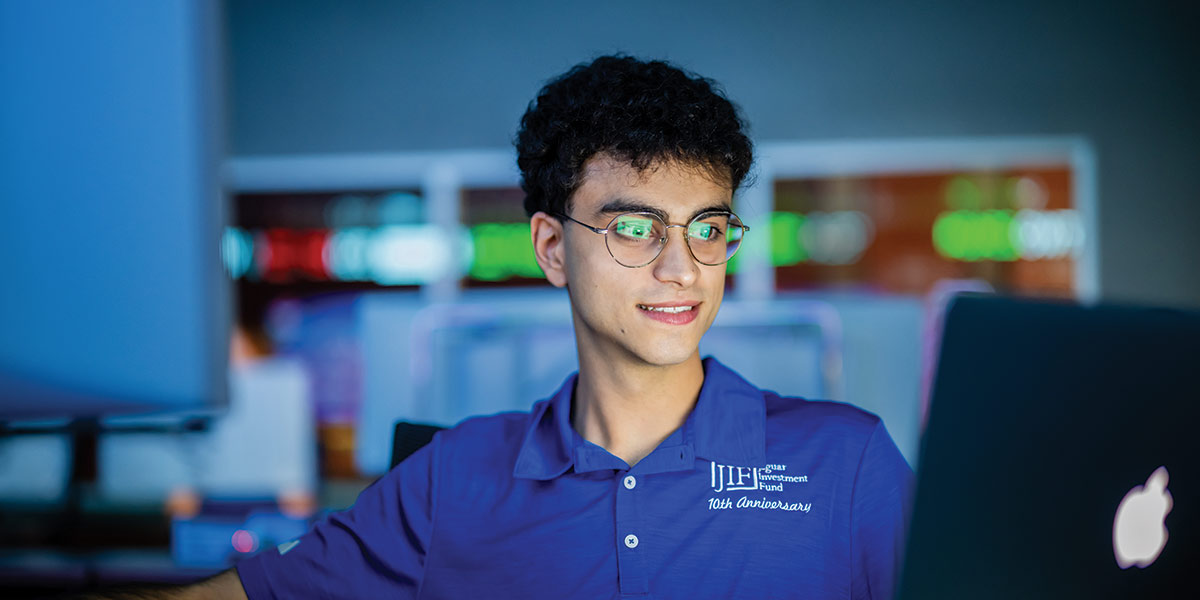
Those savvy fund managers were a bunch of Mitchell College of Business students. Their fund, the Jaguar Investment Fund, is celebrating its 10th birthday.
The JIF began in 2015 with contributions from Mobile banker Clarence M. Frenkel Jr. and longtime South benefactor Abraham “Abe” Mitchell totaling $250,000. The college added another $250,000 in 2018. By the end of fiscal 2025, the fund’s value had grown to $1.5 million.
In its decade of existence, the JIF has averaged annual gains of 13.71%. The average annual gain over the past 10 years for all comparable professionally managed investment funds was 12.46%. That’s according to the mid-2025 S&P Global SPIVA Scorecard (the most recent available) for U.S. funds that invest in large companies.
"We’re managing the money fiscally and responsibly, and the students are learning things. Ultimately, that is the goal. — Dr. Chris Lawrey JIF Director"
How it Works
Of the students who apply to become Jaguar Investment Fund managers, the college selects 12 or 13 each semester. They enroll in Student Managed Investment Fund, a three-credit class, for a maximum of two semesters.
Each student must make at least two pitches per semester to buy or sell stocks, usually as part of a three-person team. That involves hours of sifting through layer after layer of financial data. At least 70% of the class must approve each transaction.
The instructor has veto power. Lawrey, an associate professor of finance, says the previous teacher exercised that privilege once. Lawrey hasn’t yet. He almost did when a charismatic team talked the class into approving a sketchily researched stock buy. Then the coolest thing happened. Another team dug into the nitty-gritty of the company’s fundamentals.
Two weeks later, they presented a counter pitch for selling that stock and buying shares in another company instead. Their research was so ironclad, Lawrey says, “even the guys that made the original pitch ended up voting for the new one.”
A Second Fund
In 2021, the student Jaguar Investment Fund managers took on a second — and greater — responsibility: managing part of the University’s endowment. The University provided an initial $750,000. In January 2025, it made the first of five planned additional annual payments of $200,000.
The student managers earn a 1% annual management fee from each fund. That generates about $25,000 a year, which goes for student education, such as trips to financial conferences.
What, No Crypto?
The Jaguar Investment Fund normally invests in U.S. equities (mostly stocks) or equity funds. “We got permission to do commodity funds because the students wanted to buy gold,” Lawrey says. “They asked, ‘Where is our hedge against inflation?’” They bought SPDR Gold Shares (GLD), a fund backed by physical gold (rather than the gold futures that back many such funds). “It’s been one of our top performers,” Lawrey says.
Cryptocurrency? Too speculative. At a conference, Lawrey met an exchange-traded cryptocurrency fund manager. “He said, ‘Nobody should have more than 5% of their net worth in crypto.’ And this is a guy that runs a crypto ETF!”
DIY Fail
Can you get rich by investing like the students who manage the Jaguar Investment Fund? Don’t try it, says Lawrey. They dig deeply into the revenues, profits, free cash flows, macro-economic data and much more.
Most people don’t have the time or patience for that. Instead, Lawrey suggests investing in index funds, such as an S&P 500 index fund.
Click here to view the current issue of South Magazine
-

The Art of Medicine
Dr. Jeffery S. La Rochelle, the new dean of the Frederick P. Whiddon C...
June 17, 2026 -

Base Camp
South to scale up support with new military services home....
June 17, 2026 -
Flagship Futures
One of the newest scholarship programs at the University of South Alab...
June 17, 2026 -

Estuary of Innovation
The Frederick P. Whiddon College of Medicine building, opening in spri...
June 17, 2026