Building a Legacy of Care
Posted on February 25, 2026
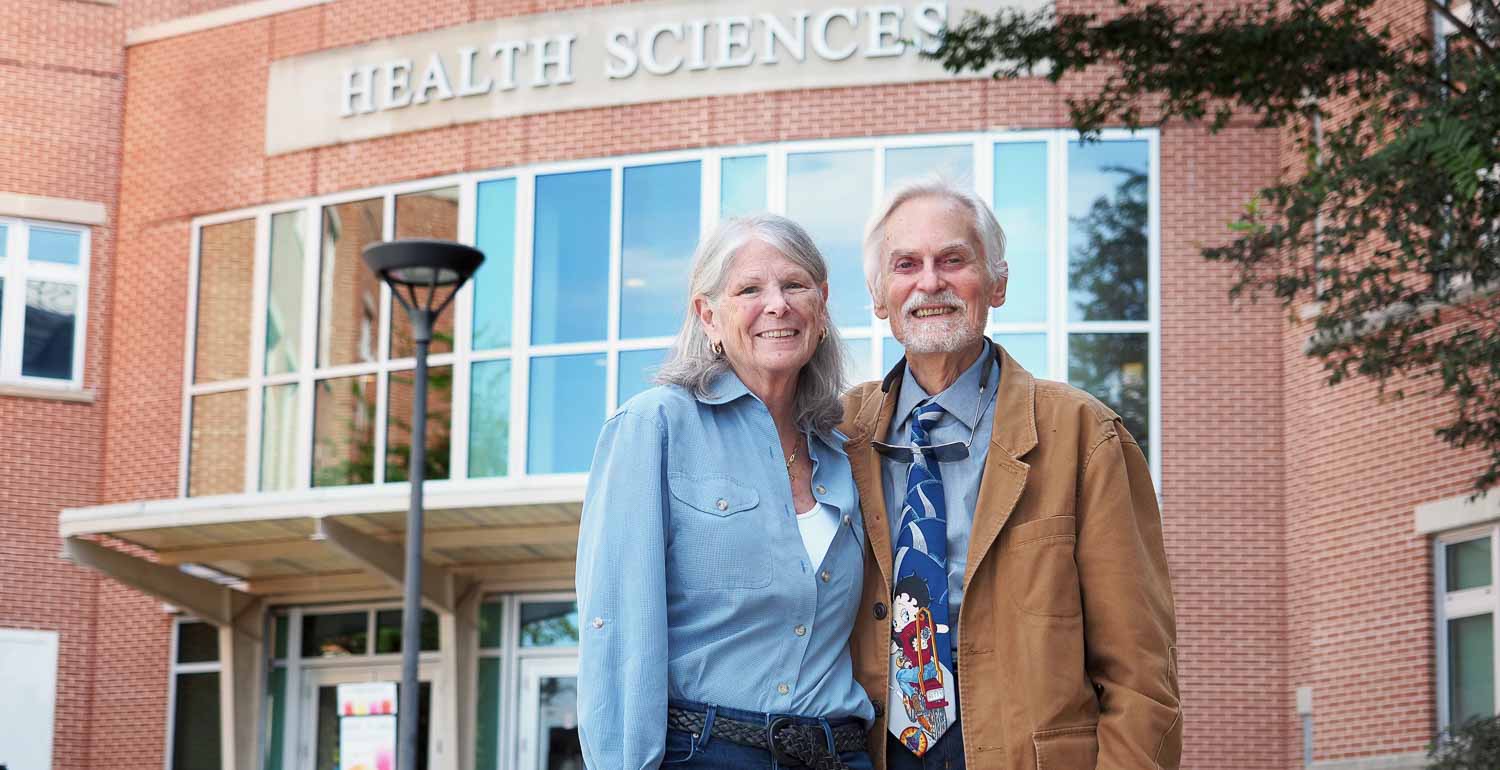
Education transformed the lives of Barbara and Leonard Bush. Now, they’re paying that legacy forward.
The two met while attending a Florida community college and fell in love. They got married and both began working in healthcare. At critical career moments, they were forced to ask themselves: Now what?
Each time, the answer was the same: Education. Each time, a college or university went the extra mile to help them earn a degree while they continued working to support themselves. Each time, the degree led to transformative career leaps.
Now retired, the Bushes want to pay forward the help they received.
“We won’t ever know these students,” Barbara said, “but they will know that they will have extra financial help to achieve their goals.”
The two have set up a $1.3 million planned gift to the University of South Alabama to create The Barbara A. and Leonard C. Bush Endowed Scholarship in Bachelor’s of Nursing and The Barbara A. and Leonard C. Bush Endowed Scholarship in Master’s of Nursing.
“We have no children,” Barbara said. Instead, their “children” will be the aspiring healthcare workers whose futures they’ll help secure.
Envision the possibilities — that, for example, “someone receiving our scholarship will have a chance at the success Leonard and I have had, and might even possibly find a cure for cancer.”
A Love Story Rooted in Education
Barbara dreamed of becoming a nurse at 5 years old. She knew it was her calling. Leonard wanted to become a teacher, but his father, an Air Force officer, instead suggested a different path: cytology. That’s the study of cells through a microscope to detect cancer and other diseases, which Leonard’s father had pursued as well.
After Leonard’s lab training and the Bushes’ wedding, they moved from Melbourne, along Florida’s Space Coast, to the town of Mexico in north central Missouri. Leonard worked as a cytologist at Audrain County Medical Center.
Barbara soon got a job there too, as a secretary. Then, the director of nursing asked if Barbara would consider becoming a surgical technologist, assisting in the operating room.
“I had no idea what a surg tech was,” Barbara said. “The director said, ‘Well, you can go and observe for a couple hours, and then tell me what you think.’ I did, and I was like, ‘Oh, I want to do that!’ So until I left to go to nursing school, I was a surgical tech.”
As Leonard completed a degree in health science, Barbara applied to a two-year nursing program in Moberly, about 40 miles away from their home at the time.
“Because he got a raise, I was able to quit work for two years and follow my dream,” she said.
Barbara earned an associate degree in nursing and obtained her license as a registered nurse. A scholarship helped — one reason why “I’m big on scholarships,” she said. But before she ever finished, her sight was set on a bachelor’s degree.
Bridges, Not Roadblocks
Leonard was also considering a return to the classroom. He wanted a four-year degree. “I wasn’t really thinking, ‘If you’re going to move up in the world, you’ll need this,’” he said. “It was just a personal goal.”
Could he do it while still working full-time? The University of Missouri transferred credits from his previous schooling and laboratory training, recognizing the work he had already done. Instead of creating hurdles, administrators helped him chart a path forward.
“They didn’t put up roadblocks,” Leonard said. “They built bridges.”
“The dean saw the potential in you,” Barbara added proudly.
After earning his bachelor’s degree in cytotechnology, new doors opened. Leonard moved into advancing laboratory technologies, helping fellow cytologists implement faster and more accurate cancer-screening systems.
Then came the most meaningful chapter of his career: clinical drug research. He contributed to studies investigating new treatments for serious and life-threatening diseases. Over time, he advanced into project management, overseeing multiple trials and coordinating complex research efforts aimed at improving — and sometimes saving — lives.
“He never would have been able to get into cancer research without his baccalaureate,” Barbara said. “His impact was transformational.”
Barbara, too, felt the pull to keep growing.
Through the University of South Alabama’s RN to BSN weekend program, she earned a Bachelor of Science in Nursing in 1990. South provided her with in-state tuition, which allowed her to continue working full time in the Florida Panhandle, where the Bushes lived at the time.
Not only did she earn her BSN, but also, in 1992, a Master of Science in Nursing with concentrations in Adult Health and Public Administration.
“The quality of education I received prepared me for my future endeavors. I just can’t praise the University of South Alabama enough,” Barbara said. “The professors were fantastic and their nursing programs are educationally stellar.”
Those two degrees launched Barbara’s career in healthcare management, where she fought to improve working conditions for nurses — thus improving patient care as well. While applying for one position, she insisted, “I cannot be understaffed in any clinical position.”
The interviewer replied, “I can work with that.” Barbara got the job. And she got
the staffing level she thought was necessary.
“I started out as a chief nursing officer and moved up to vice president in patient
care services in Montgomery, Alabama. From there, I became a chief operating officer
at a facility in Somerset, Kentucky. Then, I went on to become the chief operating
officer at Kindred Hospital in Houston, Texas. I had my own chief nursing officer,
and it was wonderful.”
After a few years, she switched to corporate risk management for the Texas locations of that same national hospital chain and then into compliance — ensuring that the organization met legal, ethical and professional standards. “My whole goal was to improve patient care — to be an advocate even from the administrative end,” Barbara said.
Living Simply, Giving Significantly
These days, the Bushes spend most of their time at The Hollow, a property with, Leonard said, “a bunch of raccoons and squirrels and deer” out in the country not far from Cookeville, Tennessee, where he was born. Barbara is originally from Ann Arbor, Michigan.
It’s a quiet life — reflective, content. But their legacy will be anything but quiet.
Across decades of work in Missouri, Texas, Florida and Alabama, the Bushes practiced a discipline that would ultimately shape their philanthropy: they lived below their means.
“We always bought homes that we knew we could afford, even though the realtors want you to buy more,” Leonard said.
They avoided excess. They saved steadily. They allowed time and patience to do their work.
When the time came for estate planning, the decision felt natural.
“We said, ‘We feel really good about this,’” Leonard said.
They envision scholarship recipients who go on to lead nursing teams, improve patient outcomes and expand access to care. The ripple effects, they know, are impossible to measure.
“If we can, in some way, positively impact a student who’s going to positively impact somebody else’s life,” Barbara said, “we’re all for that.
The Bushes hope their story inspires not only idealistic young people with big dreams but also potential donors who might be wondering how to leave a meaningful legacy that makes the world a better place
“We are leaving this legacy because we’re passionate about education, healthcare and giving future generations the opportunity to have a huge impact on the world,” Barbara said.
Their choice was simple: They put their money where their hearts are.
“We firmly believe that education is so very important that it should be a right, not a privilege for a few,” Leonard said.
“If you want it,” Barbara added, “it should be available. You have to qualify for it, of course. But financing should not be an issue.”
For Barbara and Leonard, education was never merely a credential. It was the answer to uncertainty. The engine of advancement. The pathway to service.
Now, long after their own diplomas were framed, their belief in its power will continue to transform lives — one nursing student at a time.
To learn how you can invest in current and future generations of South students, contact the Office of Development and Alumni Relations at Development@SouthAlabama.edu or (251) 460-7032.