$1.35 Million Grant Adds Screenings in Community Medical Clinics
Posted on February 26, 2026
How do you catch behavioral health issues in their early stages, before they negatively impact people's lives? Dr. Kimberly Zlomke, professor of psychology at the University of South Alabama, has embarked on a three-year project, funded by a $1.35 million federal grant, to test a community-based answer.
The South Alabama HOPES: Health-Oriented Psychology Education for Substance Use Recovery project began in July. Among its many goals, the project trains psychology graduate students in a public-health approach called SBIRT — screening, brief intervention and referral to treatment.
“We’re focused on meeting patients wherever they are,” Zlomke said, “whether it’s in primary care or other health clinics.”
When patients come in for a treatment or checkup with their medical provider, graduate trainees do a quick screen for substance use and other behavioral health concerns, such as depression, anxiety, eating disorders or even relationship issues. If concerns are identified, the students provide a brief, evidence-based intervention and connect patients to additional support when needed.
“We are hoping to identify concerns early, before substance use becomes more severe or begins to significantly impact someone’s life,” Zlomke said, “Early support can reduce the likelihood that someone will need more intensive levels of care later on.”
The Department of Psychology has partnered with USA Health to place the grad students at the Stanton Road Clinic next to University Hospital and at the USA Health Adolescent and Young Adult Health clinic. Zlomke hopes to partner with OB-GYN and neonatal clinics, plus clinics from other health systems — covering the full age range from prenatal through adult care.
The students — five each year — are working on doctoral degrees in clinical and counseling psychology. They get stipends to reduce financial stress and allow them to focus on their training and patient care.
An Aha Moment
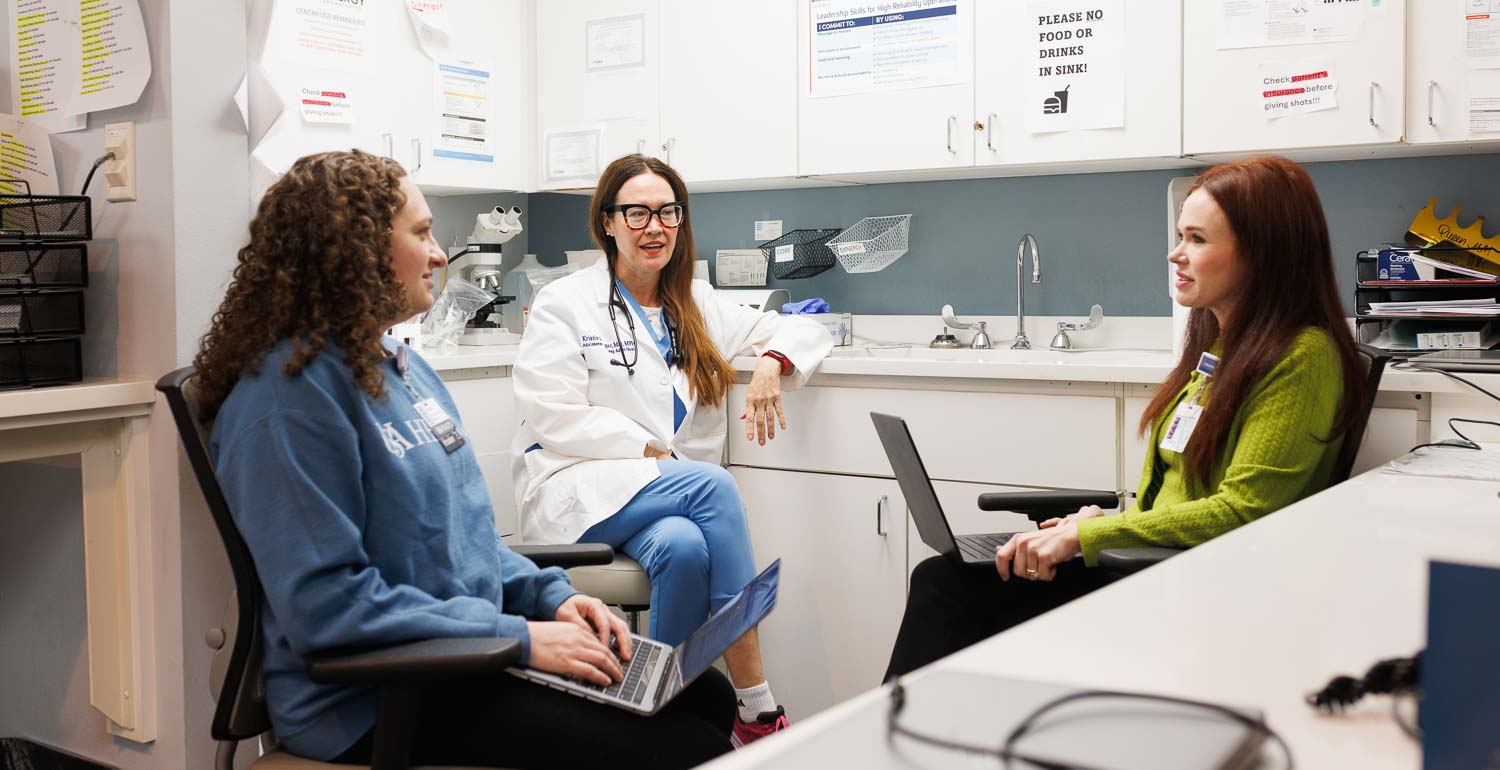
On a recent Wednesday afternoon, doctoral students Rachel Henderson and Victoria Chassin met with Dr. Kristin Rager, professor and division chief for adolescent medicine at USA Health, at the Adolescent and Young Adult Health clinic on Old Shell Road. They meet with Rager a couple of times a week to discuss cases.
On this day, one of the cases reviewed involved a child with social anxiety. The team focused on strategies for engaging parents in a plan for gradual exposure therapy.
One of Rager's specialties is working with children with eating disorders. That piqued Henderson’s interest early on.
“I think that I gained a lot of knowledge about eating disorders from my work with her, but I think even more broadly than that, working in an integrated care setting has given me an idea of what this will actually be like in my career,” said Henderson, who earned both her bachelor’s and master’s degrees at South. “This solidified this for me. In fact, when I first started, I went to Dr. Zlomke's office zealously and said, ‘This is it. Like, this is what I want to do, and I know it now.’”
Rachel Henderson
I went into psychology originally with an idea that I knew that I wanted to help people.
And just before entering my master's program, I'd gone to New Orleans, and I saw a
veteran, a homeless veteran, on the street. And it was just this kind of experience
where I felt compelled to stop and talk to him, and he told me his story, and you
know, about some of the horrific things that he had seen, and I wondered in that moment,
you know, who would help this person? You know, would he be judged by people walking
by and be viewed as someone who, you know, was a bad person and had made bad decisions?
Or would he be offered help? And it was at that moment, I knew, like, I wanted to
be able to help people. I wanted to have the skills to help people who didn't otherwise
have the resources to help themselves. South has definitely been an integral part
of my success and my journey, and I'm really proud to be a Jaguar, a lifelong Jaguar,
is what I tell people.
The South Alabama HOPES program also provides education for psychology faculty members. “We’re all enhancing our competency in substance use screening, prevention, early intervention, and recovery-oriented care,” Zlomke said. “I’m a child psychologist, so I am enhancing my competencies around working with children affected by prenatal substance exposure.”
Other faculty members will use their new tools in their own specialties. For example, Zlomke said, Dr. Joseph Currier, a professor of psychology, does significant with veterans and faith communities. Dr. Trés Stefurak, professor and associate dean of the College of Education and Professional Studies, works with youths involved in the juvenile justice and child welfare systems. Dr. Phillip Smith and Dr. Erica Ahlich, respectively a professor and an assistant professor, care for adults, with expertise in suicide prevention, health-related behavior, and integrated behavioral health services.
“We’re training the mental health professionals that are there today as well as the ones that hopefully will be there tomorrow,” Zlomke said.
Sustainable Impact
The project has four key objectives:
- Recruit and train students to serve in community-based care settings.
- Design and implement an evidence-based curriculum for assessing patients for substance-use disorders.
- Establish clinical partnerships as training opportunities.
- Offer professional development for psychology faculty and community providers.
The grant came from the Health Resources & Services Administration, which has designated much of Mobile County as being medically underserved and the entire county as being short on mental health professionals for low-income residents.
Zlomke hopes that by the end of the project, the partner clinics will see the value of integrated health services and sustain both the training placements and the expanded behavioral health services long-term.
The academic legacy of the program will definitely continue, she said. “We’re developing some enhanced classes and training around SBIRT and behavioral health that we will be able to sustain.”
Most of all, she said, she hopes patients continue to reap benefits. “I think the biggest impact we have had has been that patients have felt safe and supported talking with someone, even if it’s for one session, and to learn how to do deep breathing. Even if it’s for one session, to learn how to ask for social support.
“They didn’t have to navigate a complicated referral process or wait months for care. Behavioral health support was available in the same place they were already receiving medical services.”