Undergraduate students explore biomedical research at Whiddon College of Medicine
Posted on August 4, 2026
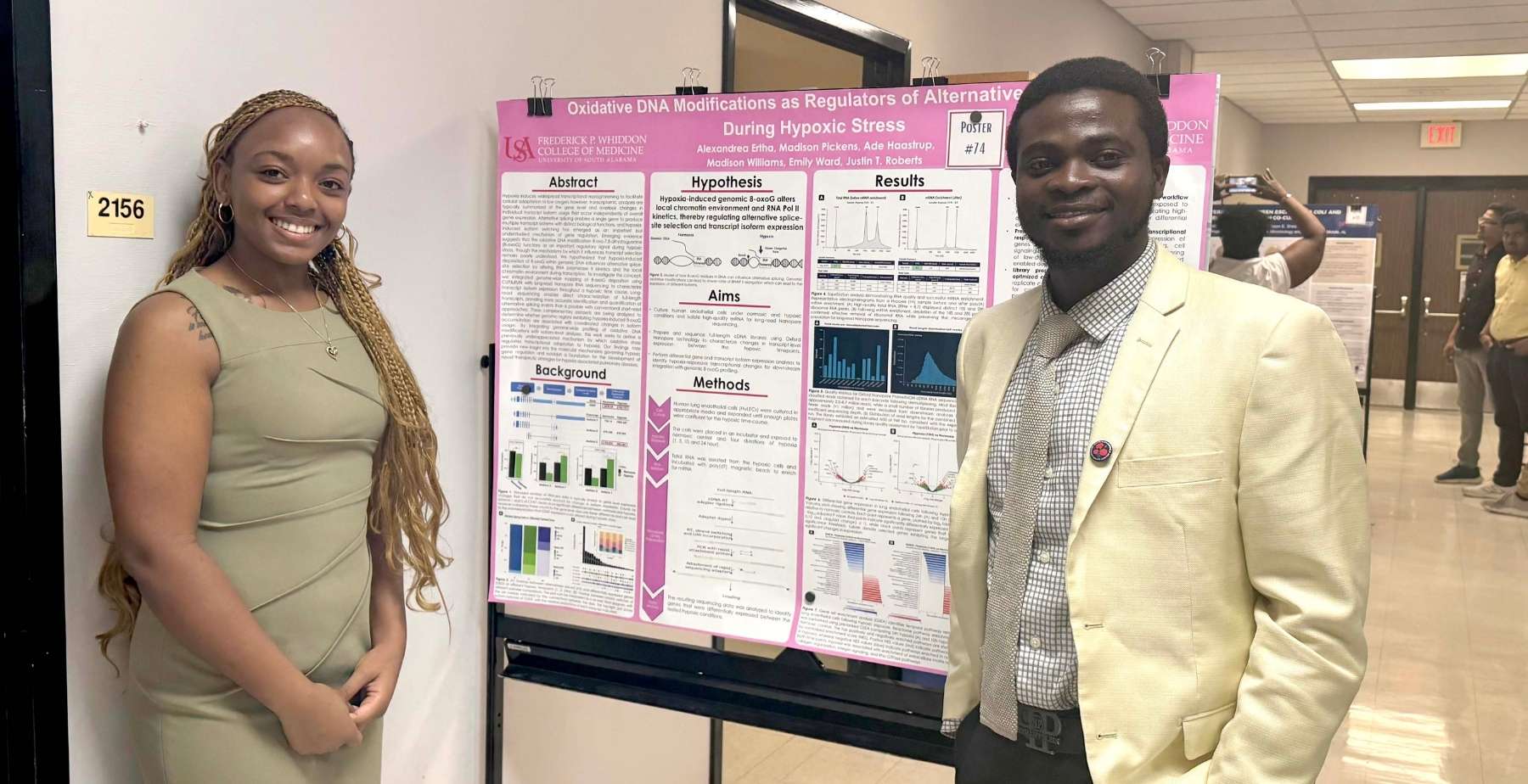
Six undergraduate students spent the summer immersed in biomedical research at the Frederick P. Whiddon College of Medicine through the Undergraduate Summer Research Program. Four students engaged in research in the basic medical sciences while two students completed pulmonary-related research with the USA Center for Lung Biology.
The program, supported by the Office of Research, Education and Training, provides undergraduate students with the opportunity to work with faculty mentors in active research laboratories, gaining hands-on experience in biomedical research while developing critical thinking, scientific communication, and professional skills. Throughout the summer, students became immersed in the research process, learning laboratory techniques, analyzing data, and contributing to projects designed to advance scientific discovery.
Working closely with their faculty mentors, each student explored a unique area of biomedical research while gaining valuable insight into careers in science and medicine. The mentorship they received throughout the program fostered both their scientific development and professional growth.
The summer culminated with the Whiddon College of Medicine's Medical Student Summer Research Day, where the undergraduate students presented scientific posters alongside participants in the Medical Student Summer Research Program. The event also gave them the opportunity to learn about a broad range of biomedical research topics and engage with other emerging researchers.
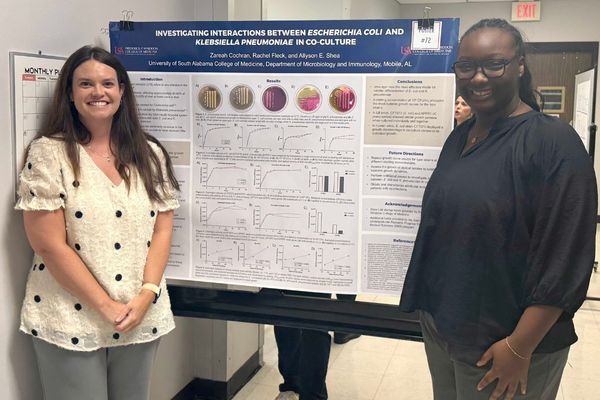 Dr. Allyson Shea and Zareah Cochran
For Zareah Cochran, the program provided more than laboratory experience; it helped her discover a passion for research and envision a future pursuing it. Working in the laboratory of Allyson Shea, Ph.D., an assistant professor of microbiology and immunology, Cochran gained confidence as a researcher while developing new technical and communication skills.
One of the biggest lessons she learned was that research rarely follows a straight path. After her team shifted the direction of its project to investigate co-infections involving Escherichia coli and Klebsiella pneumoniae, she saw firsthand how unanswered questions drive scientific discovery. She was also surprised by the challenge of translating months of work into a clear, compelling research poster.
“Before this summer, I wasn't sure what I wanted to do after graduation,” Cochran said. “This experience gave me clarity. I can absolutely see myself working in a research laboratory and designing experiments to answer important scientific questions. I'm now considering applying to Ph.D. programs this upcoming year.”
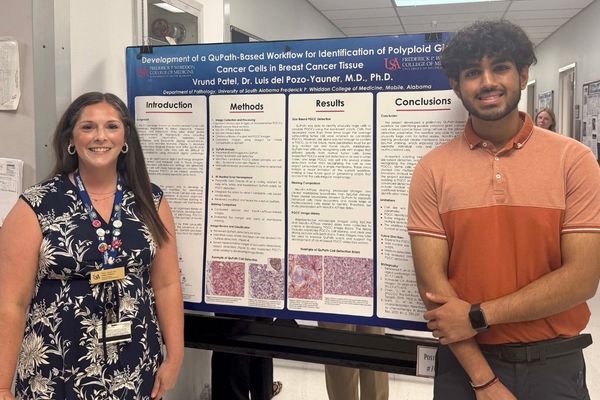 Skye Andrade and Vrund Patel
For Vrund Patel, the most meaningful aspect of the program was the collaborative environment created by faculty mentors and fellow researchers. Throughout the summer, he developed both laboratory and computational research skills while working closely with experienced investigators who encouraged questions and emphasized learning.
The experience also gave Patel a new appreciation for the pace of scientific discovery. He learned that meaningful results often require persistence, flexibility and repeated experimentation.
“Science is constantly evolving, and I want to be part of that growth,” Patel said. “Participating in research this summer inspired me to continue conducting research throughout my undergraduate education and, hopefully, during medical school.”
Faculty mentor Justin Roberts, Ph.D., an assistant professor of pharmacology, said watching students develop confidence throughout the summer was one of the program's greatest rewards.
“It was really rewarding to mentor an undergraduate who had never worked in a research lab before,” said Roberts, who mentored Alexandrea Ertha. “Seeing her gain confidence and discover that she genuinely enjoyed research was one of the highlights of my summer. It's exactly what makes programs like this so valuable.”
Edgar Escalante, who participated through the Center for Lung Biology, came away with a deeper appreciation for the collaborative nature of scientific research. Attending laboratory meetings and presenting his poster alongside other student researchers gave him a firsthand look at how scientists build on one another's ideas.
He was especially surprised to learn that unsuccessful experiments can be just as valuable as successful ones. “Even when an experiment doesn't turn out as expected, those findings can still help other scientists by preventing them from repeating the same unsuccessful approach,” Escalante said.
For Elizabeth Catranis, the summer experience brought classroom concepts to life. Working in a research laboratory allowed her to apply knowledge from multiple science courses while gaining a better understanding of how biomedical research supports advances in medicine.
She also discovered that successful research depends as much on organization and time management as technical skills, lessons she believes will benefit her future career as a physician.
“This summer confirmed my goal of becoming a surgeon by showing me the discipline, precision and time-management skills that translate directly from the laboratory to the operating room,” Catranis said. “It also gave me a greater appreciation for the scientific process behind medicine and strengthened my commitment to pursuing this career path.”
Each student encouraged future applicants to take advantage of the opportunity, emphasizing the importance of asking questions, remaining curious and embracing every opportunity to learn. They agreed that the program’s supportive faculty mentors and hands-on research experience make it an excellent introduction to biomedical research.
“Science is such a broad field that every experience helps you become a more well-rounded scientist,” Catranis said. “Research is so much more than pipetting; it teaches you to slow down, understand every detail, and appreciate the bigger picture. Stay curious and don't be afraid to ask questions, because curiosity is what drives great research.”
“There is no better way to get your feet wet in research,” Vrund said. “This program has incredibly supportive mentors, peers, and faculty who are willing to help you every step of the way. If you're given the opportunity, I highly recommend applying and becoming part of the program.”
The Undergraduate Summer Research Program will begin accepting applications for the next cohort in February 2027, with selection decisions expected in March.