USA scientist awarded NIH grant to advance DNA repair research
Posted on August 18, 2026
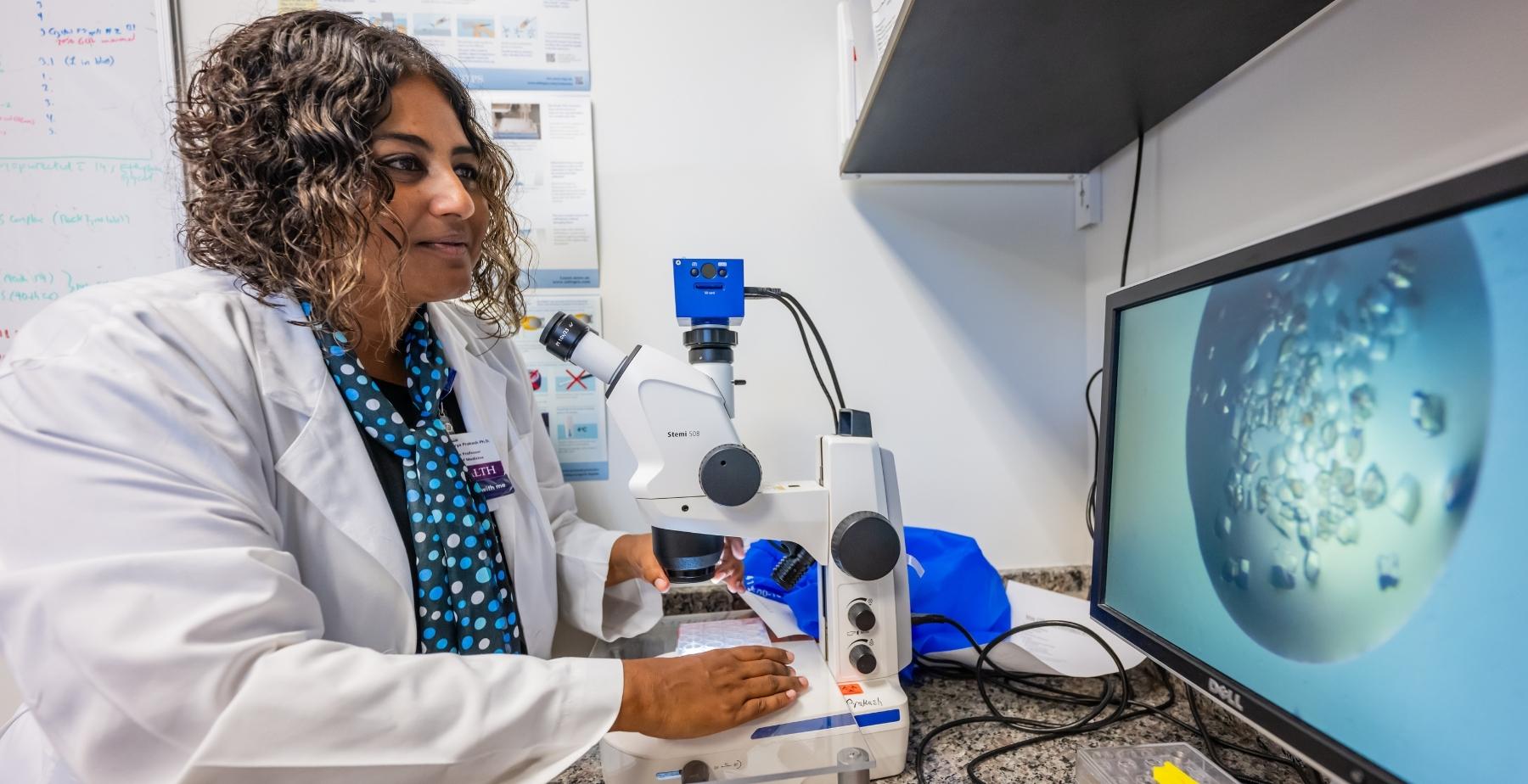
A researcher from the University of South Alabama has received a $156,000 National Institutes of Health (NIH) grant to develop new tools for studying proteins that play a critical role in repairing damaged DNA.
Aishwarya Prakash, Ph.D., professor of biochemistry and molecular biology at the Frederick P. Whiddon College of Medicine, received an R03 grant from the National Institute of Environmental Health Sciences for her project, “Innovative Nanobody Tools for NEIL1 and NEIL2: Overcoming Barriers in DNA Repair Research.”
“Our DNA is constantly damaged by normal cellular metabolism and by environmental exposures that generate reactive oxygen species,” Prakash said. “If this damage is not repaired properly, it can lead to mutations, mitochondrial dysfunction, cancer, neurodegeneration, aging-related disease, and other health problems.”
Prakash’s laboratory, housed in the USA Health Mitchell Cancer Institute, is developing nanobodies that target two DNA repair enzymes, NEIL1 and NEIL2. Known as glycosylases, these specialized enzymes help initiate one of the major DNA repair pathways called base excision repair. During this process, they recognize and remove oxidized DNA bases so the cell can restore the DNA to its correct sequence.
NEIL1 and NEIL2 are particularly important, Prakash noted, because they function in both the nucleus and mitochondria and can act on unusual DNA structures that arise during replication, transcription and repair.
However, studying these enzymes has been challenging. NEIL1 and NEIL2 are present at low levels in cells, contain flexible regions that complicate structural studies, and lack reliable commercial antibody tools.
Prakash’s project aims to address those limitations by creating a dedicated nanobody toolkit for studying NEIL1 and NEIL2. Unlike conventional antibodies, which are large and complex, nanobodies are much smaller, more stable, and easier to engineer and produce in the laboratory. Their small size and precision make them useful tools for studying difficult-to-detect proteins.
“These nanobodies can be used not only to detect the proteins, but also to stabilize them for structural biology, and potentially track their movement in cells during DNA damage responses,” Prakash said.
Preliminary data supporting the NIH proposal was funded through the Whiddon College of Medicine’s Intramural Grants Program last year. Prakash’s lab has evidence that one nanobody can stabilize NEIL1 and help researchers follow its recruitment to sites of DNA damage. The NIH funding will allow the team to expand this work systematically and develop comparable tools for NEIL2.
The tools developed through the project could benefit researchers beyond Prakash’s laboratory. Her team plans to share the reagents broadly so other scientists can use them to study how NEIL enzymes function in the nucleus, mitochondria and cellular responses to DNA damage.
Understanding these processes could have implications for diseases in which oxidative DNA damage and mitochondrial dysfunction play important roles, including cancer, neurodegenerative disorders and aging-related conditions.
“We are not only asking a biological question,” Prakash said. “We are building the tools that will allow the field to ask better questions about DNA repair.”
Prakash earned her Ph.D. at the University of Nebraska Medical Center and completed postdoctoral studies at the University of Vermont. In 2016, she joined the faculty at USA, where she focuses her research on DNA damage and repair, enzyme kinetics, mitochondrial disease and structural biology.