
Unit Operations Experiments
Planned Experimental Capabilities
The renovated Unit Operations Laboratory will provide students with experience across several major areas of chemical engineering.
Fluid Flow and Pressure Drop
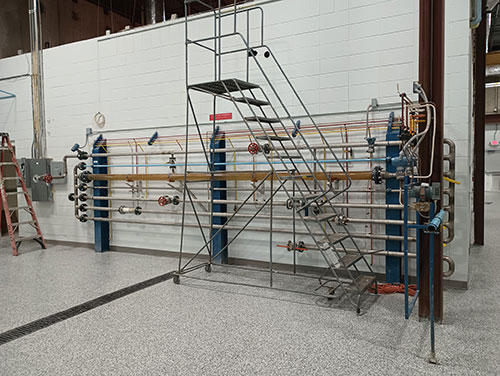
Students will investigate how liquids and gases move through pipes, valves, fittings, packed systems, and other process equipment. Experiments may examine:
- Flow-rate measurement.
- Pressure loss in pipes and fittings.
- Laminar and turbulent flow.
- Pump performance and system curves.
- Valve characteristics.
- Fluid transport through process networks.
- Comparison of measured results with engineering correlations.
These activities will reinforce concepts used in the design of pipelines, processing plants, water systems, bioprocesses, and energy facilities.
Heat and Mass Transfer
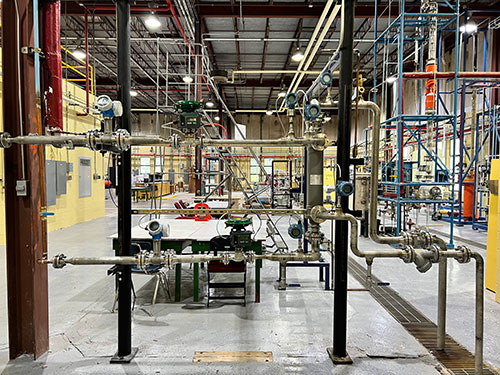
Experiments in heat and mass transfer will allow students to study the movement of thermal energy and chemical species within process systems. Planned capabilities may include:
- Heat-exchanger operation and performance.
- Conduction and convection measurements.
- Heating and cooling of process streams.
- Evaporation or condensation.
- Diffusion and interphase mass transfer.
- Humidification, drying, or related transport processes.
- Evaluation of heat- and mass-transfer coefficients.
Students will connect fundamental transport principles with equipment used throughout chemical, energy, food, pharmaceutical, and biotechnology industries.
Reaction and Separation Processes
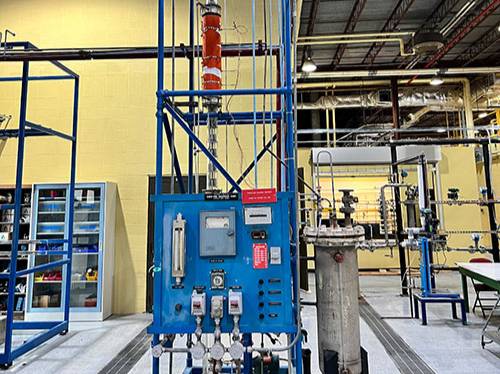
Reaction and separation operations are central to converting raw materials into useful products. Laboratory systems may allow students to explore:
- Batch and continuous reactor operation.
- Reaction kinetics and residence-time effects.
- Distillation.
- Gas absorption or stripping.
- Liquid-liquid extraction.
- Filtration or membrane separations.
- Adsorption and other purification methods.
- Material and energy balances across integrated processes.
These experiments will help students understand how reaction conditions and downstream separations influence product quality, efficiency, safety, and cost.
Fermentation Engineering and Brewing
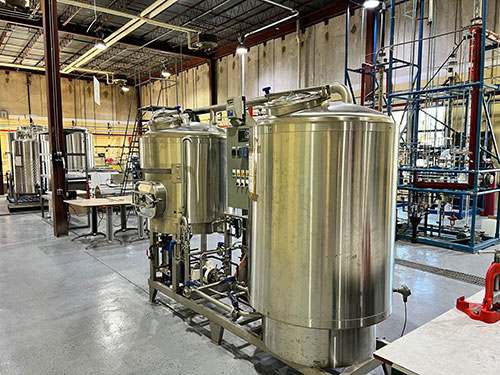
The Unit Operations Laboratory will feature a pilot-scale fermentation and brewing system that introduces students to the engineering principles underlying industrial fermentation, food and beverage production, and modern bioprocessing. While brewing provides an engaging and familiar application, the laboratory experience emphasizes the transport phenomena, reaction engineering, process control, microbiology, and biochemical engineering concepts that are broadly applicable to biotechnology and biomanufacturing.
The laboratory is being designed around a commercial-scale brewing system consisting of:
- Two-vessel 4 BBL brewhouse with integrated process pump
- Plate-and-frame wort heat exchanger
- Four 8 BBL stainless steel fermenters
- One 8 BBL brite tank
- Dedicated 4-ton refrigeration system for fermentation temperature control
These systems provide a flexible platform for investigating both traditional brewing operations and general fermentation engineering principles.
Students may perform experiments involving:
- Heat transfer during wort production and cooling
- Fluid transport and pumping operations
- Batch process design and operation
- Yeast growth and fermentation kinetics
- Effects of temperature on biological processes
- Dissolved oxygen and aeration strategies
- Process sanitation and clean-in-place (CIP) concepts
- Carbon dioxide production and gas-liquid mass transfer
- Fermentation monitoring using density, pH, temperature, and other process measurements
- Process automation and fermentation control
- Product clarification and conditioning within the brite tank
- Material and energy balances throughout the brewing process
The brewing system also provides an outstanding platform for demonstrating how chemical engineering principles are applied in modern bioprocess industries. Students gain experience with integrated process operations spanning raw material handling, thermal processing, biochemical conversion, fermentation, separation, refrigeration, instrumentation, quality control, and process optimization.
Beyond undergraduate instruction, the fermentation laboratory has the potential to support senior design projects, undergraduate research, outreach activities, workforce development, and collaborations with regional industries involved in food processing, biotechnology, fermentation, and beverage manufacturing.
Process Control and Instrumentation
Modern processing facilities depend on sensors, automated controls, and reliable process data. The renovated laboratory will introduce students to:
- Temperature, pressure, level, and flow sensors.
- Signal conditioning and instrument calibration.
- Feedback and feedforward control.
- Proportional-integral-derivative control.
- Process dynamics and transient response.
- Data acquisition and process visualization.
- Automated valves, pumps, and other control elements.
- Evaluation of process stability and control performance.
Students will gain experience operating systems in which physical equipment, instrumentation, software, and engineering judgment work together.
[Photograph or screenshot: Process-control interface and instrumentation]