
Scared Strong
Posted on January 8, 2026 by Steve Millburg
This story was published in the fall 2025 edition of South Magazine, a publication of the University of South Alabama and the USA National Alumni Association.
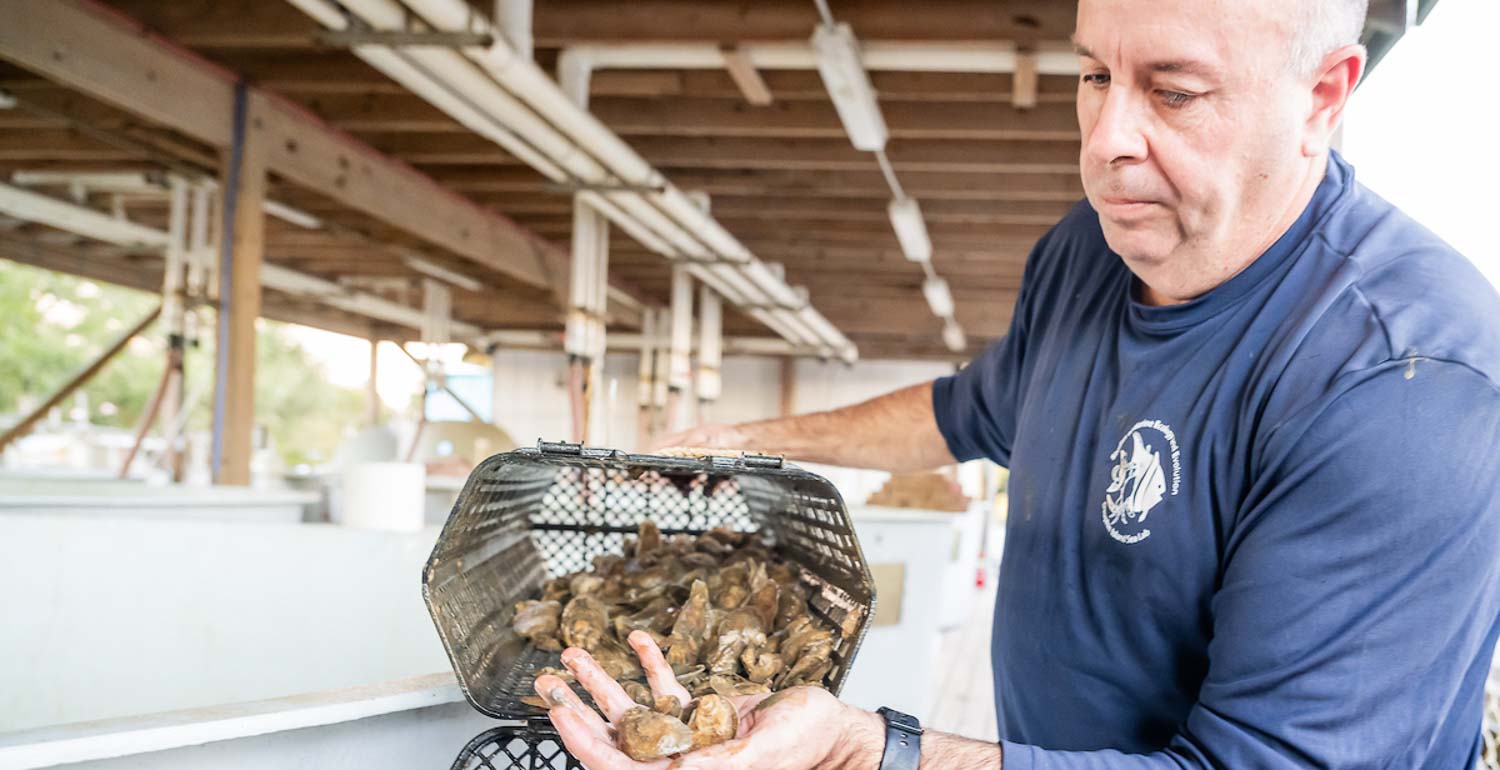
With the best of intentions, Dr. Lee Smee and other coastal Alabama researchers are deliberately terrifying baby oysters. With the tiny oysters happily settled and starting to grow, the researchers put a red-alert danger signal in the water: urine — from specific fish, crabs and snails that love to feast on oysters.
The oysters defend themselves the only way they can. They harden their shells to fend off the predators and grow big enough to get eaten by humans.
It works. Survival rates increase by up to 70%. That could have a big impact, Smee says. “This is a species that spawns in the millions and millions.”
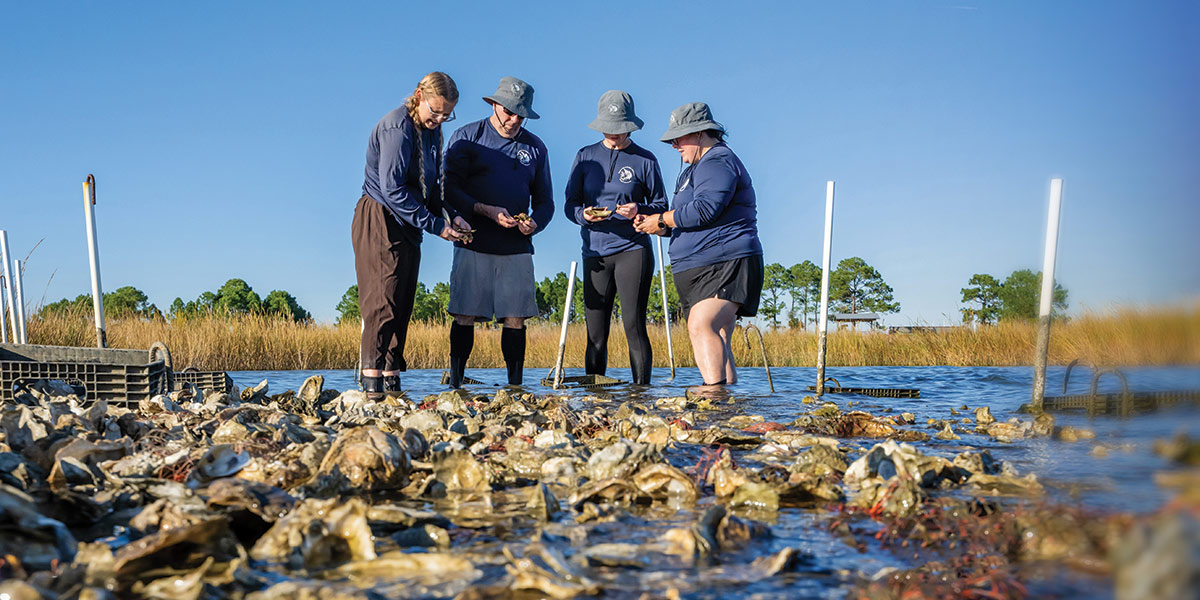
Smee is a professor of marine and environmental sciences at South and a marine scientist at the Dauphin Island Sea Lab. He’s partnered with scientists, graduate students, undergraduate interns, oyster farmers and even Scout troops, at South and elsewhere, to test some it’s-not-crazy-if-it-works ideas to reverse the decline of oysters in Gulf waters.
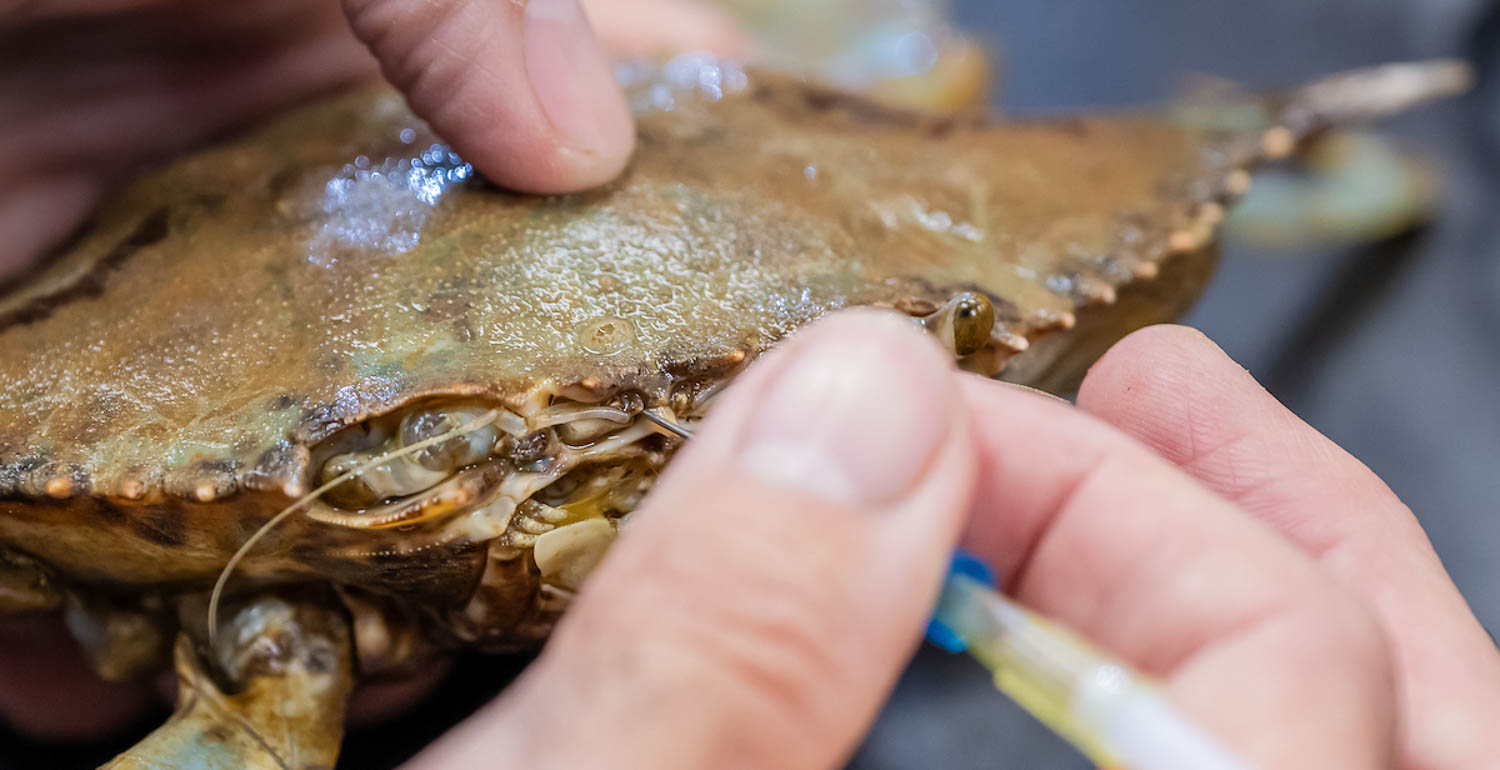
He and his colleagues have attached urinary catheters to fish. They have extracted urine from crabs using tiny hypodermic needles and steady hands. Soon, with help from chemists at Georgia Tech, they hope to be able to synthesize what Smee calls “scary juice” — a mass-producible chemical containing the components in urine that signal, “Predator!”
That could be a powerful new tool for restoring reefs and boosting declining harvests in the Gulf and beyond.
All those people are going to all that trouble because the humble oyster, a filter-feeding mollusk with gills, a heart, a nervous system and no brain, is a foundation species and ecosystem engineer providing critical habitat for the Gulf Coast. Says Smee, “Oysters, I would argue, might be the most important species in the whole Gulf.”
And they’re in trouble.
“Oyster reefs are probably the most degraded habitat in the world,” says Smee. “Somewhere around 85 to 90% of them globally are gone. And that’s certainly true here in the northern Gulf.”
Dr. Lee Smee: Oysters are, like, I would argue, might be the most important species
in the whole Gulf. They do a ton of really good, important services for us. I mean,
they're delicious. They're a commercial and a recreational fishery, and so they're
big business here. Think about all the oyster festivals and the oyster artwork. They're
part of the culture of the area. And then you figure there's these ecological benefits.
So they filter the water and they remove, you know, nitrogen and harmful things, so
they clean our water. They help with nutrient cycling. You know, they build a habitat
for themselves, but for other things like red drum and blue crabs. Maybe their most
valuable benefit is they harden the shoreline, so they protect the marsh. When someone
says, “How do we make the marsh better?” The answer is oysters.Dr. Lee Smee
Oysters clean the water, filtering out algae, sediment, nitrogen and other pollutants. Growing willy-nilly on top of each other, they build reefs that provide habitats for other species we love to eat, such as red drum and blue crabs. Reefs also protect shorelines, salt marshes and beach houses against erosion and storm surges.
And, of course, oysters taste delicious. Almost half of the country’s $250 million oyster industry is based on the Gulf Coast. Oyster farming produces more than $3 million worth of oysters each year in Alabama alone, making the state one of the largest processors of oysters. Oyster festivals and seafood restaurants boost local economies, last year helping Alabama’s beach counties, Baldwin and Mobile, to draw 9.7 million tourists.
Even if you hate their taste and never eat fish or seafood, you probably depend on
oysters for part of your diet. Chicken eggshells are mostly calcium carbonate — the
same gritty material that makes up most of an oyster shell. Chickens eat crushed oyster
shells to provide the extra calcium they need to keep up their rigorous egg-laying
schedules.
A single oyster species populates the entire Atlantic and Gulf coasts of North and South America from Canada to Argentina: the eastern oyster, Crassostrea virginica.
One female can produce 100 million eggs each breeding season. Each male releases many millions more sperm. Multimillions of offspring result. At first, they resemble tiny clams. Nearly all die or get eaten before they become large enough for humans even to notice them.
After a couple of weeks, when they’re not much bigger than a grain of sand, oyster larvae look for a home. Like house-hunting humans, the swimming larvae obsess about location, location, location. Mud or sand won’t do. They need a hard surface. Once they find one, Smee says, “they’ll decide if they like that place or not. If they don’t like it, they’ll just lift off and drift away.”
When they find the right surface, the right water salinity and whatever else oysters want for their dream house location, they glue themselves to the place they’ll remain for the rest of their lives.
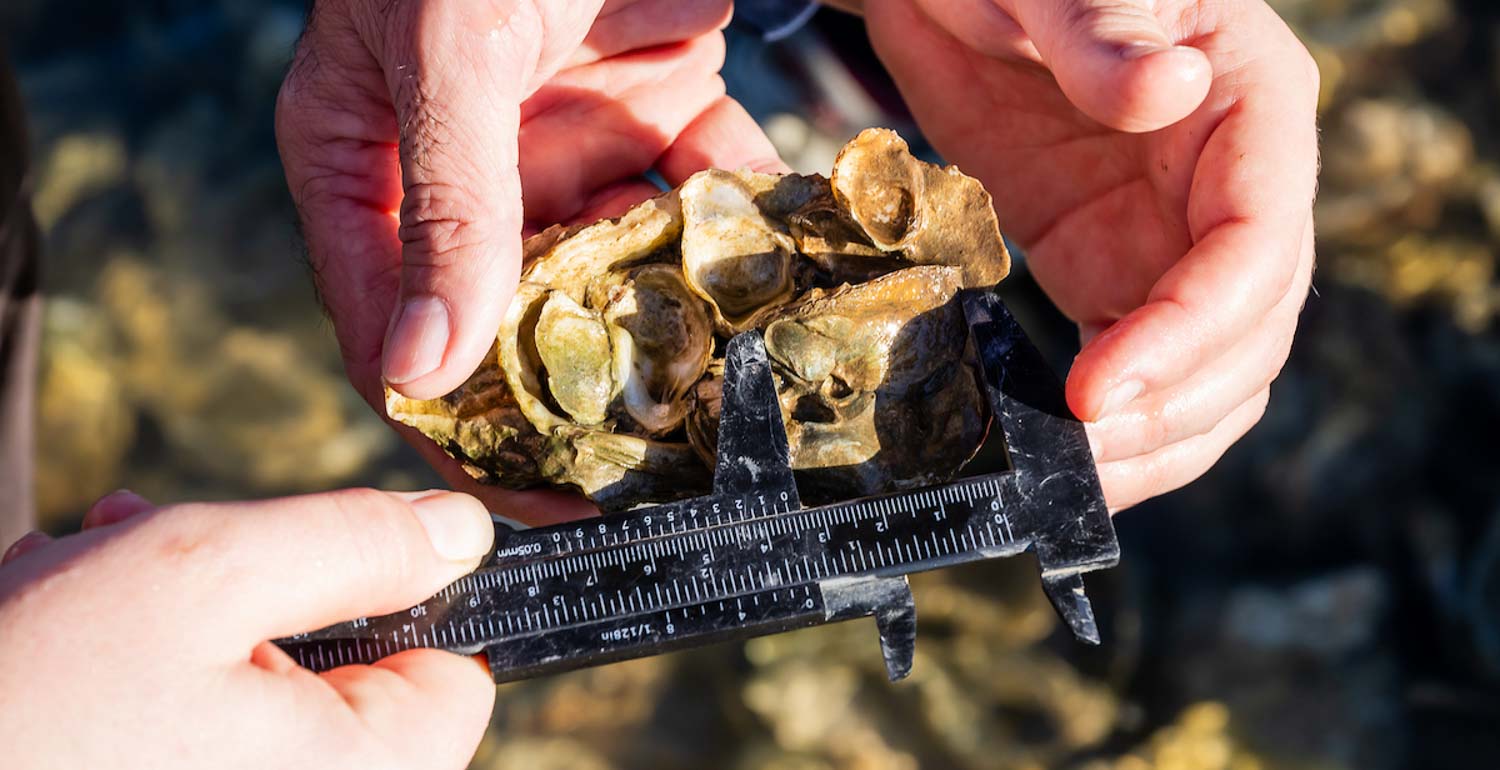
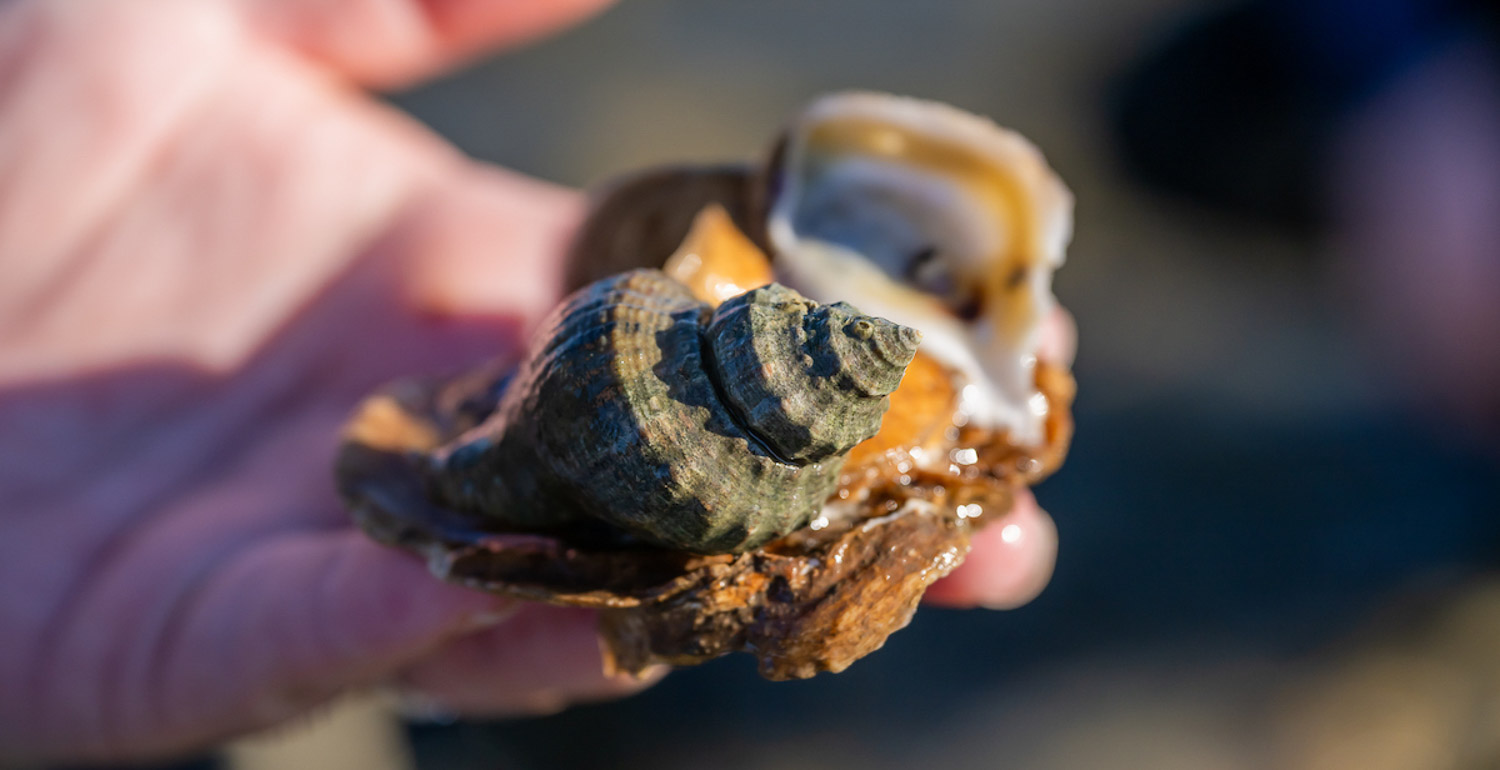
Spat (the term for oysters after they settle down) grow fast. Stationary targets for predators, they build their shells quickly by drawing minerals from the water. Blue crabs break open the shells. Oyster drills — snails an inch or two long — pry open the shells or scrape holes and suck out the meat. Sheepshead fish crush the shells.
When a wolf howls in the middle of the night, humans sacrifice their sleep to guard their livestock. Oysters can’t hear, but they can sense chemicals in the water. Smee and his colleagues guessed correctly that predator urine might work as a kind of chemical howl, stimulating a young oyster to expend extra energy on strengthening its shell at the expense of fast growth.
In tanks at the Dauphin Island Sea Lab, they exposed oysters to urine from crabs, drills and sheepshead, as well as chemicals released by oysters being crushed. They tried the substances singly and in combinations.
The oysters did indeed harden their shells, by varying amounts depending on the threat chemical. Did that actually help? To find out, the researchers transplanted the oysters to a test reef they’d built near Lightning Point in Bayou La Batre, Alabama, southwest of Mobile.
“After a year,” Smee says, “survivorship was up to 70% higher.” For a species that reproduces in the millions with minuscule survival rates, every percentage point helps. That drives Smee to continue his research.
“If you increase survival 1 or 2%, that’s potentially thousands of oysters,” he says. “And the difference between a reef that makes it and one that doesn’t is often a couple hundred to a few thousand individuals. So I think it could be super important.”
The Gulf’s Oyster Think Tank
South Alabama ranks among the top universities in the country for the study of oyster biology, ecology and fisheries. Five USA faculty members — Drs. Sean Powers, Ronald Baker, Ruth Carmichael, Steven Scyphers and Lee Smee — conduct research on topics including:
- Restoring wild fisheries for oysters and understanding the role of oyster reefs as habitat for finfish and crabs.
- Identifying contamination sources and water quality impairment and mitigating their negative impact on oyster reefs and oyster fisheries.
- Using nearshore oysters as natural breakwaters (living shorelines)
to mitigate coastal erosion.
In Her First Year, She's Giving Oysters a Start, Too
Two years ago, Lilli Moore’s dad, Michael, set up an oyster hatchery business for her: Biloxi Oyster Co. in downtown Biloxi, Mississippi.
Click here to view the current issue of South Magazine
-
The Art of Medicine
Dr. Jeffery S. La Rochelle, the new dean of the Frederick P. Whiddon C...
June 17, 2026 -

Base Camp
South to scale up support with new military services home....
June 17, 2026 -
Flagship Futures
One of the newest scholarship programs at the University of South Alab...
June 17, 2026 -

Estuary of Innovation
The Frederick P. Whiddon College of Medicine building, opening in spri...
June 17, 2026