
Burst Pulse
Burst pulse sounds are suggested to compose a majority of a dolphin’s vocal repertoire. That being said, there is still a lot of research needing to be done to better understand:
- what acoustic characteristics define a burst pulsed sounds?
- what contexts or behaviors are they associated with?
Burst pulse sounds are generally described as rapid click trains. These sounds have been observed during foraging and socializing behaviors.
Burst pulse sounds have been mentioned in cetacean research as far back as the 1940s. Over the decades, several subtypes of burst pulse sounds have been brought forward. As new information became published, some subtypes, like ones termed as “barks“, became obsolete and were no longer used as time progressed.
But as one term fades away, another comes in to take its place.
With significant advances in our technology, researchers are continuing to better define burst pulse sounds, and potential subtypes!
One such being the “Victory Squeal“
Scientists suggest this unique burst pulse represents a positive call, where dolphins may give a cheer when completing something successfully.
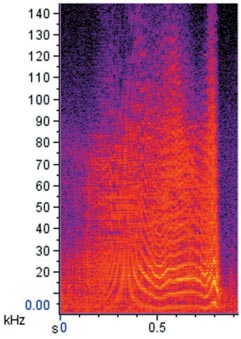
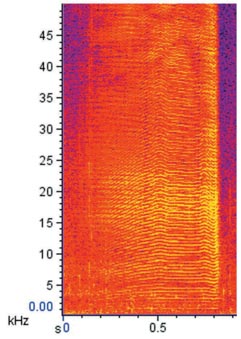
Here is a burst pulse signal. To the left, you see the full frequency range of the
sound. To the right, you see the same sound zoomed in with a range of 50 kHz.
Subtypes of Burst Pulse Sounds
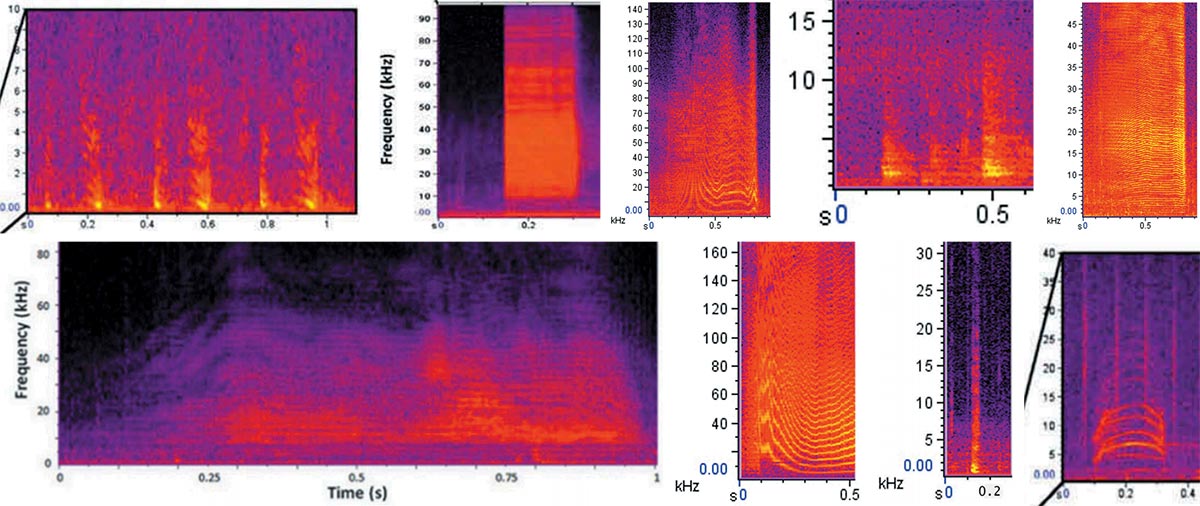 Spectrograms of different types of burst pulse signals. Top Row: (left to right) Gulp,
Grunt, Victory squeal. Bottom Row: (left to right) Thunk, Squawk type 1, Squawk type
2, Quack
Spectrograms of different types of burst pulse signals. Top Row: (left to right) Gulp,
Grunt, Victory squeal. Bottom Row: (left to right) Thunk, Squawk type 1, Squawk type
2, Quack
Burst pulse sounds are commonly named by how they may sound to the human ear. However, some scientists have begun to discuss this as a potential issue – bringing in bias and uncertainty.
If you note in the provided examples, there are two representations of a “squawk”, both having very different visual and sound characteristics. However, each scientist thought the sound heard was similar to what they thought a “squawk” sounded like.
As research continues, scientists hope to better understand burst pulse signals so that classification can become more consistent.