
USA researchers study mechanism behind gastric cancer metastasis
Posted on May 28, 2026 by Carol McPhail
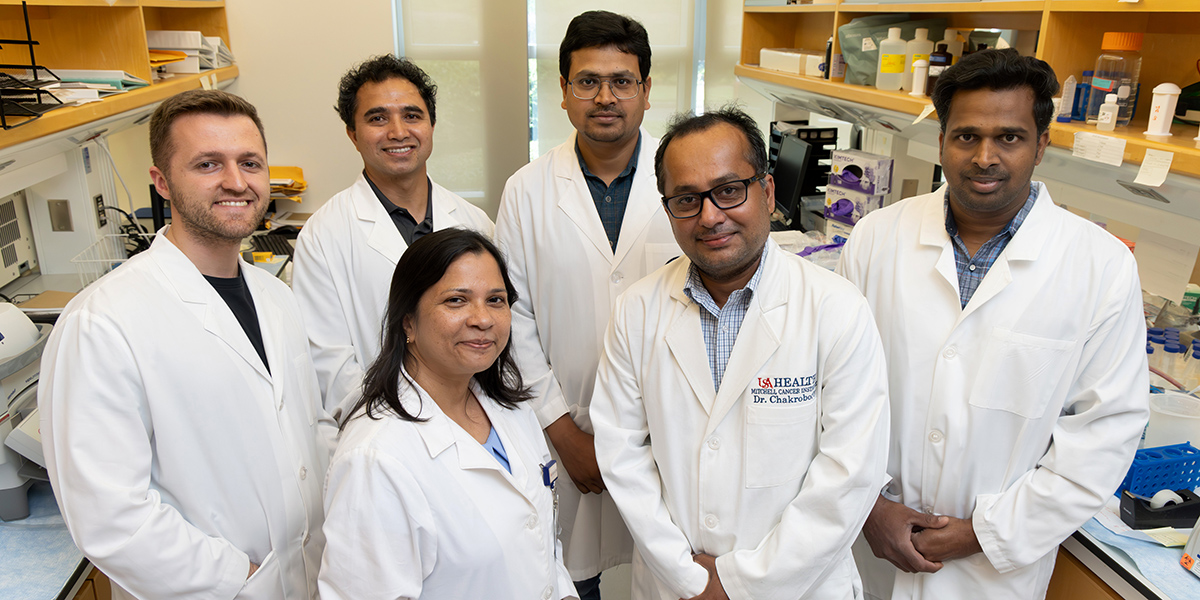
 Debanjan Chakroborty, Ph.D., left, a cancer researcher at the USA Health Mitchell
Cancer Institute and assistant professor of pathology at the Whiddon College of Medicine,
is shown with Sooraj Kakkat, Ph.D., a pathology postdoctoral fellow at MCI and lead
author of the paper published in Cancer Letters.
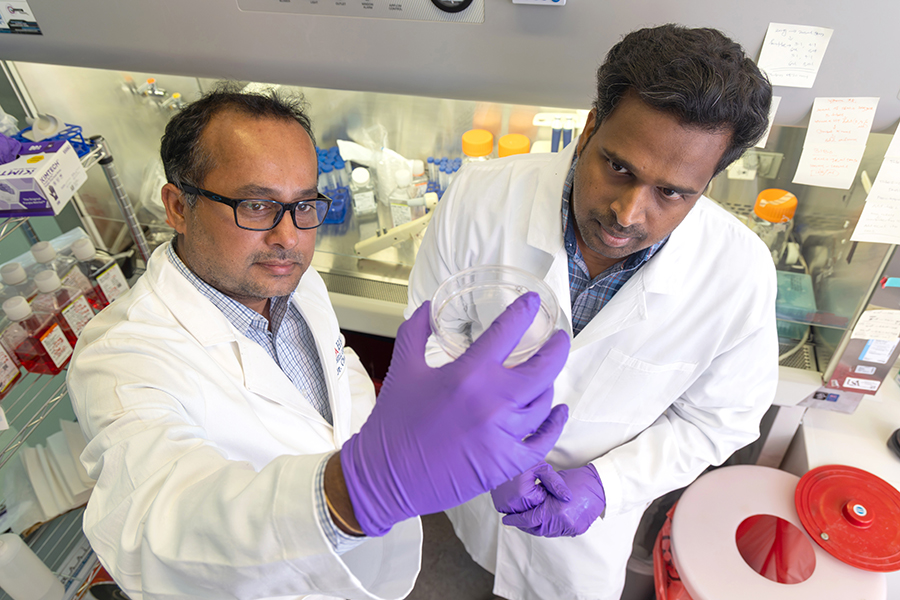
Debanjan Chakroborty, Ph.D., left, a cancer researcher at the USA Health Mitchell
Cancer Institute and assistant professor of pathology at the Whiddon College of Medicine,
is shown with Sooraj Kakkat, Ph.D., a pathology postdoctoral fellow at MCI and lead
author of the paper published in Cancer Letters.
Researchers at the Frederick P. Whiddon College of Medicine led a study to explore a mechanism that leads to the spread of gastric cancer, also known as stomach cancer.
The research, published recently in the scientific journal Cancer Letters, identifies a new molecular mechanism that explains how gastric cancer cells lose cell-to-cell adhesion and metastasize, or spread to other parts of the body.
The work was led by Debanjan Chakroborty, Ph.D., assistant professor of pathology at the Whiddon College of Medicine, and included other pathology faculty and researchers at the USA Health Mitchell Cancer Institute (MCI) and the Whiddon College of Medicine, as well as researchers at The Ohio State University. Sooraj Kakkat, Ph.D., is the lead author of the article.
Gastric cancer is one of the most prevalent malignancies and a leading cause of cancer-related deaths worldwide because it is often diagnosed at later stages, when there are fewer treatment options. It is estimated that more than 60% of gastric cancer patients are diagnosed when the cancer has already metastasized.
“The study reports the role of the stomach renin-angiotensin system (RAS) in gastric cancer progression and how blocking the function of this system with commonly used angiotensin blockers (used for lowering high blood pressure) prevents metastatic dissemination of gastric cancer cells,” said Chakroborty, who is a member of the Cancer Biology Program at MCI.
The renin-angiotensin system is typically known for controlling cardiovascular homeostasis and electrolyte balance in the body. Besides circulating in the body through hormones, components are also found in many tissues, where they help with tissue growth and maintenance.
Specifically, the researchers identified how cancer cells secrete angiotensin II, which suppresses the expression of key tight junction proteins and weakens cell-to-cell adhesion, enabling cancer cells to escape from their environment and metastasize. “Importantly, we show that blocking the angiotensin II type 1 receptor (AT1R) restores cell-to-cell attachment and helps prevent metastasis,” Chakroborty said.
Future research would aim to validate and refine the study’s approach using other gastric cancer models. Another goal would be to evaluate whether existing drugs used for treating high blood pressure could be repurposed safely for gastric cancer, either alone or combined with chemotherapy or immunotherapy, he said.
Other authors of the study include Prabhat Suman, Ph.D., Sandeep Goswami, Ph.D., Brusi Kola, Kira A. Bruno, Wendy L. Frankel, M.D., Sujit Basu, M.D., Ph.D., Elba A. Turbat-Herrera, M.D., Veronica Ramirez-Alcantara, Ph.D., Martin J. Heslin, M.D., Joel F. Andrews, Ph.D., Paramahansa Pramanik, Ph.D., and Chandrani Sarkar, Ph.D.
The research is supported by funding from U.S. Department of Defense and, in part, by Robert E. Reed Gastrointestinal Oncology Research Foundation and funding from the USA Health Mitchell Cancer Institute.
Read the full paper online: “Angiotensin II type 1 receptor blockade inhibits gastric cancer metastasis through tight junction restoration.”