
M3 Case Symposium highlights clinical learning and scholarly engagement
Posted on June 18, 2026 by Lindsay Hughes
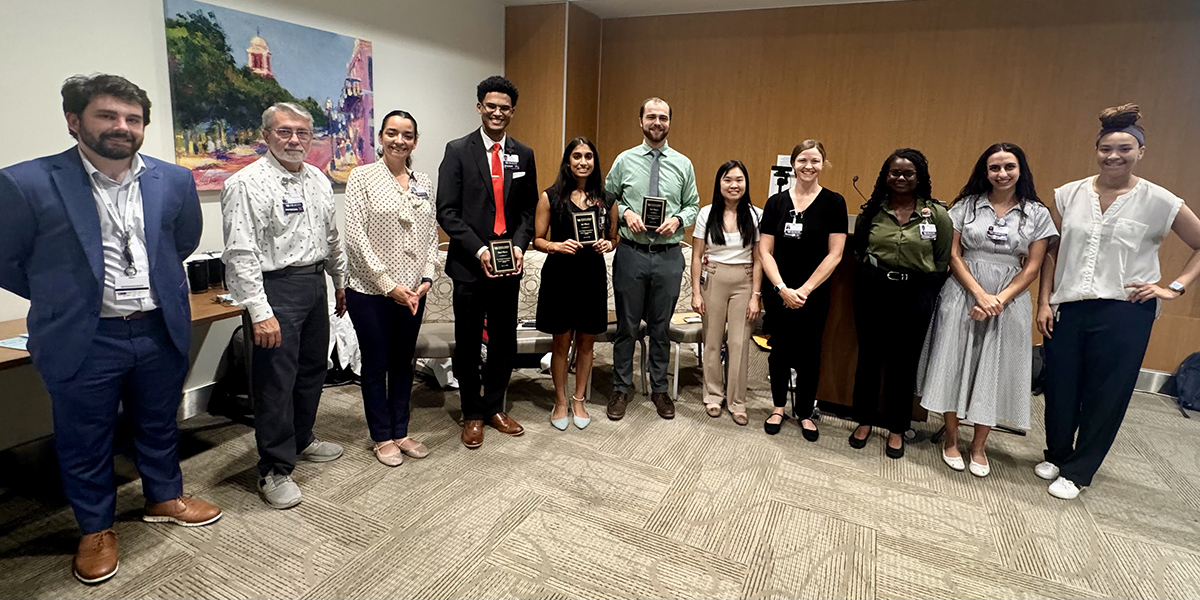
From rare genetic disorders to life-threatening cardiac emergencies, rising fourth-year medical students at the Whiddon College of Medicine recently showcased their clinical knowledge, analytical skills and scholarly engagement during the annual M3 Case Symposium held June 11 at the Strada Patient Care Center.
Hosted by the Student Assembly, the symposium featured poster presentations of unique and educational clinical cases the students encountered during their third-year clerkship rotations. A total of 55 posters were judged on originality, strength of conclusions, quality of references, overall appearance, organization and topic. The event reflected the growing engagement of medical students in clinical scholarship and research while providing opportunities to share experiences with faculty and classmates.
Among the presenters, Sachi Patel earned first place, Keegan Musaalo placed second, and James Pittman placed third.
Patel’s first-place case focused on a 40-year-old woman with mixed connective tissue disease whose symptoms initially suggested infection or a thromboembolic condition. Further evaluation revealed a large pericardial effusion with impending cardiac tamponade, requiring emergency surgical intervention.
“This case presented in the middle of the night while I was on my surgery rotation, and I found it very interesting because it was the largest pericardial effusion I had seen,” Patel said. “I also recognized that this was a diagnosis that could have been easily missed.”
Through the experience, Patel said she learned the importance of maintaining a broad differential diagnosis and recognizing that cardiac tamponade can be present before classic signs of shock develop.
“Preparing for this symposium required me to not only analyze and understand the case that I was presenting, but also focus on broader clinical objectives that could be applied to future patient care,” she said. “I am grateful for the opportunity that the Whiddon College of Medicine provides to gain experience in scholarly presentations.”
Musaalo’s second-place poster documented an exceptionally rare anatomical variant involving a duplicated cervix and normal uterus. The patient had previously experienced a pregnancy loss due to cervical insufficiency and later underwent placement of two cerclages during a subsequent pregnancy. Although both cerclages eventually failed, they prolonged the pregnancy to 22 weeks, allowing the fetus to reach the threshold of viability.
Musaalo said he chose the case because of the uniqueness of the patient’s anatomy and the unusual clinical course of her pregnancy.
“This case highlights the need for additional reporting of this anatomical variant to guide pregnancy management and demonstrates the potential utility of transvaginal cerclage in patients with complex cervical anatomy when transabdominal cerclage is not possible,” he said.
“I was blown away by the unique pathologies, uncommon disease courses and treatment modalities presented by my fellow classmates,” Musaalo added. “I am grateful to my mentor, Dr. Rajesh Paladugu, for the opportunity to present such a rare and educational case.”
Pittman’s third-place case examined a patient whose condition initially appeared to be vasculitis but was ultimately diagnosed as a rare genetic disease known as RVCL-S (retinal vasculopathy with cerebral leukoencephalopathy and systemic manifestations). The disorder affects small blood vessels and can cause blindness, strokes and multi-organ damage. There is currently no cure.
“I chose this case because it does well to highlight the need for collaboration among colleagues and thinking outside the box,” Pittman said. “I gained a greater appreciation for effective communication among healthcare professionals and the importance of reaching out to others for help when necessary.”
Charles Ogles, treasurer of the Student Assembly and one of the event organizers, said the symposium showcased the academic growth of the Class of 2027.
“It was great to see so many of our classmates present strong posters on clinical cases they encountered during their rotations,” Ogles said. “The symposium really highlighted the way our class is engaging with clinical research and using these experiences to grow beyond the day-to-day work of medical school.”
Ogles also emphasized the value of faculty mentorship and feedback throughout the event.
“Having the opportunity to present our work and receive feedback in that setting is incredibly valuable,” he said. “A lot went into making the symposium run smoothly, and I think it reflected well on our class and the kind of academic culture we are continuing to build.”
Josephine Jalkh, secretary of the Student Assembly and one of symposium organizers, said the event provided students with experiences that will continue to benefit them throughout their medical careers.
“We are extremely proud of our third-year medical students and their impressive posters at our 2026 M3 Case Symposium,” Jalkh said. “The skills and experience they gained from this event will continue to benefit them as they move toward residency, as research is the backbone of medicine.”
Serving as judges at the symposium were Haley Ballard, M.D., associate professor of internal medicine and residency program director; Samuel McQuiston, M.D., professor of radiology and vice chair of quality and safety; Maria Renee Roca Garcia, M.D., associate professor of pediatrics; and Supatida Tengsupakul, M.D., associate professor of pediatrics.
View more photos from the M3 Case Symposium on Flickr.