
USA researchers explore unexpected link between Alzheimer's protein and urinary tract infections
Posted on June 11, 2026 by Lindsay Hughes
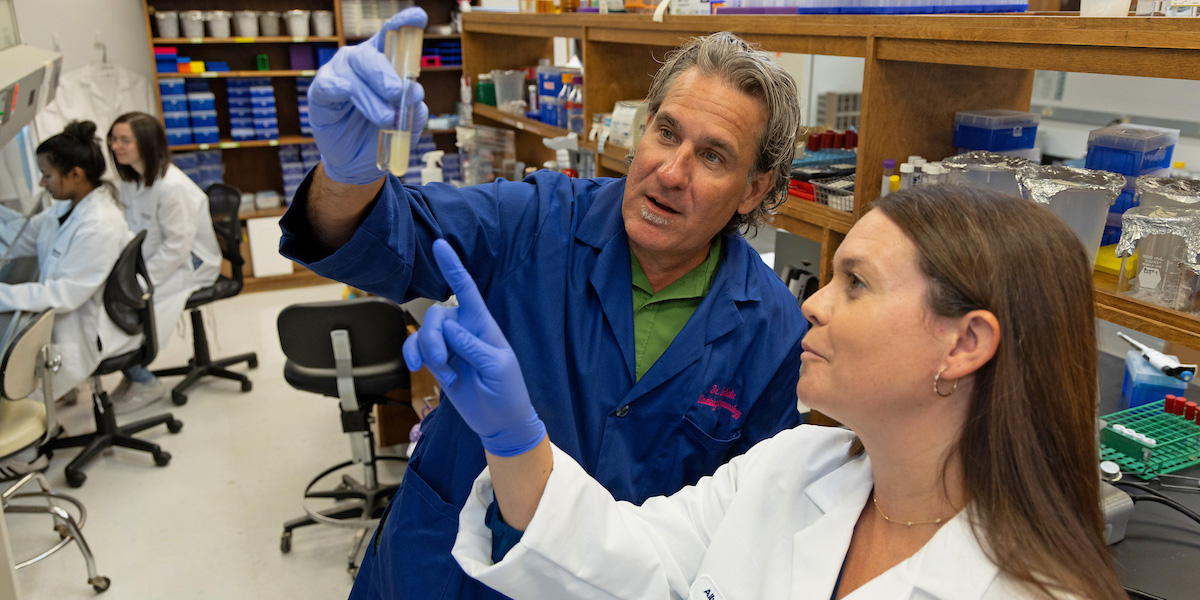
A protein best known for its role in Alzheimer's disease may also help explain why some urinary tract infections become life-threatening, according to new research underway at the University of South Alabama.
Scientists at the Frederick P. Whiddon College of Medicine are investigating whether amyloid-beta (Aβ), a protein long associated with Alzheimer's disease, contributes to kidney damage during urinary tract infections (UTIs). Allyson Shea, Ph.D., assistant professor of microbiology and immunology, and Jonathon Audia, Ph.D., professor of microbiology and immunology, are leading the project with support from a two-year, $429,000 R21 grant awarded by the National Institute of Allergy and Infectious Diseases.
The project builds on earlier findings from Audia's laboratory, which revealed elevated levels of Aβ in intensive care unit (ICU) patients with sepsis. Researchers found that patients with sepsis had significantly higher levels of the protein in their blood than ICU patients without infection, and those levels were associated with organ injury. Aβ levels also continued to rise during the first week of hospitalization.
“These findings suggest that Aβ could potentially serve as an early marker of infection severity and subsequent organ dysfunction,” Shea said.
The discoveries raised a new question: Does Aβ increase only in critically ill patients, or could it also be involved in more common infections that begin outside the hospital?
That question led Audia and Shea to join forces.
“Our ICU study prompted us to ask whether Aβ was also elevated in response to infections that do not require hospitalization or supportive care,” Audia said. “Dr. Shea's work with UTIs seemed like the perfect fit, and the collaboration was borne out of this intellectual curiosity.”
Urinary tract infections are among the most common bacterial infections worldwide. Although many can be treated successfully with antibiotics, severe infections can spread to the kidneys and bloodstream, leading to life-threatening complications such as urosepsis.
Scientists have traditionally viewed kidney damage during severe UTIs as a consequence of bacterial infection and the body's immune cell response. However, preliminary findings from the researchers suggest Aβ may also play a role.
In models of UTI, researchers observed that Aβ accumulated in the kidneys, with higher levels associated with greater bacterial burden. The findings add to growing evidence that Aβ may function as part of the body's innate immune response.
“We hypothesize that Aβ may initially function as an antimicrobial or immune-protective molecule during infection,” Shea said. “However, if production becomes excessive, prolonged or occurs in the setting of severe inflammation, Aβ may contribute to tissue injury and organ dysfunction.”
Audia said the body's ability to turn off that response after an infection is controlled may be key.
“There are many examples in medicine where a problem is caused by an inability to appropriately contract an inflammatory response,” he said. “If Aβ levels stay chronically high long after the infection is resolved, it may contribute to inflammatory damage over time in the kidney or even in other organ systems.”
Understanding when Aβ shifts from protective to harmful could significantly change how scientists think about kidney injury associated with severe UTIs and sepsis.
“Our work suggests that Aβ may accumulate in the kidney and contribute to tissue injury and altered renal function during infection,” Shea said. “Understanding this process could improve our view of how host responses contribute to disease severity and organ dysfunction.”
If researchers can determine when that shift occurs, the findings could eventually open new avenues for treatment. Several FDA-approved therapies already target Aβ in patients with Alzheimer's disease. If the protein is found to contribute to tissue damage during severe infections, similar approaches could someday be explored to reduce kidney injury and improve outcomes for patients with kidney infections or urosepsis.
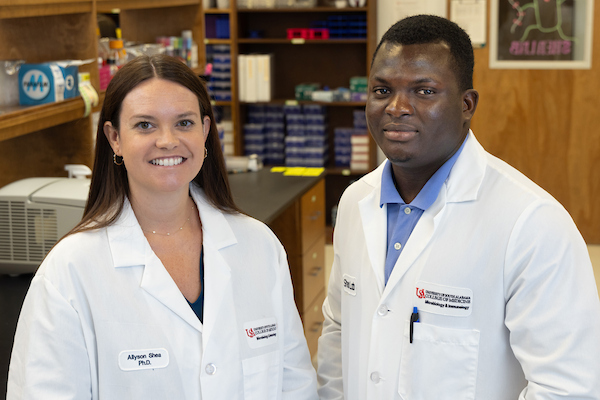 Dr. Allyson Shea and third-year Ph.D. student Oluwagbenro Adesunloro
For now, the researchers emphasize that the work is still in its early stages.
“There is still a lot we do not know about the role of Aβ during infection,” Shea said. “The goal is not to define Aβ as purely harmful or purely protective, but rather to understand when and how it plays a role during infection.”
Ultimately, that knowledge could help researchers identify high-risk patients earlier, better predict outcomes, and develop more targeted treatments for severe infections.
The team recently published a minireview related to the project in the American Society for Microbiology’s Infection and Immunity journal. The article, “Pathological or Preventative? Amyloid-β as an Effector of Innate Immunity,” is part of the journal’s New Voices in Microbiology series, which highlights early-stage investigators. Oluwagbenro Adesunloro, a third-year Ph.D. student in the Basic Medical Sciences Graduate Program at the Whiddon College of Medicine, is the first author; and Audia is a co-author.