
Class of 2026 honored at annual Academic Hooding Ceremony
Posted on May 7, 2026 by Lindsay Hughes
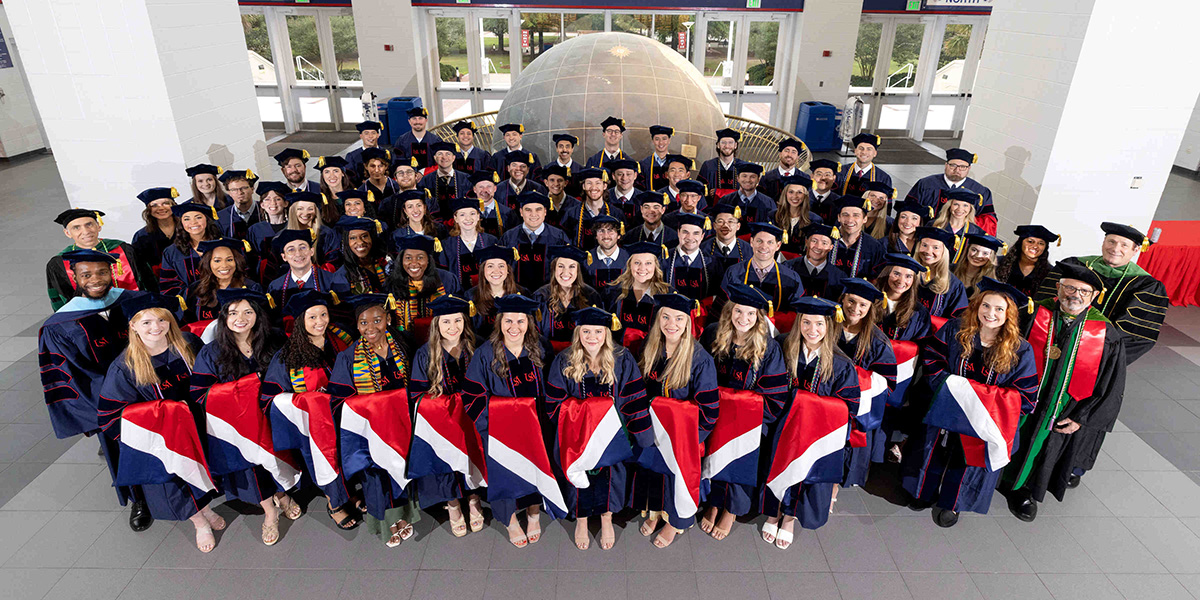
In true Mobile fashion, rain poured outside the USA Mitchell Center on Thursday morning. But inside, pride and celebration filled the arena as the Frederick P. Whiddon College of Medicine honored the Class of 2026 at its annual Academic Hooding Ceremony.
Seventy-two graduating medical students were hooded by mentors, family members and loved ones before reciting the Hippocratic Oath. Graduates with military affiliations also took the oath of office and received their new ranks. Two students from the Basic Medical Sciences Graduate Program received doctoral hoods from their major professors.
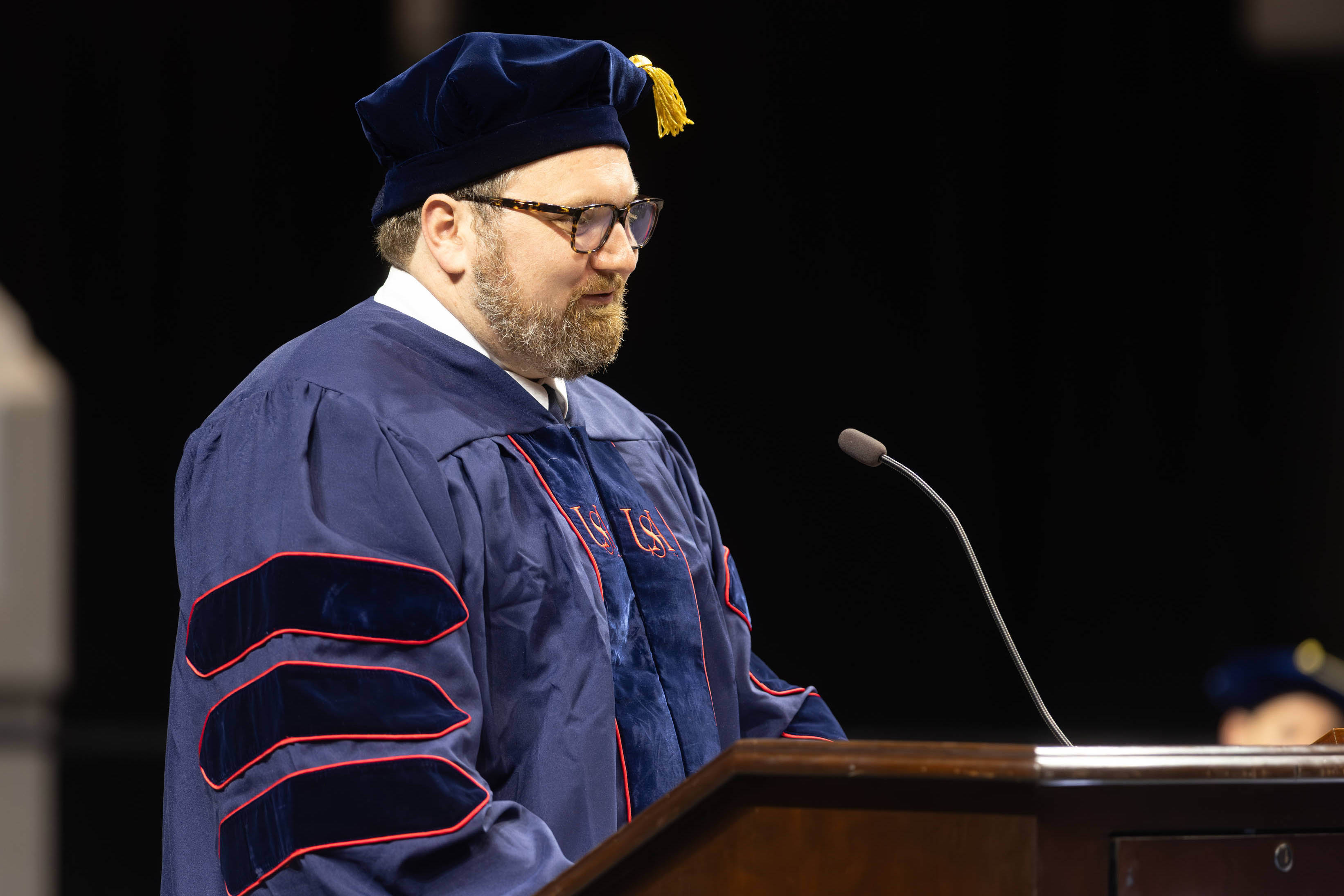
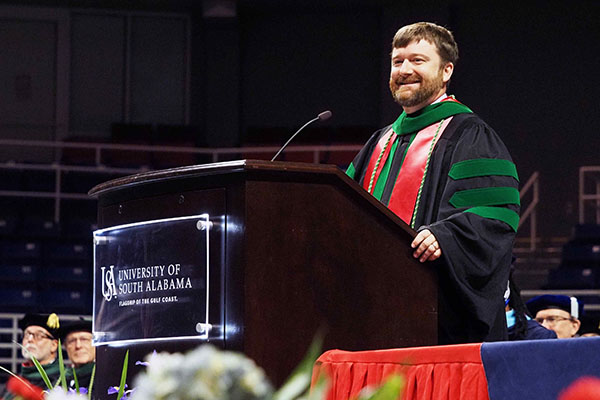 The Class of 2026 selected Caleb Butts, M.D., an associate professor of surgery and
a trauma and burn surgeon at USA Health, as the faculty member to address the class.
An alumnus of the Whiddon College of Medicine, he joined the faculty in 2019 and has
served as surgery clerkship director for the past six years.
The Class of 2026 selected Caleb Butts, M.D., an associate professor of surgery and
a trauma and burn surgeon at USA Health, as the faculty member to address the class.
An alumnus of the Whiddon College of Medicine, he joined the faculty in 2019 and has
served as surgery clerkship director for the past six years.
Butts compared medical training to an experiment in which trees grown in a controlled biosphere collapsed without wind resistance.
“In the real world, wind stresses trees. It forces them to grow deeper roots and stronger trunks. Without that stress, they never develop the strength to support themselves,” Butts said. “We are no different. Adversity is what forces us to grow. In medicine, you will feel that pressure, criticism, long hours and uncertainty. But that pressure is not something to avoid; it is something that shapes you.”
The message of resilience carried into remarks from student leaders representing both the medical and graduate programs.
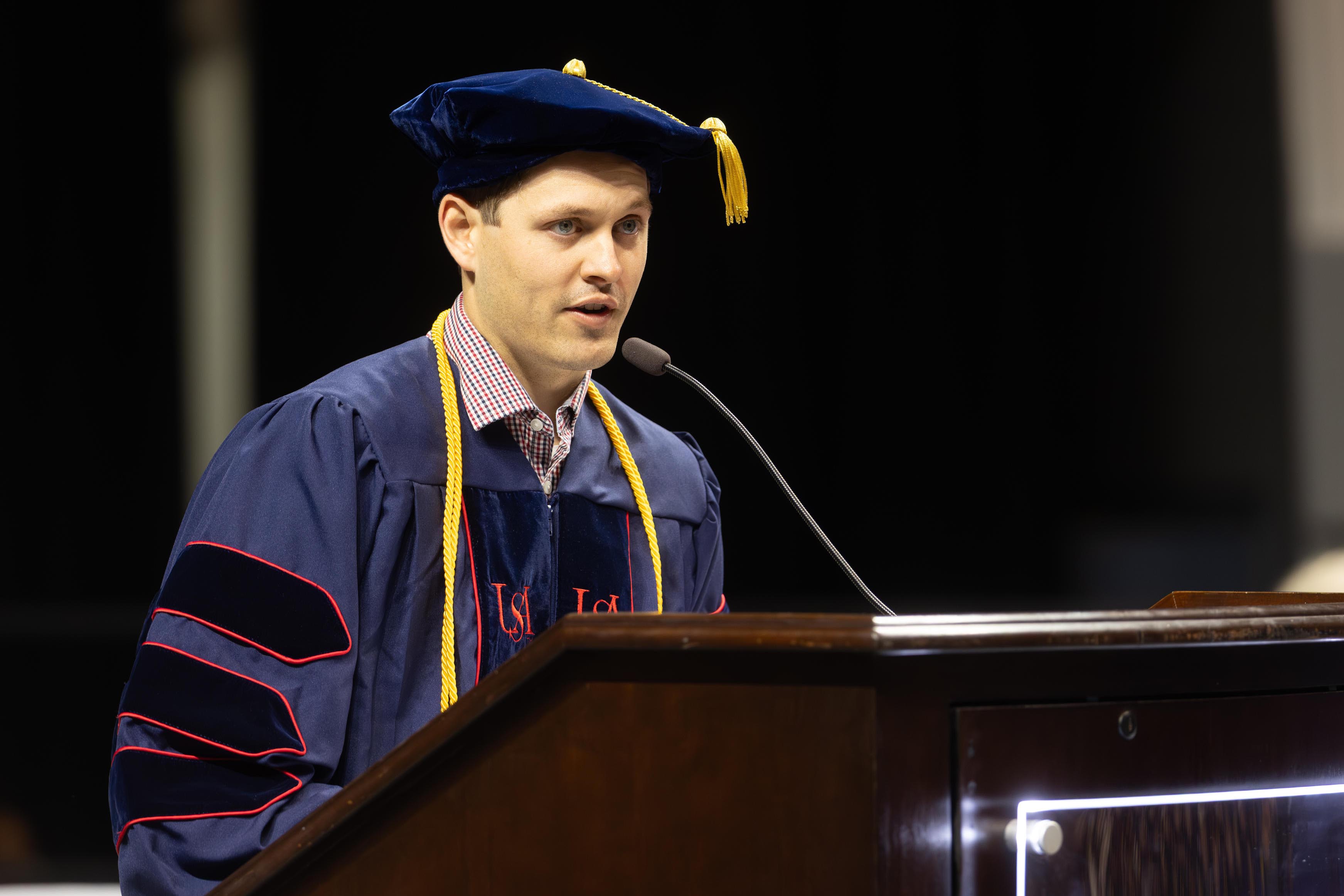 Thomas Robinson, president of the Class of 2026, was chosen to speak on behalf of
his class. He will pursue residency in general surgery at the University of Texas
Southwestern Medical Center in Dallas.
Thomas Robinson, president of the Class of 2026, was chosen to speak on behalf of
his class. He will pursue residency in general surgery at the University of Texas
Southwestern Medical Center in Dallas.
Robinson encouraged classmates to carry forward the camaraderie they built at South.
“We have become a family supporting each other through the highs and lows, and this unity has been our greatest strength, transforming an already above-average group of individuals into an extraordinary team of new physicians,” Robinson said.
“The path ahead, at times, will seem daunting, and the exhaustion we will face will definitely be unrelenting,” he said. “However, let us remember the strength and resiliency we built here at South with each other. Continue being the leaders I’ve seen you all become, creating that camaraderie and support with every team throughout your careers.”
The ceremony also recognized longtime faculty leadership and mentorship.
Robert Barrington, Ph.D., director of the Office of Research, Education and Training, introduced Mark Gillespie, Ph.D., professor of pharmacology. During his tenure, Gillespie has published more than 165 scientific papers, secured more than $35 million in extramural funding, and mentored countless students.
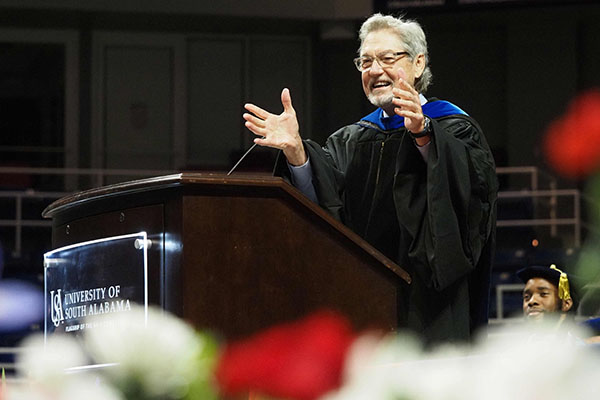 “For our graduates today, Dr. Gillespie’s career is a powerful example of what it
means to stay curious, to engage deeply, and to contribute meaningfully to science
and medicine,” Barrington said.
“For our graduates today, Dr. Gillespie’s career is a powerful example of what it
means to stay curious, to engage deeply, and to contribute meaningfully to science
and medicine,” Barrington said.
Gillespie reflected on more than four decades devoted to research, education and mentorship.
“I’ve loved my scientific career,” Gillespie said. “The discoveries are wonderful, and the failures you can tolerate. But what made everything worthwhile is right here.”
In an age of rapid technological advances in artificial intelligence, Gillespie challenged graduates to pair scientific innovation with compassion and integrity.
“We are the arbiters of truth,” he said. “AI can manage and distill information in ways no human can. But it cannot bear moral responsibility.”
“So, for providers, you are going to have to translate AI into humane care,” he continued. “For scientists, you are going to have to ensure that discovery is rigorous. Collectively, it’s up to us to prove to our patients, to our constituents, that innovation can be believed, that there is truth in science and medicine. Have faith in what we do during this period of rapid change.”
 Grant Daly was selected to represent the candidates in the Basic Medical Sciences
Graduate Program. After completing Ph.D. research in trauma and critical care, he
pursued postdoctoral research with Gillespie. In June, he will begin a postdoctoral
fellowship in the Johns Hopkins University Division of Pulmonary and Critical Care
Medicine.
Grant Daly was selected to represent the candidates in the Basic Medical Sciences
Graduate Program. After completing Ph.D. research in trauma and critical care, he
pursued postdoctoral research with Gillespie. In June, he will begin a postdoctoral
fellowship in the Johns Hopkins University Division of Pulmonary and Critical Care
Medicine.
“I was drawn to this field,” he said, “because I think even small improvements to care can have an outsized impact on long-term patient quality of life.”
Some of Daly’s favorite moments in the graduate program, he noted, involved mentoring medical students in the Summer Research Program and watching them connect patient stories to the data.
“When we reviewed patient records, they saw the patient beyond just the numbers on the spreadsheet,” he said. “I know you all will bring that same passion to your future.”
Daly added, “South Alabama calls itself the Flagship of the Gulf Coast, and I think this motto is particularly fitting for our medical school and health system.”
During the ceremony, faculty were recognized for receiving Red Sash Awards and the following honors:
- Best Pre-Clerkship Module: Respiratory (Troy Stevens, Ph.D., and Brian Fouty, M.D.)
- Best Pre-Clerkship Educator: Brian Fouty, M.D.
- Best M3 Clerkship: Pediatrics (Benjamin Estrada, M.D., and Frederick Rowell, M.D.)
- Best Clerkship Educator: Anna Foust, M.D.
Watch the recorded live stream of the full ceremony on YouTube.