
USA study sheds light on immune response behind lung damage in rare disorder
Posted on March 24, 2026 by Lindsay Hughes
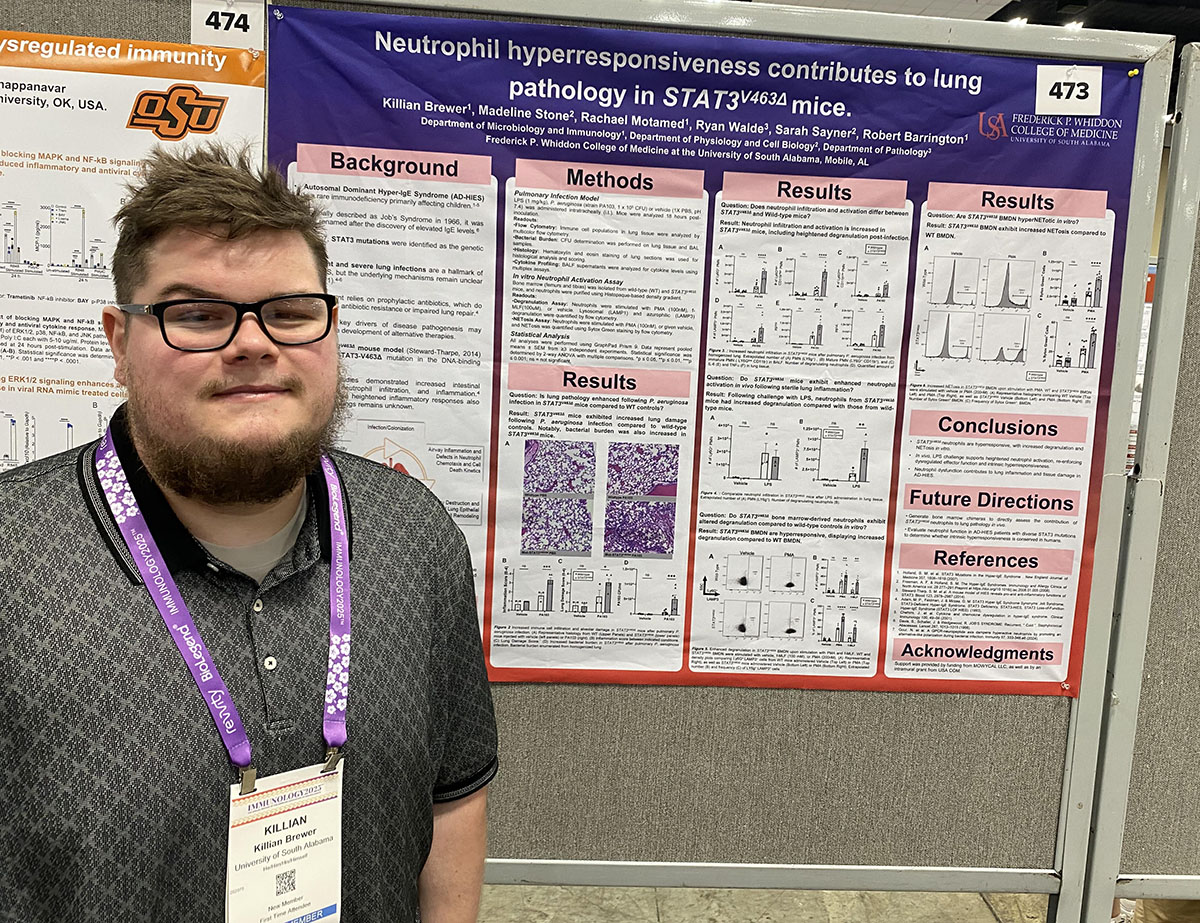 Researchers at the University of South Alabama Frederick P. Whiddon College of Medicine
have uncovered new clues about why patients with Autosomal Dominant Hyper‑IgE Syndrome
(AD-HIES) often experience severe lung complications.
Researchers at the University of South Alabama Frederick P. Whiddon College of Medicine
have uncovered new clues about why patients with Autosomal Dominant Hyper‑IgE Syndrome
(AD-HIES) often experience severe lung complications.
In a study published in The Journal of Immunology, scientists found that the body’s own immune cells can become hyper-responsive, damaging lung tissue while attempting to fight infection. The research, led by Robert Barrington, Ph.D., professor of microbiology and immunology, focused on neutrophils, white blood cells that act as one of the immune system’s first responders.
“We believe the fundamental observation from this study has implications for how we think about lung pathologies associated with poor outcomes in this pediatric condition,” Barrington said.
AD-HIES, also known as Job syndrome, is a rare immune disorder most commonly caused by mutations in the STAT3 gene. Patients frequently experience recurrent infections and chronic inflammation, particularly affecting the lungs and skin.
To better understand why these complications occur, researchers studied a model harboring the same genetic mutation associated with the disorder in human patients. After lung infections, significantly greater inflammation and lung damage was observed compared to controls, along with higher bacterial levels.
The team traced the problem to neutrophils, which rushed into the lungs in large numbers and became unusually aggressive. Instead of responding in a tightly controlled way, the cells released excessive inflammatory mediators and antimicrobial components.
“While neutrophils are essential for controlling bacteria, this exaggerated response can damage lung tissue and contribute to the severe pulmonary pathology seen in the disease,” said Killian Brewer, Ph.D., the study’s lead author and a recent graduate of the Basic Medical Sciences Graduate Program.
Researchers also discovered that the cells behaved this way even when inflammation was triggered without bacteria present. That finding suggests the abnormal response is built into the immune cells themselves rather than being driven solely by infection.
The results offer new insight into why patients with Job syndrome develop severe lung complications and could help guide future therapies. The study suggests that lung disease in the condition may stem not only from infections but also from dysregulated immune responses.
“By identifying neutrophil hyperresponsiveness as a contributor to lung pathology, the study highlights the potential value of therapeutic approaches that limit excessive neutrophil activation or inflammatory signaling while still preserving host defense,” Brewer said.
More broadly, the work illustrates a central challenge of the immune system: maintaining the balance between protection and harm.
“One of the broader lessons from this work is that pathology often emerges not from the absence of immunity but from its misdirection,” Brewer said. “The immune system operates in a narrow window between protection and damage, and understanding how genetic changes alter that balance is key to explaining why immune disorders produce such diverse clinical outcomes.”
Much of the research was conducted by Brewer during his doctoral training in Barrington’s laboratory. Based on the strength of the study, Brewer was recruited to continue his research as a postdoctoral fellow at Vanderbilt University Medical Center.
In his new role in rheumatology and immunology, Brewer’s work focuses on immune regulation by small RNAs, from both bacteria and host cells, and how these regulatory pathways influence immune responses in autoimmune diseases such as lupus and rheumatoid arthritis.
Brewer said the training he received at the Whiddon College of Medicine helped prepare him for the transition to a more translational research environment that includes analyzing patient-derived samples.
“Working in Dr. Barrington’s lab was instrumental in preparing me for this transition,” he said. “His mentorship emphasized rigorous experimental design and mechanistic thinking about how immune responses drive disease.”
“Killian demonstrated exceptional scientific rigor, creativity, and independence in leading this study from conception through execution," Barrington said. "His work involved a comprehensive set of in vivo and ex vivo experiments, integrating complex immunological approaches to uncover a fundamentally new insight into AD-HIES pathogenesis. Notably, his work helped establish that neutrophils are not merely passive responders during infection, but active drivers of lung damage. Killian’s ability to synthesize mechanistic findings into a clear and impactful narrative reflects a high level of scientific maturity and positions him as a promising emerging investigator.”
 Additional authors on the study include Madeline Stone, a student in the Basic Medical
Sciences Graduate Program; Rachael L. Motamed, M.D., a 2025 alumna who graduated with
research honors; Ryan Walde, M.D., a surgical pathology fellow at Vanderbilt who completed
his residency training at USA Health; Domenico Spadafora, Ph.D., manager of the Flow
Cytometry Shared Resource Laboratory; and faculty members Jonathon P. Audia, Ph.D.,
professor of microbiology and immunology, and Sarah Sayner, Ph.D., professor of physiology
and cell biology.
Additional authors on the study include Madeline Stone, a student in the Basic Medical
Sciences Graduate Program; Rachael L. Motamed, M.D., a 2025 alumna who graduated with
research honors; Ryan Walde, M.D., a surgical pathology fellow at Vanderbilt who completed
his residency training at USA Health; Domenico Spadafora, Ph.D., manager of the Flow
Cytometry Shared Resource Laboratory; and faculty members Jonathon P. Audia, Ph.D.,
professor of microbiology and immunology, and Sarah Sayner, Ph.D., professor of physiology
and cell biology.
Read the full article, “Neutrophil hyperresponsiveness contributes to lung pathology in STAT3 mice,” in The Journal of Immunology.