
Barrington presents invited lecture on rare lung disease research
Posted on May 12, 2026 by Lindsay Hughes
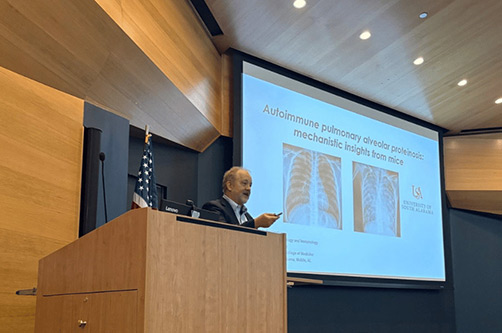 Robert A. Barrington, Ph.D., an associate professor of microbiology and immunology
and director of the Office of Research Education and Training at the Whiddon College
of Medicine, recently served as an invited speaker at Adventures in Molecular Immunology,
a symposium hosted by Loyola University Chicago’s Center for Translational Research
and Education.
Robert A. Barrington, Ph.D., an associate professor of microbiology and immunology
and director of the Office of Research Education and Training at the Whiddon College
of Medicine, recently served as an invited speaker at Adventures in Molecular Immunology,
a symposium hosted by Loyola University Chicago’s Center for Translational Research
and Education.
Barrington was one of 12 invited speakers featured during the two-day conference, which highlighted a broad range of immunology research topics, including wound healing, cancer metabolism and immune cell development.
The symposium also celebrated the career of Katherine L. Knight, Ph.D., longtime chair of Loyola’s Department of Microbiology and Immunology and Barrington’s Ph.D. mentor. “Katherine skillfully balanced steady guidance with intellectual freedom, and she graciously continued to mentor me throughout my career,” he said.
Barrington’s presentation focused on his laboratory’s research into autoimmune pulmonary alveolar proteinosis, or aPAP, a rare and potentially fatal lung disease. The condition occurs when the immune system produces antibodies that interfere with alveolar macrophages, specialized immune cells responsible for clearing surfactant from the lungs.
As surfactant accumulates in the lungs, patients can develop severe breathing problems because oxygen exchange becomes impaired. Current treatment often requires whole lung lavage, an invasive procedure in which the lungs are washed to remove excess surfactant buildup.
A major obstacle in aPAP research has been the lack of effective preclinical models. “Our work has helped establish a novel model that allows us to study the immune pathways responsible for producing these harmful antibodies,” Barrington said
Using the model, Barrington’s team has identified new immune mechanisms that may contribute to the disease process. Researchers are now working to determine whether those findings apply to patients, which could eventually lead to new treatment strategies.
The research reflects Barrington’s broader focus on rare diseases, an area of growing global concern. Although each individual rare disease affects a relatively small number of people, rare diseases collectively impact nearly 10% of the world’s population, an estimated 475 million people. Despite advances in identifying genetic causes for many rare conditions, patients often face years-long delays in diagnosis, and effective treatments remain limited.
“My lab focuses on rare disease research with the goal of discovering new insights that can contribute to effective therapeutic strategies for patients,” Barrington said.