
Med student presents award-winning case on pregnancy-related neurological disorder
Posted on May 12, 2026 by Lindsay Hughes
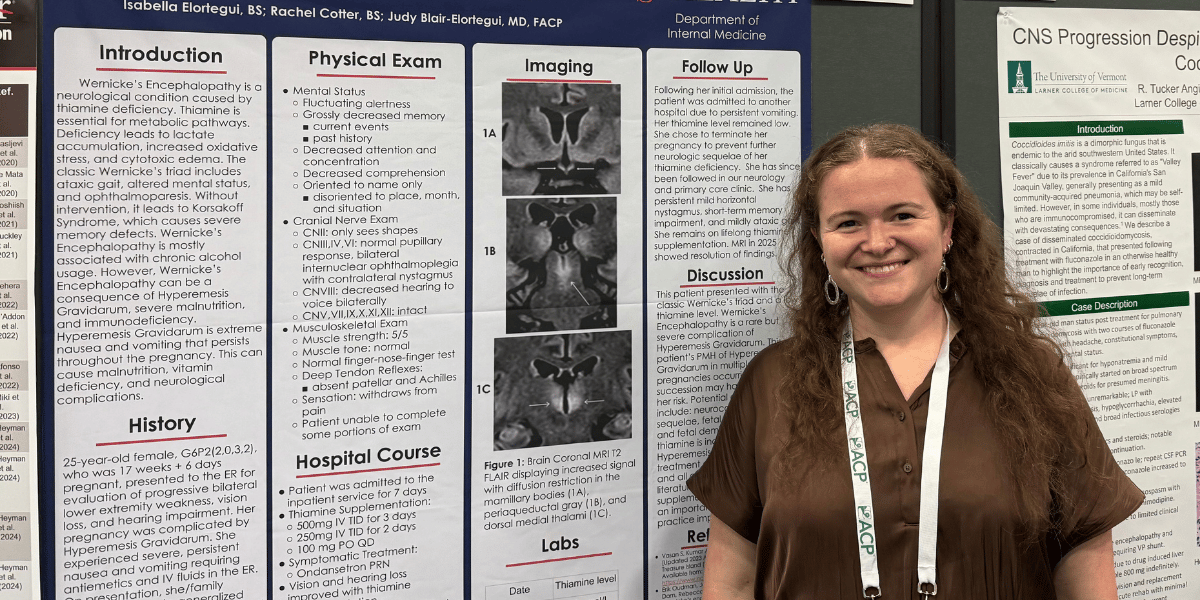 Second-year medical student Isabella Elortegui represented the Frederick P. Whiddon
College of Medicine on a national stage this spring, earning top honors at the American
College of Physicians’ Internal Medicine Meeting 2026 for a clinical case study highlighting
a rare neurological complication of pregnancy.
Second-year medical student Isabella Elortegui represented the Frederick P. Whiddon
College of Medicine on a national stage this spring, earning top honors at the American
College of Physicians’ Internal Medicine Meeting 2026 for a clinical case study highlighting
a rare neurological complication of pregnancy.
Elortegui won the medical student section for clinical vignettes during the conference, held April 18 in San Francisco, for her presentation titled “Wernicke’s Encephalopathy Secondary to Hyperemesis Gravidarum.”
She examined the case of a 25-year-old pregnant patient who developed Wernicke’s encephalopathy, a severe neurological disorder caused by thiamine (vitamin B1) deficiency. The condition is most commonly associated with chronic alcoholism and is rarely seen in nonalcoholic patients.
The patient, who was nearly 18 weeks pregnant, was transferred from a rural hospital after experiencing progressive lower extremity weakness, vision and hearing loss, and visual hallucinations. Physicians later confirmed Wernicke’s encephalopathy through laboratory testing and MRI findings.
“She had the classic triad of symptoms associated with Wernicke’s encephalopathy,” Elortegui said, including gait problems, altered mental status and eye movement abnormalities.
The patient initially improved after receiving thiamine supplementation and was discharged after seven days. However, her neurological symptoms later worsened despite continued treatment. To prevent further neurological damage, she ultimately decided to terminate the pregnancy. She continues to experience lasting short-term memory, gait and vision complications and remains on lifelong thiamine supplementation.
Hyperemesis gravidarum, a severe form of nausea and vomiting during pregnancy, affects about 3% of pregnancies and can lead to significant nutritional deficiencies if left untreated.
Elortegui said the case underscores the importance of recognizing nutritional deficiencies in pregnant and malnourished patients, particularly in areas with limited access to obstetric care.
“Internal medicine, family medicine and emergency medicine physicians are increasingly encountering obstetric patients, especially in rural communities where OB care may be limited,” she said. “This case highlights why physicians outside of obstetrics need to consider thiamine supplementation early to help prevent the development of Wernicke’s encephalopathy.”
Elortegui said she was honored to present the work at a national conference.
“I was really excited for the opportunity to present research and to shine a light on our unique patient population,” she said. “It is such an honor to win the medical student poster competition and showcase the hard work we do on the Gulf Coast.”
The conference also carried personal significance for Elortegui, who attended and presented alongside her mother, Judy Blair-Elortegui, M.D., associate dean for graduate medical education at the Whiddon College of Medicine.
“Attending with my mom was such a cool and unique experience,” she said. “Being able to talk with physicians and other healthcare professionals about this area of practice improvement and hopefully help prevent Wernicke’s in future pregnant patients was incredibly rewarding.”
Elortegui credited T.J. Hundley, M.D., associate dean for medical education; Anna Foust, M.D., assistant professor of internal medicine and pediatrics; and Blair for their guidance and support in preparing for the conference.