
Connecting the curriculum: M.D. program review strengthens physician training
Posted on April 9, 2026 by Lindsay Hughes
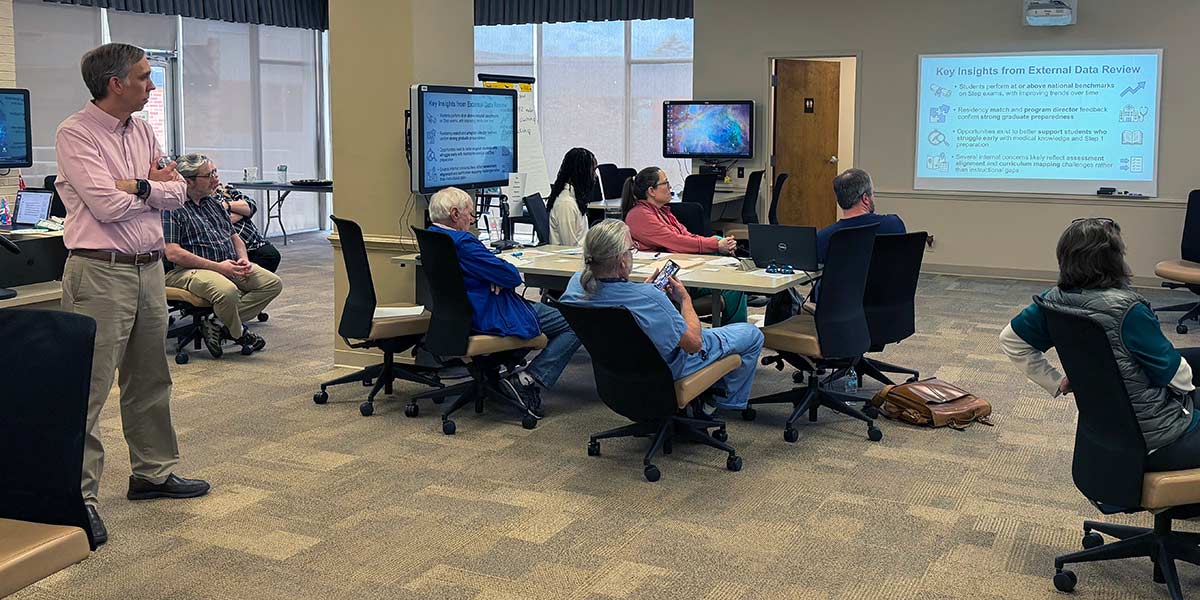
 Educators from across the Whiddon College of Medicine recently came together to explore
a big-picture question: How well is the college preparing tomorrow’s physicians?
Educators from across the Whiddon College of Medicine recently came together to explore
a big-picture question: How well is the college preparing tomorrow’s physicians?
Throughout medical school, each stage of the four-year curriculum builds on the previous one to create a seamless learning experience. To support that progression, faculty and staff conducted a comprehensive review of the Doctor of Medicine program to ensure it prepares graduates for the challenges of residency.
The session brought together course directors, clerkship directors, faculty from both the pre-clerkship and clerkship phases, and staff from the Division of Medical Education and the Office of Accreditation and Planning. The effort was strengthened by collaboration with the University’s Office of Institutional Effectiveness, with Julie Estis, Ph.D., associate vice president of institutional effectiveness, co-facilitating part of the session.
Using interactive dashboards, the group analyzed a wide range of data to assess how effectively the curriculum supports student learning and the achievement of program objectives.
“It is important to review the entire medical education program to ensure that we are equipping students with the necessary knowledge, skills and behaviors to be prepared for graduate medical education training and serve their communities,” said T.J. Hundley, M.D., associate dean for medical education.
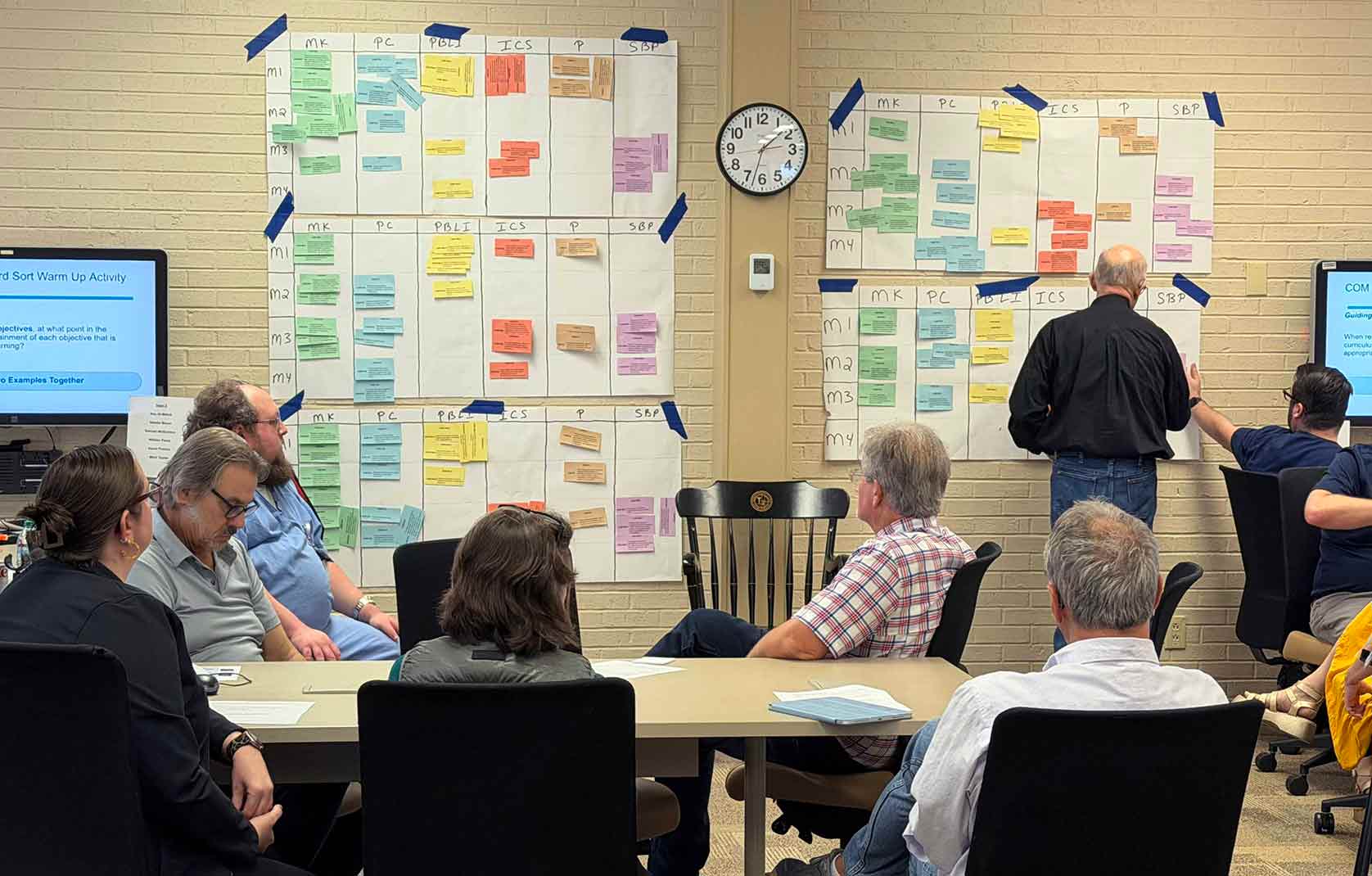
Attendees were divided into working groups of five to six members, designed to include faculty with experience across undergraduate and graduate medical education. Each group reviewed the same aggregate data while designated facilitators guided discussion and recorded key insights.
During the evaluation, participants analyzed internal curriculum assessment data along with external benchmarks, including performance on the United States Medical Licensing Examination and national feedback on graduate readiness.
“The curriculum is a comprehensive collaborative effort where each person contributes,” Hundley said. “Bringing everyone together allows us to share best practices, consider other viewpoints, and collaboratively develop solutions to any areas of improvement identified.”
That collaborative approach allowed participants to assess the curriculum from multiple perspectives.
“We are at our best when we are considering all of the lenses and viewpoints of faculty that are shaping our future physicians,” said David S. Williams, Ph.D., MPA, assistant dean for institutional and academic success. “Collaboration with intentional buy-in from faculty is the only way to successfully evaluate our programs, in my experience.”
A highlight of the session, Hundley said, was seeing faculty from different phases of the curriculum exchange ideas and gain a deeper understanding of how their teaching connects across the four-year program.
“I was very excited watching how the pre-clerkship faculty and clerkship faculty were sharing ideas explaining the different approaches in teaching,” Hundley said. “It really helped everyone have a better understanding of how each phase of the curriculum trains students for the next phase. We got to watch silos dissolve in real time.”
The review emphasized several strengths within the program, including strong student outcomes and a highly engaged faculty.
“The biggest strengths include the high-quality education, faculty engagement in teaching, and GME programs reporting our graduates are prepared for the rigors of residency training,” Hundley said.
Beyond the data, participants highlighted the college's learning environment as a fundamental strength.
“Our caring faculty and student-to-faculty ratio were two prominent strengths, along with the very strong outcomes we see each year from our medical students,” Williams said.
The process also identified areas for continued growth.
One focus moving forward will be strengthening how the curriculum teaches and assesses practice-based learning and improvement, an area increasingly emphasized in residency training. This competency focuses on residents’ ability to evaluate their own care practices, apply scientific evidence, and continuously improve patient care through self-evaluation and lifelong learning.
Findings from the workshop have been presented to the Curriculum Committee, which will develop action items and assign working groups to address improvement priorities.
Williams said, “The structure of the session was intentionally designed to provide a rich data set to the Curriculum Committee with recommended actions that would help bring the hard work of the faculty into a real action plan to show progress.”