
USA Cancer Research Named One of Science’s Top 10 Breakthroughs of 2025
Posted on January 15, 2026 by Lindsay Hughes
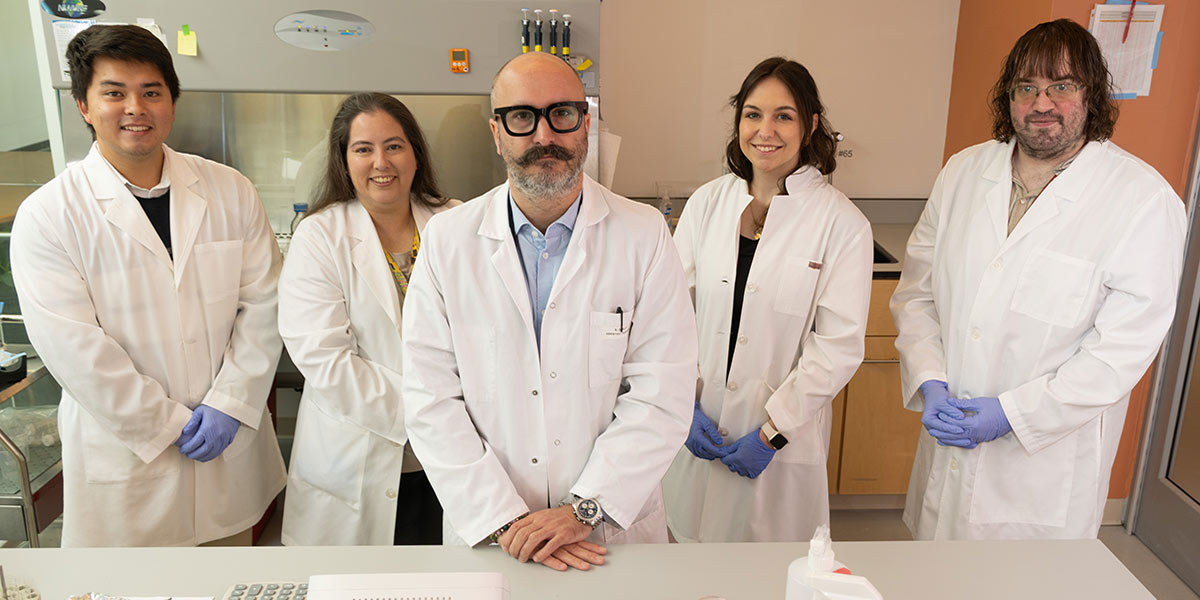
Research led by Simon Grelet, Ph.D., at the University of South Alabama, which uncovered a previously unknown way nerves drive cancer spread, has been recognized as one of Science journal’s Top 10 Scientific Breakthroughs of 2025.
The honor, announced in the Dec. 18, 2025 issue of Science, highlights major advances across all scientific disciplines. Published by the American Association for the Advancement of Science (AAAS), the magazine is regarded as one of the world’s leading peer-reviewed academic journals, making the selection a significant distinction for both Grelet and the university.
Grelet is an assistant professor of biochemistry and molecular biology at the Frederick P. Whiddon College of Medicine and a researcher at the USA Health Mitchell Cancer Institute, where he directs the Cancer Innervation and Neurobiology Laboratory. The selected research identified a novel mechanism by which neurons transfer mitochondria — the cell’s energy-producing structures — to cancer cells. This interaction fuels cancer metastasis and opens new possibilities for therapeutic intervention.
“Receiving this recognition from Science is a tremendous honor and a powerful affirmation of our work,” Grelet said. “It means a great deal to me, and it is deeply rewarding to see this research acknowledged at such a high level.”
Grelet acknowledged that his lab would not have achieved such a comprehensive development without the scientists who partnered in this study, notably the lab team of Gustavo Ayala, M.D., from UTHealth Houston. “Most importantly, this recognition reflects the collective efforts of my laboratory members, collaborators and co-authors, who worked tirelessly to bring this project to fruition,” he said. “It is a team achievement grounded in sustained commitment, creativity and perseverance.”
As part of the recognition, Grelet has been invited by a Science editor to present the work at the upcoming AAAS annual meeting in Phoenix, Arizona, where the editor will introduce his talk.
Grelet noted that the honor brings increased visibility to the field of cancer neuroscience, a growing area of investigation that examines how nerves influence cancer development and progression. Although clinical and pathological studies dating back to the early 2000s first identified tumor innervation as biologically relevant, the field has expanded rapidly in recent years.
Research from Grelet’s lab has shown that breast cancer innervation sits at the intersection of cancer plasticity and metastasis, and more recently, how nerves can metabolically support cancer cells and fuel metastatic spread.
“I believe the field is now reaching a critical moment, with a growing number of investigators and studies entering this space, where these discoveries can begin to translate into meaningful benefits for patients,” he said.
In parallel, Grelet’s team is expanding its work in mitochondrial biology, particularly the emerging field of intercellular mitochondrial transfer.
“Cancer rarely invents entirely new mechanisms, but instead hijacks pre-existing physiological processes,” he explained. “I believe that our demonstration of mitochondrial transfer at the nerve–cancer interface may reveal a deeper and previously unrecognized physiological mechanism that cancer exploits during progression.”
Richard Honkanen, Ph.D., professor and chair of biochemistry and molecular biology at the Whiddon College of Medicine, said the recognition reflects both Grelet’s leadership and the university’s growing research profile.
“This achievement reflects Dr. Grelet’s exceptional scientific leadership, creativity, and sustained commitment to ambitious research,” Honkanen said, “while also highlighting the growing strength and national visibility of the department’s research enterprise and the University of South Alabama’s expanding role in high-impact biomedical discovery.”
Christopher Davies, Ph.D., associate dean of research at the Whiddon College of Medicine, said the recognition places Grelet among a select group of scientists whose work has had exceptional impact.
“With his research being recognized by Science as one of the year’s breakthrough discoveries, Dr. Grelet joins a truly exclusive group of scientists whose work is judged to be of exceptional significance,” Davies said. “This recognition marks another milestone in his rapid ascent as a leader in his field and further elevates the reputation of the University of South Alabama and the Mitchell Cancer Institute as centers of cutting-edge research.”
Grelet said the honor reinforces his commitment to pursuing bold, high-risk ideas in an environment that supports long-term scientific discovery. “Only a small fraction of ambitious projects ultimately succeed,” he said. “But when they do, it is especially rewarding to see their impact unfold.”
Grelet joined the Whiddon College of Medicine and the Mitchell Cancer Institute in 2020 after completing postdoctoral studies at the Hollings Cancer Center, Medical University of South Carolina in Charleston. He earned a Ph.D. from the French National Institute of Health and Medical Research at Reims University in France.
He is a recipient of the National Institutes of Health/National Cancer Institute MERIT Award and was named the 2025 recipient of the Mitchell Cancer Institute’s Mayer Mitchell Award for Excellence in Cancer Research.