
USA researchers present findings on pneumonia, brain health at international conference
Posted on April 1, 2026 by Lindsay Hughes
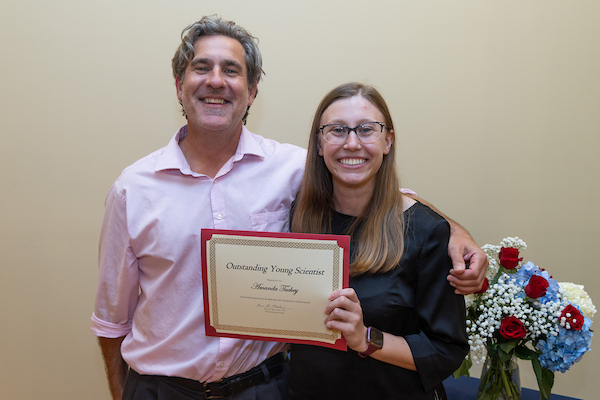 Research from the University of South Alabama’s Frederick P. Whiddon College of Medicine
exploring how pneumonia affects the brain was recently presented at a scientific conference
focused on respiratory infections.
Research from the University of South Alabama’s Frederick P. Whiddon College of Medicine
exploring how pneumonia affects the brain was recently presented at a scientific conference
focused on respiratory infections.
The Biology of Acute Respiratory Infection Gordon Research Conference brought together scientists from around the globe to Pomona, California, to share emerging research on how respiratory pathogens interact with the immune system and the human body. The conference is known for highlighting cutting-edge, often unpublished science and fostering collaboration among researchers at all stages of their careers.
Among the presenters was Amanda Tuckey, Ph.D., a postdoctoral fellow in the laboratory of Jonathon Audia, Ph.D., professor of microbiology and immunology at the Whiddon College of Medicine.
“The conference was an excellent opportunity to share my work and engage with researchers in related fields,” Tuckey said. “The diverse backgrounds offered valuable feedback and new perspectives that will help guide future directions of our research.”
Tuckey, an alumna of the college’s Basic Medical Sciences Graduate Program, presented two research projects examining how the body responds to severe lung infections caused by the opportunistic pathogen Pseudomonas aeruginosa.
One project focused on the role of the amyloid precursor protein, commonly associated with Alzheimer’s disease, in regulating the immune response during bacterial pneumonia.
Using various models of infection, Tuckey and colleagues found that loss of the amyloid precursor protein resulted in worse outcomes. The research indicates that the amyloid precursor protein regulates key immune cell functions related to bacterial clearance and inflammation.
A second project Tuckey presented explored a longstanding clinical mystery: why some people who survive severe lung infections that require hospitalization go on to experience lasting problems with memory, thinking or concentration even after they are “recovered.”
To investigate this question, the researchers developed a biological “tracking” system that permanently marks cells exposed during a lung infection caused by P. aeruginosa. The approach allowed scientists to follow how infection-related signals move through the body over time.
“We found that the signal is strong in the lung early on,” Audia said, “but later appears in the brain and persists well after the lungs have cleared the infection.”
Using an advanced technique known as spatial transcriptomics, the team mapped gene activity across brain tissue and identified small, region-specific areas showing lasting changes following infection.
“Together, our findings suggest that pneumonia can trigger durable, localized changes in the brain, and our approach provides a way to pinpoint where those changes occur and what may be driving them,” Audia said.
The two research projects may ultimately be connected. Because the amyloid precursor protein studied in Tuckey’s first project is also closely tied to brain biology, researchers believe the immune processes occurring during lung infection could help explain how pneumonia leads to neurological changes.
In addition to the main conference, Tuckey presented at the accompanying Gordon Research Seminar, a smaller meeting designed specifically for graduate students and postdoctoral researchers to share their work and exchange ideas in a collaborative setting.